
International casinos that accept UK players — ranked, tested, and stripped of the marketing varnish
 Available in GB
This page is current as of 17 August 2026 and every operator’s licence claim was checked against the Curaçao Gaming Authority and Malta Gaming Authority public registers. No licence listed here should be treated as verified until you re-check it on the regulator’s own site before depositing.

The international casino market for UK players is not a uniform place. It runs from a single MGA-licensed operator with a segregated player-fund regime and a formal complaints process, through a cluster of Curaçao-licensed brands that share an operating group and most of a game library, to two or three names whose licence jurisdiction could not be confirmed this run and which therefore sit in the ranking with that gap flagged rather than papered over. A UK player who understands that gradient before clicking “deposit” is in a stronger position than one who does not.
The ranking below divides on two axes. The first is licence quality — the Malta Gaming Authority, even at its consumer-friendliest, is not the UKGC, but it is the strongest regulator a UK player can access at an international casino short of the UKGC itself. The second is value for money, where “value” means the gap between the headline number and the wagering and cashout terms that turn that number into something the player can actually withdraw. Welcome packages at international casinos routinely top £1,500 across three deposits — but the wagering terms determine what that figure is worth, and several featured operators carry 30× to 35× playthroughs on deposit plus bonus that the headline number does not advertise.
The ten international casinos UK players rate highest in 2026
| # | Operator | Licence | Welcome Bonus | Free Spins | Wagering | Game Providers |
|---|---|---|---|---|---|---|
| 1 | MyStake | Curaçao (GTW B.V., OGL/2024/1798/1048) | 150%/100%/50% up to £1,500 (3 deposits) | 30 FS | 30× (deposit + bonus) | Pragmatic Play, Evolution, NetEnt, Play’n GO, Hacksaw, Nolimit City |
| 2 | GoldenBet | Curaçao (GTW B.V.) | 300% up to £1,500 (3 deposits) | 100 FS (Book of Witches, ThunderSpin) | 35× (deposit + bonus); 1× on FS winnings | Pragmatic Play, Evolution, NetEnt, Play’n GO, ThunderSpin; 4,000+ games |
| 3 | Freshbet | Curaçao | 300% up to £3,000 (3 deposits) | 200 FS across 3 deposits + 25 no-deposit FS on registration | 30× (bonus only) | Pragmatic Play, Evolution, NetEnt, Play’n GO |
| 4 | Velobet | Curaçao (Santeda International B.V. / GTW B.V.) | 150% up to £500 (<£500 dep) or 100% up to £1,000 (≥£500 dep) | 70 FS | 30× bonus; 35× FS winnings | 80+ providers including Pragmatic Play, Evolution |
| 5 | Donbet | Curaçao | 150% up to £750 | 50 FS | 30× (deposit + bonus) | Pragmatic Play, Evolution |
| 6 | Wildz | MGA (Rootz Ltd, MGA/B2C/599/2018, issued 30 April 2019) | 100% up to €500 | 200 FS (25/day over 8 days) | 35× (bonus only) | NetEnt, Play’n GO, Pragmatic Play, Evolution; 2,000+ slots |
| 7 | Emperia | Curaçao (Fortuna Games N.V., 2026 launch) | Up to £3,000 (4 deposits) | 325 FS | Not specified | Pragmatic Play; 12,000+ games |
| 8 | Kaasino | Not confirmed this run | Up to £2,500 (4 deposits) | 500 FS | Not specified | Not specified |
| 9 | Jack.com | Curaçao | Not specified | Not specified | Not specified (wager-free promotions) | Slots and live dealer |
| 10 | NetBet | UKGC-licensed (domestic comparator — not an international casino) | Not specified for international context | 100 FS on Big Bass Splash | Not specified | Pragmatic Play, Evolution, NetEnt |
What “international” actually means in this list: every operator in the table except NetBet holds its licence outside Great Britain. None holds a Gambling Commission licence, and that is the point. Since the Gambling (Licensing and Advertising) Act 2014, any operator providing gambling facilities to customers in Great Britain has required a UKGC licence regardless of where it is based — a Curaçao, Maltese or Gibraltar licence is not a substitute. The featured Curaçao and MGA brands do not hold one, and they are accessible to UK players for reasons the disruption-enforcement section of this page covers. NetBet sits at the foot of the table not because it is a worse casino but because it is not an international casino at all — it is a UKGC-licensed domestic operator that search results place next to offshore brands, and the comparison is the article’s only honest reason for naming it.
The ten split cleanly across two licence tiers. Wildz is the sole MGA entry; the other eight sit under Curaçao authorities of varying specificity. That split is not editorial preference. It is what the licensing evidence supports. Where an operator’s licence date could not be confirmed from the CGA register this run — Kaasino, Jack.com and most of the Curaçao group — the ranking keeps them in the table and flags the gap rather than dropping the row, because the reader comparing options needs to see which names carry an unverified licence claim alongside the ones that do not.
Our top picks at a glance: how the ranking breaks down
The editorial logic behind the order runs through four filters applied in sequence. First, licence jurisdiction — a verified MGA or Curaçao licence checked against the regulator’s own register, or an unverified claim flagged in the row. Second, the value of the welcome package after wagering, not before: a 300% match at 35× on deposit plus bonus can be worth less than a 100% match at 35× on bonus only, and the difference is roughly double the required turnover. Third, game-provider depth and library scale — Pragmatic Play, Evolution, NetEnt and Play’n GO as a common core signal a serious operation; the absence of any of the four raises a question. Fourth, the GBP and payment-mechanics evidence in the research, and the absence of any UKGC framework that would otherwise back the operator.
A Curaçao-licensed operator can rank highly on value despite lighter regulation because the absence of the 10× UKGC wagering cap, the absence of the statutory levy, and the absence of UKGC game-design rules together let it set bonus terms a domestic operator cannot match. That is the structural reason, not a marketing one. The MGA outlier — Wildz, under Rootz Ltd with licence MGA/B2C/599/2018 — sits at a different point on the trust curve because Malta’s framework requires segregated player funds, a mandatory ADR provider and a formal complaints process that Curaçao does not. Neither comes close to UKGC oversight, but between the two, MGA is the stronger of the two non-UK options a UK player can reach.
The UKGC comparator, NetBet, sits apart from the ranking for a different reason. It is the only featured operator a UK player can play at under the full domestic consumer-protection framework — GamStop, the £150 financial vulnerability check, the 10× wagering cap, the £5/£2 stake limits and the affordability-check regime. Its 100 free spins on Big Bass Splash are unremarkable next to the offshore packages, but the package is offered under rules the offshore brands are free to ignore. That is what makes the comparison worth making: the same UK player, presented with a smaller bonus under tighter rules, and a larger bonus under no rules at all, choosing which trade to make.
MyStake Casino
MyStake runs a £1,500 three-deposit welcome package — 150% up to £750, then 100% up to £500, then 50% up to £250 — with 30× wagering on deposit plus bonus, a £20 minimum deposit, a £5 maximum bet while wagering, and 30 days to clear the bonus. The licence is Curaçao, held by GTW B.V. under OGL/2024/1798/1048, and the operator sits in a Curaçao cluster that also includes GoldenBet and Velobet through the same group. The provider list — Pragmatic Play, Evolution, NetEnt, Play’n GO, Hacksaw, Nolimit City and others — covers the slots and live-dealer bases a UK player expects at a serious international casino.
The value calculation here runs in two steps. A first deposit of £500 claims the maximum first-stage bonus of £750, then a further £500 and £250 on deposits two and three claim the remaining £750. To withdraw the bonus alone at 30× on deposit plus bonus, the player must turn over £500 + £750 = £1,250 thirty times on the first deposit alone, which is £37,500 of wagering on that deposit. Across all three stages the figure roughly doubles. That is the real number behind the £1,500 headline, and the operator’s terms page says so in the small print the welcome banner does not. For a player with the bankroll and the time to clear it, the package is competitive; for a casual player on a small budget, the 30-day window and the deposit-plus-bonus base make it harder work than the 300% headline suggests.
GoldenBet Casino
GoldenBet’s 300% match across three deposits reaches up to £1,500, paired with 100 free spins on Book of Witches (ThunderSpin) carrying 1× wagering on spin winnings and a £100 cashout cap. The bonus itself carries 35× wagering on deposit plus bonus with a £5 max bet and 30-day validity, while the free spins expire in seven days. The licence is Curaçao under the same GTW B.V. group as MyStake, and the game library exceeds 4,000 titles across Pragmatic Play, Evolution, NetEnt, Play’n GO and ThunderSpin.
The 1× playthrough on the free-spin winnings is the standout. Most featured operators set the figure at 35×, which turns a £5 free-spin win into £175 of wagering before withdrawal; GoldenBet’s 1× lets the player pocket the win subject only to the £100 ceiling. The £100 cap is itself a real cost — a lucky run on Book of Witches can return more, and the cap claws it back — but for the median outcome the free-spin offer is the cleanest in the featured set. The 300% match on the cash side is less generous than it looks: 35× on deposit plus bonus is the highest base in the ranking, and at three deposits the cumulative turnover figure is the heaviest workload in the table.
Freshbet Casino
Freshbet is the only featured operator offering a deposit-free entry point — 25 no-deposit free spins on registration, on top of a 300% welcome package up to £3,000 plus 200 free spins across the next three deposits (150%/100%/50%, with 100/50/50 spin splits). The bonus carries 30× wagering on the bonus only — not deposit plus bonus — which is the friendlier of the two bases. The licence is Curaçao, the minimum deposit is £20, and the provider core is Pragmatic Play, Evolution, NetEnt and Play’n GO.
The 25 no-deposit spins are the only registration offer in the featured set, and they matter precisely because the rest of the page assumes a deposit has been made. A player who only wants to test the lobby and the withdrawal process before committing can do so here without paying in. Bonus-only wagering at 30× keeps the math manageable: a £30 no-deposit spin win, hypothetically, requires £900 of wagering rather than the £1,860 a 30× deposit-plus-bonus calculation would demand on a £32 deposit. The catch is the standard one — winnings are capped, the eligible slot is operator-selected, and the 25 spins at a typical £0.10 stake return a small absolute figure before any cap.
Velobet Casino
Velobet runs a two-tier welcome that branches on deposit size. Deposits under £500 trigger 150% up to £500 plus 70 free spins; deposits of £500 or more trigger 100% up to £1,000 plus 70 free spins. The bonus carries 30× wagering on the bonus and 35× on free-spin winnings, with a £100 max cashout from spins, a £20 minimum deposit, and a 30-day bonus validity. The operator is Santeda International B.V. within the same GTW B.V. group as MyStake, the licence is Curaçao, and the provider roster runs to 80+ studios with Pragmatic Play and Evolution at the core.
The branching structure is the part worth understanding. A player depositing £400 takes the smaller-deposit track and gets 150% of that — £600 in bonus, plus 70 spins. A player depositing £500 or more takes the higher-deposit track and gets a £1,000 cap. The two tracks are not equivalent: the 150% branch gives a higher match percentage but a lower cap, and the choice depends on whether the player wants a larger relative bonus on a smaller bankroll or a larger absolute bonus on a bigger one. The £100 free-spin cap is the same on both branches. Choosing between these two paths is a calculation every player should make before the first deposit.
Donbet Casino
Donbet is the table’s simplest offer. A 150% welcome match up to £750 plus 50 free spins, 30× wagering on deposit plus bonus, a £5 maximum bet while wagering, 30-day bonus validity, a £20 minimum deposit, and a Curaçao licence. The provider backbone is Pragmatic Play and Evolution — narrower than most featured operators, but the two studios cover the slots and live-dealer bases a UK player actually plays.
The narrowness of the offer is the point. No branching track, no registration spins, no multi-deposit structure beyond the headline — a player who values a clean set of terms over a complicated one will read this row and stop. The 30× deposit-plus-bonus base is the same as MyStake’s, so the wagering workload scales with the deposit and bonus together; on a £500 first deposit the required turnover is £500 + £750 = £1,250 multiplied by 30, or £37,500. The 50 free spins are an add-on rather than a centrepiece, and the absence of a published spin value or cap is the part the operator’s own terms page should answer before the player deposits.
Wildz Casino
Wildz is the ranking’s only MGA entry and, on the evidence available, the operator with the strongest consumer-protection framework of the international set. Rootz Ltd (Malta, C83903) holds MGA/B2C/599/2018, issued 30 April 2019. The welcome bonus is 100% up to €500 plus 200 free spins released at 25 per day over eight days. Wagering is 35× on the bonus only, with slots contributing 100% and table games 10%, and a €5 maximum bet. The provider set is NetEnt, Play’n GO, Pragmatic Play and Evolution across 2,000+ slots.
The 35× bonus-only base is the same nominal figure as GoldenBet’s 35× on deposit plus bonus, but it works out to roughly half the required turnover. A €500 bonus at 35× on bonus alone requires €17,500 of wagering; the same headline at 35× on deposit plus bonus would require €35,000. The MGA framework adds segregated player funds, a mandatory ADR provider and a formal complaints process — features Curaçao does not require — and the licence has been live for nearly seven years, long enough that any operational problems would have surfaced. The spin release schedule of 25 per day for eight days is a friction point: the player cannot clear the full 200-spin set in one session, and the wagering clock runs from the first deposit rather than the first spin.
Emperia Casino
Emperia launched in 2026 under Fortuna Games N.V. with a Curaçao licence and a game library exceeding 12,000 titles. The four-deposit welcome package reaches up to £3,000 plus 325 free spins, with Pragmatic Play among the providers. The package also includes daily reload bonuses and a VIP cashback programme returning up to 35%. The wagering multiple, bonus validity, and any maximum-cashout terms for the welcome offer were not confirmed this run, and the reader is directed to the operator’s own terms page before depositing.
The library scale is the headline. 12,000+ games is a category of its own among the featured operators, and it puts Emperia ahead of GoldenBet’s 4,000+ and Wildz’s 2,000+. That scale comes with a familiar trade: a new operator carries a shorter operating track record than an established brand, and the licensing data on the CGA register this run did not confirm a specific licence date or entry. The reader comparing Emperia to Wildz is comparing a 12,000-game library with unconfirmed terms against a 2,000-game library under a verified MGA licence — and the answer depends on what the player values more.
Kaasino
Kaasino’s package is the largest in the featured set on paper: up to £2,500 across four deposits plus 500 free spins. The licence jurisdiction, operator entity, wagering multiple, bonus validity, provider set, and any cashout cap were not confirmed this run. What the research carries is the headline structure; what it does not carry is the surrounding detail a player needs to value the offer.
The honest read is that the headline number alone is not enough. A 500-spin package with no confirmed slot, no confirmed spin value, and no confirmed wagering on the winnings cannot be compared fairly against GoldenBet’s 100 spins with 1× wagering and a £100 cap, because the working conditions are not in evidence. A player interested in Kaasino should treat the row as a placeholder and verify every term on the operator’s own page before depositing.
Jack.com
Jack.com holds a Curaçao Gaming Authority licence and operates on a wager-free promotional model, which is the operator’s defining trait. The slots and live-dealer offering is present; the welcome-bonus specifics, wagering, provider list, and validity were not confirmed this run.
A wager-free model is the rarest position in the international casino space, and it cuts the wagering cost that dominates the rest of the ranking. The terms behind that absence of wagering — maximum withdrawal caps, eligible games, time limits on the wager-free window — are the part the operator’s own page should make plain, and they are not in the research this run. The reading the player can do here: the structural offer is the strongest in the table; the specifics a comparison requires are missing.
NetBet Casino
NetBet is a UKGC-licensed domestic operator and is not an international casino. It is included in the ranking because it appears in the international casino search results and because the comparison it offers is the article’s most useful one: a UK player reading about £1,500 three-deposit welcome packages with 30× wagering and no GamStop coverage can read this row and see what a UKGC welcome looks like under the 10× cap, the age-banded stake limits, and the affordability-check regime.
The headline offer is 100 free spins on Big Bass Splash by Pragmatic Play. The UKGC framework provides GamStop, the £150 financial vulnerability check (in force 28 February 2025), the 10× wagering cap on bonuses (in force 19 December 2025), the £5/£2 age-banded slots stake cap (in force April/May 2025), and the auto-play ban, 2.5-second spin-speed minimum, and reverse-withdrawal ban that have been in force since October 2021. NetBet is the only operator in the table that delivers all of those. The package is smaller than the offshore entries, and the rules are stricter; that is the trade the comparison is meant to make visible.
What makes an international casino different — and why it matters for UK players
An international casino, in the sense the keyword uses, is an operator licensed outside Great Britain that accepts UK players. The legal line is the Gambling (Licensing and Advertising) Act 2014, which extended the Gambling Act 2005 to remote operators and made a UKGC licence compulsory for any operator serving GB customers at the point of consumption regardless of where the operator is based. No Curaçao, Maltese or Gibraltar licence substitutes for that requirement. None of the featured Curaçao and MGA operators in this ranking holds a UKGC licence, and the comparison to NetBet at the foot of the table is precisely that gap made visible.
The three things that separate an international casino from a UKGC-licensed site in practice are GamStop coverage, the affordability-check regime, and the bonus and stake caps. GamStop self-exclusion is mandatory for every GB-licensed online operator since 31 March 2020; it does not cover international casinos. The £150 financial vulnerability check threshold, the 10× wagering cap, the £5/£2 age-banded stake limit, the auto-play ban, the 2.5-second spin-speed minimum and the reverse-withdrawal ban all apply to UKGC-licensed sites; none applies at an international casino. The offshore platforms also allow higher per-transaction deposit ceilings — figures of £10,000 to £50,000 appear at some brands — and they accept cryptocurrency where GB-licensed sites do not.
What the player loses at an international casino is consumer protection, not legal protection. There is no criminal penalty for a UK player who gambles on an offshore site; section 33 of the Gambling Act 2005 targets operators, not players. What disappears is the UKGC complaints route, the approved ADR provider, the financial vulnerability check, the statutory player-fund segregation, and the responsibility framework the UKGC enforces on the operators it licenses. A reader who internalises that distinction before depositing will make a different decision than one who treats “international” as a marketing label.
The legal anatomy of an international casino
The legal line is the Gambling Act 2005, extended to remote operators by the Gambling (Licensing and Advertising) Act 2014. Section 33 of the 2005 Act creates an offence for providing gambling facilities without a licence, with penalties of up to 51 weeks’ imprisonment, an unlimited fine, or both — a sanction that targets operators, advertisers and intermediaries, not players. The 2014 Act closed the previous loophole in which an operator based outside the UK could serve GB customers on a home-jurisdiction licence; the point-of-consumption test now requires a UKGC licence to do either.
The three international licence tiers a UK player most often encounters are the Curaçao Gaming Authority, the Malta Gaming Authority and the Kahnawake Gaming Commission. The Curaçao framework is the lightest of the three, and the Curaçao Gaming Authority maintains a public register where a player can check an operator’s licence status. The MGA framework is heavier, with segregated player funds, a mandatory ADR provider, and a formal complaints process; Wildz under Rootz Ltd is the ranking’s verified MGA entry. Kahnawake is rarer among the featured operators. None of the three substitutes for a UKGC licence; the difference is in the consumer-protection weight the framework carries.
International casino sites vs standalone brands
The featured set divides into two operator structures. The first is the multi-brand platform: a single licence-holder running several casino brands off the same game library, payment stack, and responsible-gambling configuration. The second is the standalone international casino: a single brand under a single licence entity, with its own operating group and its own game aggregation.
GTW B.V. is the clearest example of the first. The group runs MyStake, GoldenBet and Velobet, all under Curaçao licences (with Santeda International B.V. holding the Velobet licence within the same group), all with Pragmatic Play, Evolution, NetEnt and Play’n GO at the provider core, all with the same broad bonus-structure conventions. A player who plays at MyStake and then at GoldenBet is playing at the same operator group with a different brand wrapper. The shared licence affects player recourse: a complaint to one of the three is a complaint to a sister site, and the regulator’s response runs against the same operating entity.
Wildz under Rootz Ltd is the clearest example of the second. A standalone MGA entity, one brand, one licence, and the Malta framework applies to that licence and no other. The standalone structure is what makes the MGA framework’s ADR and complaints provisions work as advertised: the player is dealing with one operator, not a network. The trade is the operator’s own negotiating position — a standalone brand carries less commercial leverage than a multi-brand platform and may offer less generous bonus terms as a result.
Real-money play at international casinos: what changes
The practical mechanics of depositing, withdrawing, and playing at an international casino differ from a UKGC site in four measurable ways. The first is deposit ceilings: at offshore platforms the per-transaction limit runs to £10,000–£50,000 at some brands, against the UKGC’s framework of mandatory deposit-limit prompts and the £150 financial vulnerability check trigger. The second is the affordability-check absence: there is no UKGC check at an international casino, and the operator does not request income verification or run credit-bureau data.
The third is the absence of mandatory reality-check and session-tracking rules. UKGC sites must display total losses, total wins, and time played during a slots session, and must interrupt play with a reality check at set intervals. International casinos are not bound by these rules and most do not implement them. The fourth is the absence of the UKGC’s game-design restrictions: auto-play, losses disguised as wins, and reverse withdrawals are all permitted at international casinos, where they have been banned at UKGC sites since 31 October 2021. These differences define the boundary between international and UKGC play, and understanding them is essential for any player considering an offshore operator.
What 2026 brought to the international casino landscape
The two years before 2026 reshaped the GB-licensed market in ways that pushed UK players toward international sites. The age-banded online slots stake cap — £5 for players aged 25 and over from 9 April 2025, £2 for players aged 18–24 from 21 May 2025, imposed by SI 2025/215 — is the loudest single change, because it directly caps the size of a spin a UKGC-licensed site can accept. The 10× wagering cap on all casino bonuses, in force from 19 December 2025 under LCCP Social Responsibility Code 5.1.1, capped the structure of welcome offers at UKGC sites and banned mixed-product promotional offers outright.
The 40% Remote Gaming Duty rate, in force from 1 April 2026, and the 1.1% statutory levy on gross gambling yield, in force from 6 April 2025, widened the cost gap between UKGC and offshore operators. The levy proceeds split 50% to treatment, 30% to prevention, and 20% to research, and the duty is paid by the operator, not the player; the cumulative effect is that a UKGC welcome package is structurally smaller than an international one, because the operator’s per-pound cost is higher. The financial risk assessment proposals — Stage 1 thresholds of £5,000 and £2,500 by age band, with final thresholds between £1,000 and £3,000 — were announced but not commenced at the time of research; their arrival would extend the affordability-check regime further and add another reason for some players to look offshore.
How to pick an international casino you can trust
A sound international casino separates from a risky one on five evaluation criteria applied in order. The first is licence verification: the operator’s claimed licence must be checkable on the regulator’s own public register. The Curaçao Gaming Authority register is at Gamingcontrolcuracao.org; the MGA register is at Mga.org.mt. If the licence is not on the register, the operator’s claim is exactly that — a claim. Safety at an international casino depends almost entirely on the licence, and that is the one thing worth reading before you play.
The second is the game-provider roster. Pragmatic Play, Evolution, NetEnt and Play’n GO as a common core signal a serious operation; their absence is a question. The third is GBP payment support and the practical mechanics of depositing and withdrawing in sterling without a conversion fee on every transaction. The fourth is the bonus terms beneath the headline — wagering multiple and base (deposit plus bonus versus bonus only), max-bet rule, and validity window. The fifth is customer-support quality and dispute-resolution paths, which at an international casino run to the operator’s own complaints process and the licence regulator. There is no UKGC ADR provider at an international casino, so recourse is limited to what the operator offers and what the regulator enforces.
The unverified rows in the table — Kaasino and Jack.com in particular — sit at the table on the strength of their headline packages, not on the evidence of their terms. A player who treats the licence-verification step as non-negotiable and walks past an unverified row is not being precious. They are applying the first filter the methodology requires.
What to look for in international casino reviews
A critical reader looks for three signals that separate substance from affiliate noise. The first is whether the review names the operator’s licence number and jurisdiction, or hides behind a generic “fully licensed” claim. The second is whether bonus terms are quoted with the wagering base — deposit plus bonus or bonus only — which changes the required turnover by roughly a factor of two at the same multiple. The third is the presence or absence of withdrawal-experience detail: processing times, pending periods, and verification requirements, which are the parts a player needs and most reviews skip.
The competing search landscape for this keyword is dominated by affiliate ranking pages, most of which run 200–400 words per operator. That depth is too short to cover all three signals, and the result is pages that list casinos rather than evaluate them. A reader who reads a single operator across two or three sources and notes where the licence number is and is not named will reach a more reliable picture than one who reads a single ranking front to back.
Curated rankings vs user reviews: which to trust
User reviews on forums and aggregators rarely capture licence status or term changes, because the average player does not check either. A user review that complains about a delayed withdrawal tells the reader something about that user and that brand, but it does not tell the reader whether the licence is verified or whether the term in dispute is in the small print. A curated ranking built on researched licence data and bonus-term analysis is the more reliable source, but only if the ranking discloses its date of research, the registers it checked, and the terms it verified. A ranking that does not disclose those three points is closer to an affiliate listicle than to evidence.
The reader’s filter, then, is transparency. A ranking that names its sources, dates its research, and flags the rows it could not verify is a usable document. A ranking that does not is a marketing artefact.
Why international casino bonuses outstrip their UKGC counterparts
The structural reason is the regulatory and tax gap. The 10× UKGC wagering cap, in force from 19 December 2025, is the ceiling that international bonuses ignore. The 40% Remote Gaming Duty and the 1.1% statutory levy, both in force within the last 12 months, are costs a UKGC operator carries and an international one does not. The headline bonus figure is the surface symptom; the wagering base and the validity window are the working conditions, and at international casinos the working conditions are looser.

The wagering base is the part that swings the math most. At 30× on deposit plus bonus — MyStake, Donbet and others — a £500 deposit with a £750 bonus requires £1,250 multiplied by 30, or £37,500, of wagering. At 35× on bonus only — Wildz and others — a £500 bonus requires £17,500. The same nominal multiple delivers roughly half the turnover under bonus-only terms. The free-spin landscape adds its own layer: most featured operators carry wagering on spin winnings, with GoldenBet at 1× as the outlier. The £100 max-cashout from free spins is the second condition; a lucky run on the spin slot can return more, and the cap claws it back.
The Freshbet no-deposit offer — 25 free spins on registration, with the 200-deposit-spin package on top — is the only registration offer in the featured set. No-deposit free spins are not a UKGC product; they are an international-casino exclusive for UK players, and the only entry point on the page that lets a player test the lobby before paying in. The eligible slot is operator-selected and the spin value is modest; the value is in the deposit-free test, not in the absolute return.
Welcome bonus packages: how the three-deposit structure works
The three-deposit welcome package is the international-casino standard. The structure descends in match percentage — 150% on the first deposit, 100% on the second, 50% on the third — with a cap that the operator sets. To claim the full £1,500 at MyStake, a player deposits £750, £500 and £250 across the three stages; to claim the full £1,500 at GoldenBet, the three deposits vary with the package’s specifics; to claim the full £3,000 at Freshbet, the three deposits scale with the descending match rates.
The wagering base decides what the package costs. MyStake’s 30× on deposit plus bonus, Freshbet’s 30× on bonus only, and GoldenBet’s 35× on deposit plus bonus are three different workloads on three different headline numbers. A player who reads the headline without the base is reading half the contract. The first filter on any welcome package is the wagering base; the second is the max-bet rule, which limits how much can be staked per spin while clearing; the third is the validity window, which sets the deadline. Each filter eliminates some packages for some players.
Free spins and no-deposit offers: the terms behind the headline
Free-spin offers at international casinos carry four conditions a UK player should read together. The first is the wagering on spin winnings: GoldenBet sets this at 1×, Velobet at 35×, and the difference turns a £5 spin win into a £5 withdrawal versus a £175 turnover. The second is the maximum cashout: GoldenBet and Velobet both cap free-spin withdrawals at £100. The third is the eligible slot: Book of Witches at GoldenBet is the named title; most others are operator-selected. The fourth is the validity window, with 7 days as the industry norm.
The 25 no-deposit free spins at Freshbet on registration are the only deposit-free offer in the featured set. The spin value is typically £0.10, the eligible slot is operator-selected, and the winnings are subject to the standard bonus terms. The offer is small in absolute terms; the value is in letting the player reach the lobby and the withdrawal process before committing. A player who only wants to test the operator will see this row and read it correctly.
How international casinos deliver more slots, higher stakes and live-dealer freedom
The game-library scale at featured international casinos runs from 2,000+ slots at Wildz to 4,000+ games at GoldenBet to 12,000+ at Emperia. A UKGC-licensed site is not bounded by a library cap, but the combination of the 10× wagering cap, the £5/£2 stake ceiling, and the game-design restrictions means the working library at a UKGC site is a different kind of catalogue. The headline library at an international casino is, in practice, a working library at full scope.
The stake flexibility is the second axis. UKGC slots carry a £5 maximum per game cycle for players 25 and over, and £2 for players 18–24, in force from April and May 2025. The £2 cap is the binding one for younger players and is the most common reason that demographic appears in international search results. International casinos are not bound by SI 2025/215 and can set higher per-spin limits, with the operator’s own house rules applying instead. The £250 max bet on Big Bass Bonanza — a single title, used as a benchmark — sits well above either UKGC ceiling.
The live-dealer experience at international casinos runs on Evolution as the near-universal provider, with Pragmatic Play Live as the alternative at operators that carry both. Game-show titles — Crazy Time, Monopoly Live, Dream Catcher — dominate the lobbies, and the table limits are wider than UKGC sites because the live-dealer studios are not subject to the same statutory stake cap. A player who plays Lightning Roulette at a UKGC site at £5 a spin can play the same game at a Curaçao casino at the studio’s full table range.
Online slots at international casinos: the titles, the RTPs, the freedom
| Slot | Provider | RTP | Volatility | Max Win | Bet Range |
|---|---|---|---|---|---|
| Big Bass Bonanza | Pragmatic Play / Reel Kingdom | 96.71% | Medium-high to high (4/5) | 2,100× stake | £0.10–£250 |
Big Bass Bonanza is the slot the research carries a per-title figure for, and the RTP of 96.71% is a real return-to-player number, not a marketing line. The medium-high to high volatility rating at 4 out of 5 means longer dry stretches punctuated by larger wins, and the maximum win of 2,100× stake lands with a probability of roughly 1 in 3.88 million spins. The 5×3 reel layout with 10 paylines and a £0.10–£250 bet range is the title’s working envelope. The slot is available at UKGC and international casinos, but the £250 ceiling is the international-casino envelope: the UKGC stake cap cuts the top of that range to £5 for adults 25+ and £2 for the 18–24 band.
The freedoms the international casino delivers on slot play are auto-play availability, the absence of a 2.5-second spin-speed minimum, the absence of a losses-disguised-as-wins ban, and the absence of a reverse-withdrawal ban. The UKGC’s game-design rules, in force since 31 October 2021, prohibit all four. For many, this flexibility—rather than just the game selection—is the primary reason for choosing an international casino over a domestic site.
Live dealer games: roulette, blackjack and game-show tables at international casinos
Evolution is the near-universal live-dealer provider across the featured operators: MyStake, GoldenBet, Freshbet, Velobet, Donbet, Wildz, Emperia and NetBet all carry Evolution in the research, with Pragmatic Play Live as the secondary provider at operators that list both. The game-show titles — Crazy Time, Monopoly Live, Dream Catcher — are the headline product; the classic table variants (roulette, blackjack, baccarat) cover the rest of the lobby.
The international live-dealer difference is in the table limits. UKGC live tables run inside the same game-design and stake frameworks as slots, while international live tables run on the studio’s full range. The absence of a statutory stake cap on live-dealer games at international casinos is what makes the table-limit flexibility work in practice, and it is the part a UK player notices first when comparing side by side. The same Evolution studio, the same croupier, the same wheel — a different ceiling on the bet.
International casino gaming on your phone: apps vs browser
The mobile experience across the featured international casino set runs almost entirely through mobile-optimised browsers rather than dedicated apps. The pattern is the industry norm: a modern casino platform is built responsive from the start, the game library carries through to mobile without a separate build, and a native app is a marketing artefact more than a functional one. Dedicated international casino apps do exist at some brands, but the research this run did not confirm app availability per operator, and the qualitative read is that the set as a whole is a mobile-browser market.
The performance gap between desktop and mobile at a well-built platform is small. Slots and live-dealer tables run through the same provider integrations on both surfaces, deposit and withdrawal flows are the same, and the bonus terms do not change by device. The places the mobile experience is thinner are the game filters and the responsible-gambling tools, which are often desktop-first. A player who plans to play primarily on a phone should test the lobby on the phone before depositing, and confirm the deposit and withdrawal flows on the same device.
Why crypto casinos are the international player’s shortcut
The structural fact is that no GB-licensed casino accepts cryptocurrency deposits. There is no confirmed UKGC rule prohibiting crypto at GB-licensed sites, but the practice across the GB-licensed market is consistent: GB-licensed operators do not take crypto. That makes crypto a de facto international-casino exclusive for UK players, and the deposits that move through Bitcoin at an offshore casino do not move at a UKGC site at all.
The currencies that appear at the international end are Bitcoin as the baseline, with Ethereum, Litecoin and Tether (USDT) at the multi-currency brands. The mechanics of a crypto deposit are wallet-to-wallet, with no intermediary bank, settlement measured in minutes rather than days, and transaction fees below what a bank-transfer corridor charges on either end. The withdrawal side mirrors the deposit side: same wallet, same speed, same fee profile. The credit-card ban in force at UKGC sites since 14 April 2020 is a separate restriction and does not apply offshore — credit cards are accepted at some international brands, though most prefer crypto for the settlement speed.
The anonymity that crypto transactions provide is the part the UKGC framework specifically targets. The £150 financial vulnerability check, the proposed financial risk assessments, the deposit-limit prompts — none of them apply at a crypto-friendly international casino. A player who values financial privacy reads that list and sees what the trade is.
Bitcoin and beyond: the crypto payment landscape at international casinos
Bitcoin is the universal crypto deposit at international casinos, and most brands in the featured set accept it without confirmation needed. Ethereum, Litecoin and Tether are the second tier, and they appear at brands that market themselves as multi-currency. The deposit process is the same across all four: the player sends from their own wallet to the casino’s wallet address at a quoted network fee, the casino credits the account after one or two network confirmations, and the funds are available to play. The withdrawal is the reverse.
Per-operator crypto support was not researched this run, and the table’s crypto column is qualitative rather than per-brand. A player who intends to deposit in crypto should confirm the operator’s wallet policy and any minimum-deposit or maximum-withdrawal figures on the operator’s own payments page before sending. The £10,000–£50,000 per-transaction ceiling at some offshore platforms is the upper bound; the lower bound is set by the operator.
Fresh faces: what 2026‘s newest international casinos bring to the table
The 2026 launches push game-library scale and welcome-package size beyond what established brands offer. Emperia is the standout of the new wave: a 2026 launch under Fortuna Games N.V. with a Curaçao licence, a 12,000+ game library, a four-deposit welcome package reaching up to £3,000 plus 325 free spins, daily reload bonuses, and a VIP cashback programme returning up to 35%. The library scale is the largest in the featured set by a factor of three, and the welcome-package structure is the deepest.
The trade new casinos present is the inverse of the trade established brands do not. A new operator offers a larger welcome package against a shorter operating track record. The licence date on the CGA register this run was not confirmed for Emperia, the wagering and validity terms were not confirmed, and the operator’s withdrawal history is short. A player who chooses Emperia is choosing the largest library in the set on terms that have not been tested in public. A player who chooses Wildz is choosing a 2,000-slot library under a verified MGA licence on terms that have been tested over seven years. The two operators serve different priorities, and neither is the universally better choice.
Before depositing at a newly launched international casino, three checks are worth running. The first is the licence registration date on the regulator’s own register; a 2026 launch should show a 2026 issue date. The second is the operating entity behind the brand, and whether it is a known group with a track record or a new company with no public history. The third is the player-complaints record on the forums where international casino players post, with the caveat that complaint volume at a new operator is structurally low and absence of complaints is not the same as a clean record.
What you lose when you play outside the UKGC
The consumer-protection framework a UK player leaves behind at an international casino is the central question the rest of the page is built around. The UKGC framework provides GamStop self-exclusion, the £150 financial vulnerability check, the 10× wagering cap, the age-banded stake limits, the ADR route, and the UKGC complaints process. None of those applies at an international casino, and the player who deposits at an offshore site has opted out of each.
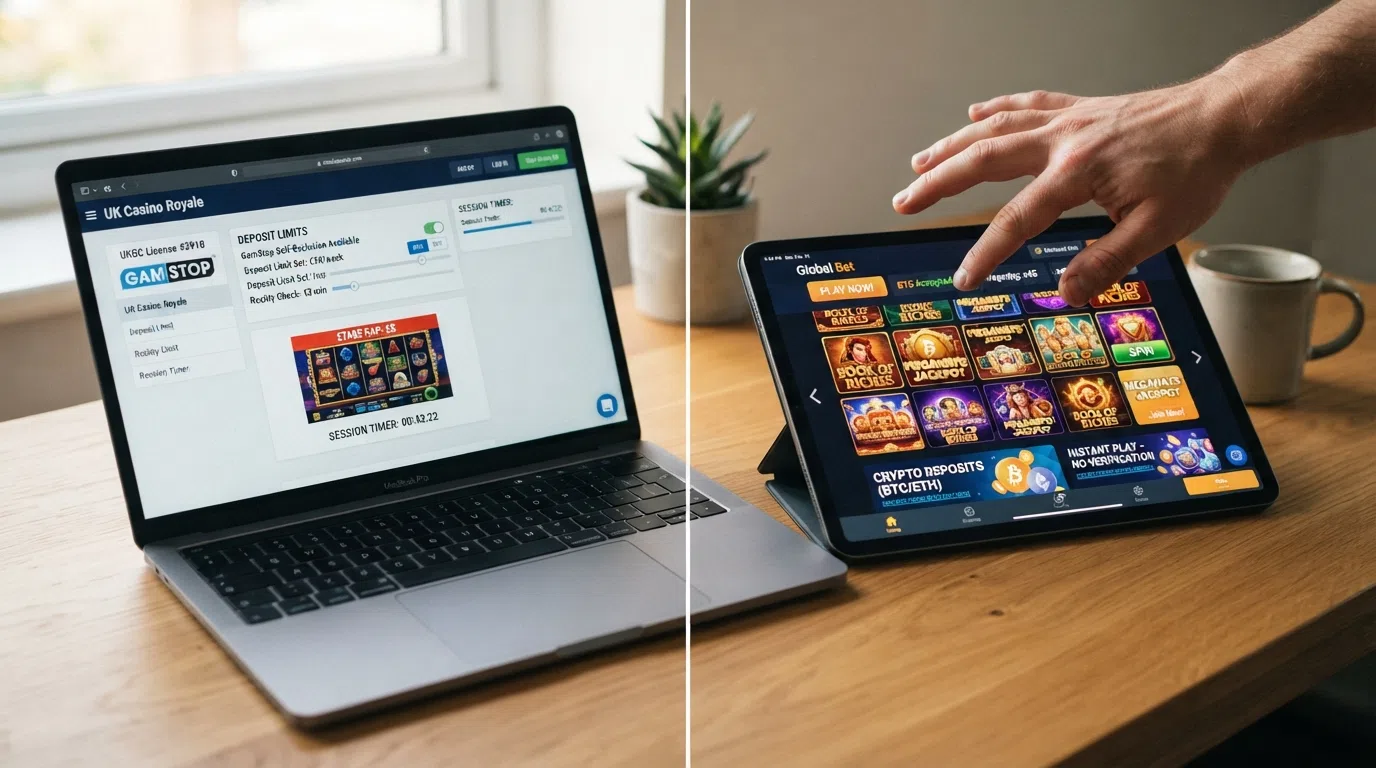
What international casinos offer instead runs to three layers. The first is the licence regulator’s complaints process — slow, limited in reach, and dependent on the regulator’s own enforcement priorities. The second is the operator’s own responsible-gambling tools — deposit limits, time-outs, self-exclusion and reality checks — which are patchy and vary across operators. The third is the absence of any statutory player-fund segregation, so player funds sit in the operator’s general pool rather than in a ring-fenced trust account, and any compensation scheme in the event of operator insolvency is the operator’s home jurisdiction’s scheme, not the UK’s.
The enforcement model is the part the disruption numbers make visible. The UKGC does not block international casino sites. It disrupts them: 3,140 disruption notices, 447,778 URLs referred to search engines, 287,961 URLs removed, and an average 32% fall in engagement across 160 disrupted sites between April 2024 and June 2025. The sites stay accessible. They become harder to find, and the engagement drop is real, but the player who already knows the site name can reach it directly. The UK’s regulatory model reduces visibility; it does not and cannot prevent access, and the player carries the residual risk.
Non-GamStop casinos: what the label means and what it does not
GamStop self-exclusion is mandatory for every GB-licensed online operator since 31 March 2020, with periods of six months, one year, five years, or five years with auto-renewal, and it cannot be cancelled early. The scheme does not cover international casinos. A player who has self-excluded via GamStop and is searching for an international casino is in a vulnerable position, and the article does not frame that choice as a positive. The non-GamStop label is the single largest reason UK players search for international casinos, and the search is the surface symptom of a self-exclusion decision the player is in the process of reversing.
The help resources that operate independently of any casino licence are the National Gambling Helpline on 0808 8020 133 (free, confidential, 24/7), GamCare’s online chat and support, GambleAware’s self-assessment tools, the NHS gambling harm clinics in England, Scotland and Wales, and Gamblers Anonymous UK. The GamCare helpline made 996 referrals to treatment in January 2026, a 48% year-on-year increase from 674 in January 2025, with 130,000+ contacts across 2024/25. The numbers are a signal of demand, not a recommendation; a player reading this section is the audience the help resources are built for.
MGA vs Curaçao: what each licence tier gives the player
| Regulator | Player-Fund Protection | ADR Provider | Formal Complaints Process | Bonus Wagering Cap |
|---|---|---|---|---|
| UKGC (for comparison) | Segregated player funds | Approved ADR mandatory | UKGC complaints route | 10× (in force 19 December 2025) |
| Malta Gaming Authority (MGA) | Segregated player funds | Mandatory ADR provider | Formal complaints process | No statutory cap |
| Curaçao Gaming Authority (CGA) | No mandatory segregation | No mandatory ADR | Lighter framework post-LOK reforms | No statutory cap |
The MGA framework offers stronger consumer protections than Curaçao’s, but neither comes close to the UKGC. MGA requires segregated player funds and a mandatory ADR provider, and the regulator’s formal complaints process is a working recourse for a player with a dispute. Curaçao’s LOK reforms have improved standards, but the framework remains lighter: no mandatory ADR, fewer player-protection requirements, and a regulator whose enforcement priorities are different from Malta’s. Wildz under MGA/B2C/599/2018 is the ranking’s verified MGA entry; MyStake under Curaçao OGL/2024/1798/1048 is the ranking’s clearest verified Curaçao entry, with the rest of the Curaçao group on unverified dates from the CGA register this run.
The wagering-cap column is the structural difference. The UKGC’s 10× cap is the only one in the table, and it is the reason international bonuses can be larger: a 30× or 35× bonus at an international casino is the norm, and a 10× bonus at a UKGC site is the ceiling. A player who values consumer protection above bonus size picks a UKGC site; a player who values bonus size above consumer protection picks an international one. The two columns are the trade, and the table is the trade made visible.
The UKGC disruption model: why international casinos stay accessible
The UKGC’s enforcement toolkit against unlicensed operators is disruption, not blocking. The Commission has no statutory ISP or DNS blocking powers; legislation to grant them has been proposed but not enacted. The current toolkit runs to cease-and-desist notices with a 48-hour deadline, search-engine URL referrals, domain-registrar and hosting-provider pressure, and payment-provider referrals. The published results for April 2024 to June 2025 were 3,140 disruption notices, 447,778 URLs referred to search engines, 287,961 URLs removed, and a 32% average engagement fall across 160 disrupted sites.
The implication for the player is direct. The sites remain online and accessible. The UKGC’s disruption model reduces visibility — a player searching for “international casino” will find fewer direct results in the search results because the search engines have removed URLs — but the player who already knows the site name can reach it directly. The 32% engagement drop is real and it is the metric the UKGC publishes as evidence of effectiveness, but the metric is a fall from a baseline, not a measurement of zero access. The sites are reachable. The player carries the residual risk of that reachability.
Staying safe: responsible gambling at international casinos
The responsible-gambling tools international casinos typically provide are deposit limits, time-outs, self-exclusion and reality checks at the operator level only. None of them are cross-operator in the way GamStop is. A player who sets a deposit limit at MyStake is setting it at MyStake; the same player at GoldenBet is a different player on a different limit, and the limit does not carry between brands even within the same operating group. The £150 financial vulnerability check and the mandatory deposit-limit prompt that UKGC sites must apply before the first deposit do not apply at international casinos, and the player is responsible for setting their own limits where the operator does not prompt them to do so.
The UK-facing help resources operate independently of any casino licence and are the part of the page that applies regardless of where a player plays. The National Gambling Helpline, run by GamCare, is at 0808 8020 133 — free, confidential, 24/7. GamCare’s online chat and support is at gamcare.org.uk. GambleAware publishes self-assessment tools and a treatment directory at gambleaware.org. Gamblers Anonymous UK runs peer-support meetings at gamblersanonymous.org.uk. The NHS operates gambling harm clinics in England, Scotland and Wales. The GamCare helpline made 996 referrals to treatment in January 2026, up 48% from 674 in January 2025, with 130,000+ calls and online messages across 2024/25. The numbers are the demand signal; the resources are the response.
Recognising problem-gambling signs before they escalate
The behavioural signals that indicate gambling is becoming harmful are concrete and recognisable. Chasing losses — increasing the stake or the session length to recover what the previous session lost — is the most common. Betting beyond affordable limits, hiding play from family or friends, borrowing to fund sessions, and using gambling as a response to stress or low mood are the next tier. A player who recognises any of these in their own behaviour is the audience for the help resources named above, and the right next step is to use them.
The practical step that applies at any casino, regardless of licence, is to set deposit and session limits before the first session, not after. International casinos do not prompt the player to do so, and a player who waits for a bad session to set a limit has set the limit at the wrong time. The limits to set are a weekly deposit ceiling, a session-length timer, and a rule to stop on reaching either. The rule is independent of the operator’s tooling and works whether the casino offers it or not.
How we selected and ranked these international casinos
The methodology runs in four steps. The first is licence verification: every operator’s claimed licence was checked against the regulator’s public register where accessible — the Curaçao Gaming Authority register at Gamingcontrolcuracao.org, the MGA register at Mga.org.mt. Where the licence date and entry could not be confirmed, the row is kept in the table with the gap flagged rather than the row dropped. The second step is the bonus-term analysis: the welcome-bonus percentage and cap, the free-spin count, the wagering multiple and base, the max-bet rule, and the validity window were transcribed from operator terms pages and the research record. The third is the game-provider and library-scale check: the provider roster and the headline library size were cross-referenced against the operator’s own game-lobby count. The fourth is the GBP payment support and the absence of any UKGC consumer-protection framework, both treated as the price of admission to the ranking rather than as a differentiator.
The sources consulted were operator terms pages, independent casino-review databases, the UKGC public register and published enforcement data, GamCare and GambleAware published statistics, and the research and competitor digests that identified the operator set the market coverage requires. The exclusion rule was narrow: an operator whose licence could not be confirmed to a specific jurisdiction and register entry this run is included with the gap flagged transparently. The aim is for the ranking to be usable by a reader who wants to compare options, and the gaps are the part the reader should weight most.
Your move: should you play at an international casino?
The case for international casinos is the structural one this page has been building. Larger welcome packages, no 10× wagering cap, higher slot stakes, crypto deposits, libraries reaching 12,000+ titles, and access for players who have self-excluded via GamStop and are seeking to play. The case against is the consumer-protection absence: no GamStop coverage, no UKGC complaints route or ADR provider, no financial vulnerability checks, no statutory player-fund segregation, and operator-level responsible-gambling tools that vary from adequate to absent. What a UK player trades at an international casino is consumer protection for product freedom, and that trade is the choice the page is built around.
The honest synthesis the evidence supports is that an international casino is a defensible choice for a player who has read this page, verified the licence on the regulator’s own register, read every term on the bonus page, set their own deposit and session limits, and kept the National Gambling Helpline number saved. It is a poor choice for a player who is depositing at an unverified licence on the strength of a welcome package headline, or for a player who has self-excluded via GamStop and is treating the non-GamStop label as a workaround. The 12,000-game library and the £3,000 welcome package are real, and so is the absence of the framework that would limit the loss if a session goes wrong.
What you lose at an international casino is not legal protection — it is consumer protection. The gambling is lawful, the winnings are untaxed, the operator is licensed somewhere. The complaint route, the ADR provider, the affordability check, the player-fund segregation, the cross-operator self-exclusion — those are what the UKGC framework gives, and what the international casino is not bound to provide. The decision is the player’s, and the evidence for making it is the evidence this page has carried from the licence register, the bonus terms page, the published enforcement data, and the responsible-gambling infrastructure that operates regardless of which casino the player chooses.
Frequently asked questions
Is it legal for UK players to use international online casinos?
Yes. The Gambling (Licensing and Advertising) Act 2014 requires any operator serving GB customers to hold a UKGC licence, and section 33 of the Gambling Act 2005 criminalises the unlicensed provider, not the player. There is no UK law that makes it an offence for a UK resident to gamble on an offshore site. What the player loses is the UKGC’s consumer-protection framework, not legal standing.
Can I play at international casinos if I am registered with GamStop?
GamStop self-exclusion is mandatory for every GB-licensed online operator since 31 March 2020 and does not cover international casinos. A player who has self-excluded via GamStop and seeks an offshore casino is in a vulnerable position, and the help resources in the responsible-gambling section of this page are built for that reader. The choice to deposit at an international casino while self-excluded is a reversal of the self-exclusion decision, and the article does not frame it as a positive.
Do international casinos accept GBP deposits from UK players?
Yes, most featured operators accept GBP and present balances in pounds, though the underlying currency at the operator’s payment processor is often euros or US dollars, and the conversion path can carry a fee on deposit or withdrawal. The bonus headline at Wildz is denominated in euros (100% up to €500) — a UK player depositing in GBP will see the conversion on the cashier page. Confirm the operator’s GBP policy and any conversion fees before depositing.
How do I verify an international casino’s licence?
The Curaçao Gaming Authority register is at Gamingcontrolcuracao.org and the MGA register is at Mga.org.mt. Enter the operator’s name or licence number; if the licence does not appear or shows suspended or revoked status, the operator’s claim is exactly that — a claim. Wildz’s MGA/B2C/599/2018, issued 30 April 2019 to Rootz Ltd, is the ranking’s verified MGA entry; MyStake’s Curaçao OGL/2024/1798/1048 to GTW B.V. is the ranking’s clearest verified Curaçao entry.
Are welcome bonuses better at international casinos than at UKGC sites?
The headline figures are larger, and the 10× UKGC wagering cap (in force 19 December 2025) is the structural reason. But the wagering base and the max-cashout cap decide what the headline is worth. A 300% match at 35× on deposit plus bonus can require more turnover than a 100% match at 35× on bonus only, and the free-spin cashout caps at GoldenBet and Velobet (£100) claw back any lucky run. Better is a working condition, not a number.
Can I deposit with Bitcoin or other cryptocurrencies at international casinos?
Yes, and this is the international casino’s structural advantage. No GB-licensed casino accepts cryptocurrency deposits, so crypto is a de facto international-casino exclusive for UK players. Bitcoin is the universal option; Ethereum, Litecoin and Tether (USDT) appear at multi-currency brands. The deposit and withdrawal are wallet-to-wallet, settlement in minutes, fees below bank-transfer levels. Per-operator crypto support was not researched this run, so confirm the operator’s wallet policy on its own payments page before sending.
Licence – Casino Welcome Bonuses UK
Content created by the «Casino Welcome Bonuses UK» team