
The Best Foreign Casinos for UK Players, Ranked and Explained
 Available in GB
A UK player who lands on a Curaçao-licensed homepage is greeted with the same first question every casino asks: *how much would you like to deposit?* The difference sits behind that question. The site is not regulated by the UK Gambling Commission, it is not part of GamStop, and the bonus terms displayed in flashing banners will not be the same terms that govern the withdrawal. This page is for UK players weighing that gap. It ranks ten foreign casino brands accessible from Britain, sets out the licences they actually hold, breaks down the wagering terms that determine whether a bonus is withdrawable, and is honest about the protection architecture a UK player steps out of the moment they sign up.
*Currency and data current as of 17 August 2026; operator licence claims verified against the UK Gambling Commission public register and the Curaçao Gaming Control Board register.*
Why UK Players Are Turning to Foreign Casinos in 2026
A foreign casino, in the UK market, is any operator that accepts registrations from consumers in Great Britain without holding a UK Gambling Commission operating licence. Where the operator is based is irrelevant. A Malta-incorporated company, a Curaçao-licensed brand, and a Costa Rica-registered platform are all “foreign” the moment they serve a person sitting in Birmingham, Bristol or Belfast. The Gambling (Licensing and Advertising) Act 2014 converted the regulatory regime from point-of-supply to point-of-consumption, and the UKGC makes the rule plain: “You must have a licence to serve British consumers. For example, if your business is based in Malta, but your betting website or app can be played by people in England, Scotland or Wales.”
That legal reality is now colliding with a tax one. The Remote Gaming Duty increase that took effect in April 2026 has become a “significant headwind” for onshore operators, and one that “would contribute to player migration offshore.” The UK offshore online gambling market grew in 2026, and the gap between what a UK-licensed site can offer and what a Curaçao-licensed one can offer has widened accordingly. UK players are not crossing the line because the product has changed. They are crossing the line because the price the onshore operator can afford to charge has changed.
What a Foreign Casino Actually Is
Under the Gambling (Licensing and Advertising) Act 2014, any operator offering remote gambling to consumers in Great Britain must hold a UKGC operating licence. A casino without one is foreign in the UK market regardless of its home jurisdiction. The criminal offence sits squarely on the operator side. No UK law penalises a player for gambling at an unlicensed foreign site, but the operator serving that player without a UKGC licence commits an offence under the 2014 Act.
A foreign casino in the UK market typically holds a licence from one of three places. The first is the Curaçao Gaming Control Board, which was rebuilt in 2024 so that it now licenses operators directly rather than through master-licence holders — a structural change that brought the regime closer to tier-one jurisdictions. The second is the Malta Gaming Authority, which has its own player-dispute channel and a longer enforcement record. The third is Costa Rica, which is not a gaming licence in the statutory sense at all; it is a data-processing registration with no dedicated gaming regulator, no formal player-dispute mechanism and no deposit-protection scheme. None of these licences carry UKGC recognition, and the UKGC public register is the only definitive test: if a brand is not on it, the brand is not licensed to serve GB consumers.
The Terminology Spectrum: Foreign, Offshore, Non-UK and International
Four labels float around the UK market, and they are not interchangeable. *Foreign casino* is the broadest: any operator outside UKGC jurisdiction that accepts UK registrations. *Offshore casino* typically signals a low-tax or light-touch jurisdiction — Curaçao, Costa Rica — and carries a risk connotation in UK media coverage, because the operator’s enforcement reach is narrower than the UKGC’s. *Non-UK casino* is a neutral factual descriptor used by comparison sites, and it states what the operator is not without implying anything about quality. *International casino* is the marketing word, and it often obscures the absence of UKGC licensing behind a global-facing brand identity. MyStake, a Curaçao GCB licensee outside the UKGC framework, is what the marketing page calls “international”; the legal page calls it “offshore”; and the UKGC register simply does not list it. Same operator, three vocabularies, and the register is the one that counts.
UK-facing coverage uses a set of native terms that the offshore literature does not always mirror. UKGC, GamStop and GamCare are the local vocabulary, and the rest of this page uses them as a UK reader would.
Why UK Players Cross the Line to Casino Sites Outside the UK
Four structural reasons drive the migration. First, stake limits: since May 2025, the UKGC has capped online slot stakes at £2 per spin for players aged 18–24 and £5 per spin for players aged 25 and over, attached as a condition to every remote casino operating licence. At a foreign casino those caps do not apply, and a player who wants to play £10 or £20 per spin has no onshore option. Second, bonus restrictions: the LCCP Social Responsibility Code 5.1.1(3b) forbids licensees from bundling betting, casino, bingo and lottery products into a single promotion. A UK-licensed site cannot offer a welcome package that mixes a casino match with free sports bets; a Curaçao site routinely does. Third, the tax gap: the April 2026 RGD increase widened the value differential that offshore operators exploit through richer welcome packages and lower overheads. Fourth, payment flexibility: crypto deposits and same-day crypto payouts at foreign casinos offer a speed and payment-method dimension that few UKGC sites match, and the UKGC’s mandatory identity-verification and affordability-check architecture is a friction layer the offshore space does not impose at the deposit stage.
Top Foreign Casinos for UK Players: Our 2026 Comparison
Ten foreign casino brands accessible to UK players were checked against their home-jurisdiction licence registers, their bonus wagering multipliers, their free-spin terms and their game-provider rosters. The table below ranks them side by side. Cells where research does not carry a figure are marked with an em dash rather than an estimate. The split is structural: eight of the ten featured brands hold a Curaçao licence and two are Costa Rica-registered, and that split shapes dispute resolution and player recourse for every brand on the list.
| Casino | Licence | Welcome Offer | Wagering | Free Spins | Game Count |
|---|---|---|---|---|---|
| MyStake | Curaçao GCB (OGL/2024/1798/1048) | 300% up to €1,500 across 3 deposits (150% up to £750 first) | 30x (deposit + bonus) | 30 no-deposit + 200 with welcome | ~7,500+ |
| GoldenBet | Curaçao GCB (OGL/2024/1587/0365) | 300% up to £1,500 across 3 deposits | 35x bonus / 10x FS | 100 (deposit-triggered) | 4,000+ |
| Freshbet | Curaçao GCB | 100% up to £500 first (250% up to £1,500 total) | 30x (bonus) | 25 no-deposit | — |
| Velobet | Curaçao | 150% up to £500 + 70 FS (<£500) or 100% up to £1,000 + 70 FS (≥£500) | 30x bonus / 35x FS | 70 (deposit-triggered) | — |
| Donbet | Curaçao GCB (OGL/2024/250/0115) | 150% up to £750 + 50 FS | 30x | 15 no-deposit + 50 with welcome | ~6,000+ |
| Jackbit | Curaçao | 100 FS on Hot Chilli Bells | 1x (deposit + winnings) | 100 (wager-free on spins) | — |
| Winstler | Curaçao (master 5536/JAZ) | 600% up to £9,500 | — | — | 4,000+ |
| Slottio | Costa Rica | 200% up to £500 first (3-tier ~£3,500 total) | 10x | — | — |
| 7Bit | Curaçao (Dama N.V.) | 100% up to 1.5 BTC + 100 FS | 35x bonus / 45x no-deposit FS | 100 (Elvis Frog in Vegas) | 7,000+ |
| Winorio | Costa Rica | 100% up to €500 + 150 FS | — | 150 (deposit-triggered) | 10,000+ |
The wagering column is the one that determines whether a bonus is withdrawable, and the spread across these ten operators is wide. Jackbit’s wager-free structure is the outlier at one end. Slottio’s 10x sits at the bottom of the rest. MyStake, Freshbet and Donbet cluster at 30x, which is the de facto industry norm. GoldenBet splits into 35x on bonus funds and 10x on free-spin winnings, and 7Bit’s no-deposit free spins carry a 45x multiplier. Winstler and Winorio do not publish their wagering terms in the research this page draws on, and that gap is the page’s own data, not a guess; the headline number on a bonus is not the number that determines what the player pays to clear it.
To make the wagering multiplier concrete, take a £100 deposit at MyStake with a 150% first-deposit match. The bonus is £150, the combined total is £250, and at 30x that produces £7,500 in required turnover before any of it becomes withdrawable. At a £5 stake per spin (the UKGC ceiling for players aged 25 and over, used here only as an arithmetic anchor), that is 1,500 spins; at five seconds per spin, that is roughly 42 minutes of continuous play. The same arithmetic at 7Bit’s 45x no-deposit free-spin rate stretches the clearing time proportionally. The number is illustrative, not predictive: it assumes every spin loses, which is statistically improbable over a sample that size, and the actual time depends on variance, bonus-feature frequency and what the player actually wagers.
MyStake Casino
MyStake is operated by Santeda International B.V. / GTW B.V. and holds Curaçao GCB licence OGL/2024/1798/1048, granted in June 2024 and under GCB review as of April 2026. The brand sits outside both the UKGC framework and GamStop. The game floor runs to roughly 7,500 titles across 90-plus providers — Pragmatic Play, NetEnt, Play’n GO, Evolution, Microgaming, Hacksaw Gaming and Yggdrasil among them — making it one of the deeper libraries in the featured set. The welcome package reaches 300% up to €1,500 across three deposits, opened by a 150% first-deposit match up to £750 plus 200 free spins and 30 no-deposit free spins. The 30 no-deposit spins let a player sample the platform without funding an account; the 200 spin leg requires a deposit to trigger. Wagering is 30x on the deposit-plus-bonus combined total with a 30-day validity window. The bonus’s headline figure is generous; the constraint is whether the player can clear £7,500 of turnover on a £250 combined total inside a month. For a player with a moderate bankroll and a willingness to grind through low-volatility slots, MyStake is the strongest combined offer in the set. For a player chasing a quick withdrawal, the 30x clearing window is the constraint that defines the experience.
Freshbet Casino
Freshbet holds a Curaçao GCB licence and positions itself as a European-facing crypto casino with a multi-provider game floor — Pragmatic Play, Evolution, NetEnt and Play’n GO are present, among others. The welcome package totals 250% up to £1,500 across three deposits, starting with a 100% first-deposit match up to £500 and 25 free spins that require no deposit. Wagering on bonus funds sits at 30x, which places Freshbet in the same clearing-cost band as MyStake and Donbet, but the smaller first-deposit match ceiling keeps the absolute turnover lower for a player who only takes the first leg. Freshbet is a strong option for a player who wants crypto deposit rails and a low-friction sign-up, offering a straightforward 30x multiplier without complex combined-total framing.
Donbet Casino
Donbet is operated by GTW B.V. under Curaçao GCB licence OGL/2024/250/0115. The platform runs roughly 6,000 games — about 5,500 slots and 120-plus live-dealer tables — which is the largest explicit live-dealer count in the research this page draws on. The welcome offer pairs a 150% first-deposit match up to £750 with 50 free spins, preceded by 15 no-deposit free spins that let a player sample the platform before funding an account. A flat 30x wagering multiplier applies to the whole package; the operator does not split wagering rates between bonus funds and free-spin winnings the way GoldenBet does. Donbet is ideal for a player who values live-dealer depth and a no-deposit sampler, and who prefers a unified wagering requirement applied across the entire welcome offer.
GoldenBet Casino
GoldenBet is a Santeda International B.V. sister brand, holding Curaçao GCB licence OGL/2024/1587/0365 with a 4,000-plus game library spanning Pragmatic Play, NetEnt, Evolution, Play’n GO and Hacksaw. The welcome package matches 300% up to £1,500 across three deposits, and 100 free spins accompany the welcome but require a deposit to trigger. Where GoldenBet diverges from the rest of the set is in the wagering split: 35x on bonus funds and 10x on free-spin winnings, with free-spin winnings capped at £100 cashout and a 30-day validity window. The split is structurally friendlier than a flat 35x, because the free-spin leg clears at a quarter of the cost. The £100 cap on free-spin winnings is the trade-off — a player who hits a feature on the bonus spin cannot withdraw more than £100 of those winnings regardless of what the spin lands. GoldenBet is the clear choice for a player who understands the wagering split and intends to maximise the lower-multiplier leg of the welcome bonus.
Velobet Casino
Velobet operates under a Curaçao licence via Santeda International B.V. with over 70 providers — Evolution, Pragmatic Play, Play’n GO, NetEnt and Hacksaw Gaming among them. The casino-track welcome splits by deposit size: 150% up to £500 plus 70 free spins for deposits under £500, or 100% up to £1,000 plus 70 free spins for deposits of £500 or more. Wagering runs 30x on the deposit bonus and 35x on free-spin winnings, with free-spin winnings capped at £100. The tiered match rewards larger deposits but at a lower percentage, and the 35x free-spin multiplier is harsher than GoldenBet’s 10x. Velobet is a strong contender for a player depositing £500 or more who prioritises a higher absolute bonus ceiling over the lower free-spin wagering rates found at other operators.
Jackbit Casino
Jackbit is the only operator in the featured set with wager-free free spins and a 1x effective wagering requirement. The welcome incentive is 100 free spins on Hot Chilli Bells triggered by a first deposit, with no wagering requirement on the spins themselves — only the deposit and any winnings must be turned over once before withdrawal. The minimum deposit to trigger the offer is £50, the highest entry threshold in the featured set but paired with the lowest effective wagering burden. Jackbit is the pick for a player who reads bonus terms literally and is unwilling to grind through a 30x or 35x multiplier. The trade-off is a smaller game floor than MyStake or 7Bit and no published list of providers in the research this page draws on.
7Bit Casino
7Bit has operated since 2014 under Dama N.V. with a Curaçao licence and carries over 7,000 titles from NetEnt, Microgaming, Pragmatic Play, Evolution, BGaming, Play’n GO and Endorphina. The welcome offer matches 100% up to 1.5 BTC on the first deposit and adds 100 free spins on Elvis Frog in Vegas (a BGaming title). Wagering sits at 35x on deposit bonuses and 45x on no-deposit free spins, with a 14-day validity window — the shortest in the featured set. 7Bit is the pick for a crypto-funded player who values a long-established brand and a named bonus slot, and who can clear a 14-day wagering window without it expiring. The 45x no-deposit rate is the steepest in the set and warrants a careful read before claiming any deposit-free follow-up offers.
Slottio Casino
Slottio is registered in Costa Rica and focuses its game floor on slots, with a three-tier welcome package totalling roughly £3,500 across the first deposits. The first-deposit leg offers 200% up to £500 with a 10x wagering multiplier — the lowest in the featured set and a standout in a field where 30x is the norm. Costa Rica registration is not a gaming licence in the statutory sense, so there is no dedicated gaming regulator to petition and no formal player-dispute mechanism. Slottio is the pick for a player who weights the 10x multiplier above regulatory architecture, and who accepts that the absence of a statutory regulator shifts every dispute into the operator’s hands.
Winstler Casino
Winstler operates under Curaçao master licence 5536/JAZ via Favorit United N.V. and has been live since October 2022 with over 4,000 games from NetEnt, Pragmatic Play, Evolution, Microgaming, Yggdrasil, Quickspin, Habanero and Amatic. The welcome bonus advertises 600% up to £9,500 — the highest headline figure among the ten featured operators. The research this page draws on does not carry the wagering multiplier, free-spin count or validity window, so the headline number cannot be costed against the terms that determine its real value. A 600% match sounds like six times as much as MyStake, but without the multiplier it is six times the unknown, and a 50x multiplier on a £9,500 bonus produces turnover figures that change the calculation entirely. Winstler is the pick for a player who will contact the operator and read the bonus terms page directly before depositing, and who treats the 600% headline as a starting point for negotiation rather than a final offer.
Winorio Casino
Winorio launched in March 2025 under Costa Rica registration via AXENTRA LTD and carries the widest provider roster in the featured set: over 80 studios including Pragmatic Play, BGaming, Evolution, NetEnt, Nolimit City, Play’n GO, Yggdrasil, Big Time Gaming, Hacksaw Gaming, Push Gaming, Relax Gaming, ELK Studios, Thunderkick, Quickspin, Red Tiger, Betsoft, Blueprint, Endorphina, Evoplay and Booming Games, totalling over 10,000 titles. The welcome package delivers 100% up to €500 on the first deposit plus 150 free spins, with a £20 minimum deposit. As with Winstler, the research this page draws on does not carry the wagering multiplier or bonus validity window, and the gap is flagged here rather than filled in. Winorio is the pick for a player who values library breadth above all else, and who is willing to read the wagering terms before committing a deposit.
Foreign Slots Outside UKGC Limits: What UK Players Can Access in 2026
Foreign casinos carry slot libraries from the same top-tier providers UK players recognise. Pragmatic Play, NetEnt, Play’n GO and Evolution are present across the featured set, alongside studios whose full catalogues are restricted or withdrawn from the UKGC market. The structural difference is not the providers; it is the wrapper. The UKGC’s Remote Technical Standards prohibit features that the offshore market carries as standard: no autoplay, no feature-buy (the option to pay a multiple of the stake to trigger a bonus round directly), and no spins faster than 2.5 seconds. The £2 and £5 per-spin stake caps do not apply at foreign casinos, and the absence of those caps is the practical difference a player feels at the reels.
Game counts in the featured set range from roughly 4,000 to over 10,000 titles, with most operators carrying 70 or more provider studios. Winorio’s 10,000-plus is the largest in the research this page draws on; MyStake’s 7,500-plus is the densest among the Curaçao GCB licensees; 7Bit’s 7,000-plus has the longest operating history. The depth is real, and so is the difference in regulatory environment. The same Pragmatic Play slot plays the same way at a UKGC site and at a Curaçao site; the difference is whether the player is capped at £5 a spin or free to stake what the bankroll allows.
The Slot Catalogue: What Foreign Libraries Carry That UKGC Sites May Not
Foreign casinos routinely carry studios — Hacksaw Gaming, Nolimit City, Push Gaming, BGaming — whose full catalogues are available without the game-design restrictions the UKGC Remote Technical Standards impose. Hacksaw’s high-volatility scratch-and-slots hybrids and Nolimit City’s feature-buy-heavy titles are accessible in their entirety at most Curaçao-licensed sites, and BGaming’s provably-fair mechanics sit outside the UKGC certification framework entirely.
Jackbit and 7Bit illustrate the range. Jackbit names its bonus slot (Hot Chilli Bells) and anchors the welcome on a specific title; 7Bit anchors its free spins on Elvis Frog in Vegas, a BGaming release, giving a player a concrete starting point rather than an unspecified rotating feature. The absence of a single-provider lock-in means a player can move between NetEnt, Pragmatic Play, Play’n GO and dozens of boutique studios inside one account. The UKGC market also offers provider breadth; the difference is the absence of the stake and feature constraints that shape the onshore experience.
Live Dealer and Table Games at Foreign Casinos
Evolution is present across the featured set — it supplies the live-dealer floors at MyStake, GoldenBet, Freshbet, Velobet, Donbet, Winstler, 7Bit and Winorio — giving UK players access to the same live-hosted roulette, blackjack and game-show titles they would see on a UKGC site. Donbet explicitly reports over 120 live-dealer tables, the only specific live-table count in the research this page draws on; the rest of the set describes the live-dealer offering through the provider roster rather than a table count.
The structural difference is not in the game catalogue but in the regulatory wrapper. A live session at a foreign casino sits outside the UKGC affordability-check framework and outside the £2/£5 stake cap. The same dealer runs the same wheel; the player next to them at the virtual table is operating under a different rulebook.
The UK’s Legal Boundary: What Every UK Resident Needs to Know About Offshore Casinos
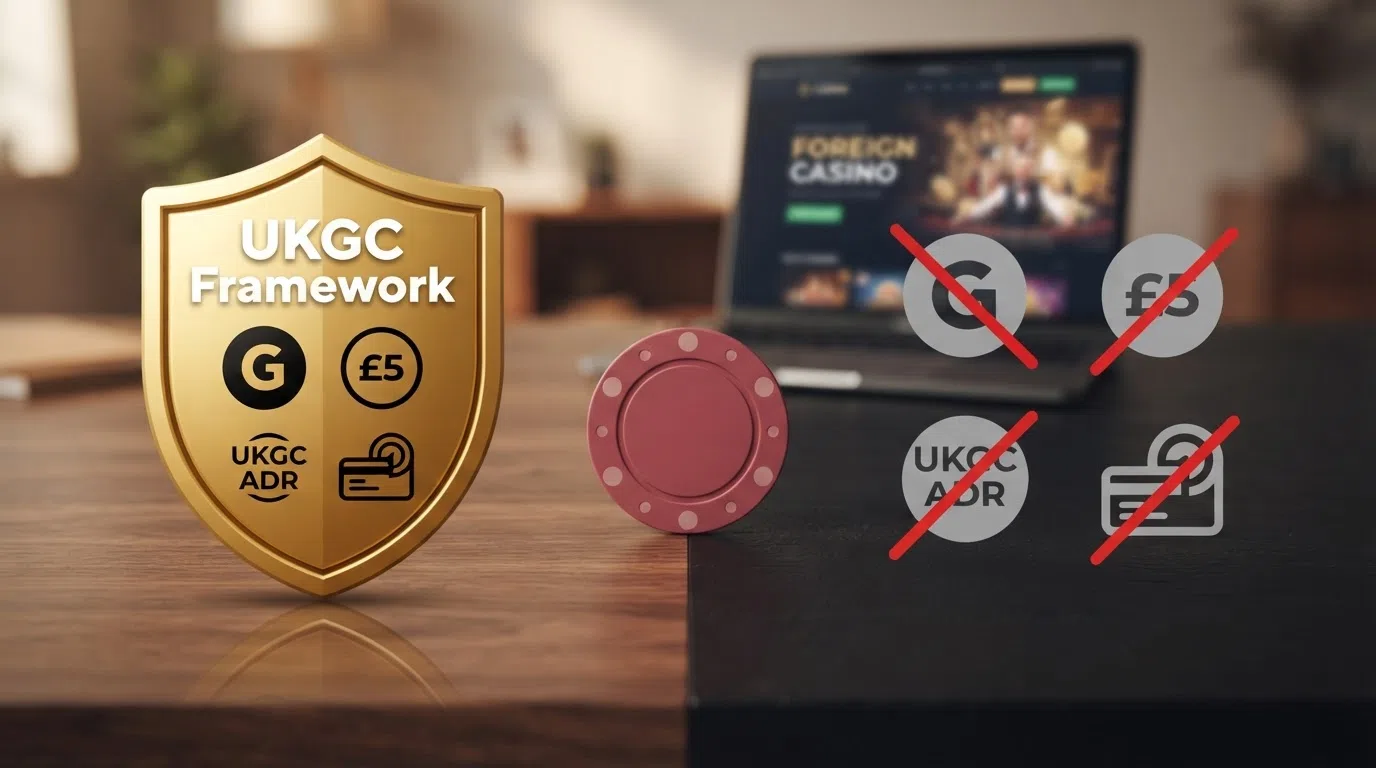
The point-of-consumption rule is the spine of the UK regime: the Gambling (Licensing and Advertising) Act 2014 makes it an offence for an operator without a UKGC licence to serve GB consumers, but no UK law criminalises the player for using a foreign site. The practical consequence is a protection gap, not a criminal record. A foreign casino’s home-jurisdiction licence — Curaçao GCB, Costa Rica registration — gives a UK player no access to UKGC-mandated protections: no GamStop, no UKGC-approved Alternative Dispute Resolution, no statutory stake or deposit limits, and no UK affordability checks.
The enforcement record is on the onshore side, and it is active. Platinum Gaming was fined £10 million in September 2025 for anti-money-laundering and social-responsibility failings. TGP Europe surrendered its licence after a £3.3 million penalty. ProgressPlay was fined £1 million; Videoslots and NetBet each settled for £650,000. The Soft2Bet Files investigation in 2026 found that FCA-regulated payment companies processed hundreds of millions of euros for a network of unlicensed casinos. The onshore market is policed; the offshore space operates outside that enforcement reach.
| Feature | UKGC-Licensed Casinos | Foreign (Non-UKGC) Casinos |
|---|---|---|
| GamStop self-exclusion | Mandatory (all remote operators) | Not available |
| UKGC-approved ADR | Available | Not available |
| Statutory slot stake cap | £2 (18–24) / £5 (25+) | No cap |
| Gross deposit limit | Mandatory from 30 September 2026 | No regulatory floor |
| Pre-deposit financial-limit prompt | Mandatory from 31 October 2025 | Not required |
| Affordability / vulnerability checks | Triggered at £150 net spend / 30 days | Not required |
| Single-product bonus rule | Enforced (LCCP SR Code 5.1.1(3b)) | No equivalent restriction |
| Mixed-product welcome packages | Prohibited | Routinely offered |
| Crypto deposits | Not generally supported | Widely supported |
| UKGC enforcement reach | Full | None |
UKGC Jurisdiction and Where It Ends
The UKGC regulates all gambling offered to consumers in Great Britain — its authority is defined by where the consumer is, not where the operator’s servers sit. The Gambling (Licensing and Advertising) Act 2014 converted the system from point-of-supply to point-of-consumption, so an operator based in Malta, Curaçao or anywhere else commits an offence if it serves a person in England, Scotland or Wales without a UKGC operating licence. The UKGC public register, last updated 29 July 2026, is the definitive reference: if a brand is not on it, the brand is not UKGC-licensed regardless of what its homepage footer claims. There is no “licensed foreign casino” for UK players — a casino serving GB consumers without a UKGC licence is unlicensed in the UK market regardless of its home-jurisdiction licence.
GamStop Self-Exclusion: Why Foreign Casinos Sit Outside the Net
GAMSTOP is a multi-operator self-exclusion scheme that has prevented registered players from accessing GB-licensed gambling websites and apps since April 2018. The scheme is mandatory for all UKGC-licensed remote operators under LCCP Condition 3.5.3, which requires licensees to have self-exclusion procedures and to take reasonable steps to prevent self-excluded individuals from gambling. A Curaçao- or Costa Rica-based casino has no obligation to participate, and none of the ten featured operators does. A player who has self-excluded via GamStop and then signs up at a foreign casino has bypassed the scheme’s entire protective architecture — the foreign operator has no way to check the GamStop register and no regulatory duty to do so.
Player Protections You Leave Behind at the UKGC Gate
The UKGC’s protection stack is a series of specific instruments, and each one stops applying the moment a player signs up at a non-UKGC site. The £2 and £5 per-spin stake caps are the most visible; the gross deposit limit and the pre-first-deposit financial-limit prompt are the most recent additions. Light-touch financial vulnerability checks, triggered when a customer’s net spend exceeds £150 in a rolling 30-day period, are a UKGC framework feature that no foreign jurisdiction replicates. UKGC-approved ADR providers give a GB player a formal escalation path when a dispute cannot be resolved with the operator directly; at a foreign casino, disputes go through the operator’s own process or, for Curaçao GCB licensees, through the Curaçao Gaming Authority’s complaints channel — a route that exists but is not equivalent in speed, cost or enforcement power.
How Offshore Casino Licences Work — and What They Do Not Guarantee
Curaçao’s licensing regime was rebuilt in 2024 — the Curaçao Gaming Authority now licenses operators directly rather than through master-licence holders, providing a regulatory structure closer to tier-one jurisdictions. A Curaçao GCB licensee must maintain a complaints procedure, and the regulator’s register lets a player verify that a licence number is genuine. The GCB’s enforcement reach is narrower than the UKGC’s, and its penalty record is less developed, but the 2024 reform raised the floor for new entrants.
Costa Rica registration is not a gaming licence in the statutory sense — it is a data-processing registration that carries no dedicated gaming regulator, no formal player-dispute mechanism and no deposit-protection scheme. The practical risk is asymmetric. A UKGC licensee that fails faces fines, licence revocation and public enforcement action; a Costa Rica-registered operator that fails leaves a player with no regulatory body to petition and no statutory compensation framework. The Curaçao GCB register is the verification source for Curaçao-licensed operators, the MGA register for Malta-licensed, and the Isle of Man Gambling Supervision Commission register for IOM-licensed. Any of those can be checked; Costa Rica has no equivalent register to check against.
Staying Safe: Responsible Gambling at Casinos Outside the UK
Foreign casinos typically offer account-level deposit limits, session timers and self-exclusion from that single operator — but no cross-operator scheme equivalent to GamStop exists outside the UKGC framework. The National Gambling Helpline on 0808 8020 133, operated by GamCare, is free, confidential and staffed 24 hours a day, 365 days a year. It is available to any UK resident regardless of where they gamble, and it is not contingent on playing at a UKGC-licensed site. Problem gambling is a recognised public health issue in the UK, and the NHS funds dedicated treatment services — the NHS Northern Gambling Service and the National Problem Gambling Clinic — that accept self-referral and GP referral and treat gambling harm irrespective of which operator a person used.
Responsible-Gambling Tools at Foreign Casinos: What Exists
Most foreign casinos in the featured set offer deposit limits, loss limits, session time limits and single-operator self-exclusion. The critical structural gap is the absence of a cross-operator self-exclusion scheme: a player who self-excludes from MyStake can still open an account at GoldenBet or Freshbet the same day, because no shared register exists across the foreign-casino market. The UKGC-mandated gross deposit limit, capping total deposits across a set period from 30 September 2026, and the pre-first-deposit financial-limit prompt required since 31 October 2025, have no equivalent at foreign casinos, where deposit caps are set by the player alone without a regulatory floor. A player who has relied on GamStop to keep their play within bounds should understand that signing up at a foreign casino removes that guardrail entirely, and that the operator’s own deposit-limit tools are the only ceiling that will apply.
UK Help Resources Every Player Should Know
The National Gambling Helpline on 0808 8020 133 is the first number to call. GamCare’s website provides a live chat channel and self-assessment tools alongside the helpline. The NHS offers dedicated gambling clinics — the NHS Northern Gambling Service and the National Problem Gambling Clinic — that accept self-referral and GP referral, and the NHS gambling support page carries self-help guidance. Gamban blocking software is available free through a GamCare referral and blocks gambling sites and apps across all devices regardless of the operator’s licence jurisdiction, which makes it one of the few tools that closes the gap GamStop leaves open. GambleAware’s service finder lists local treatment providers across the UK.
Recognising the Signs When the Safety Net Is Thinner
The UKGC framework builds in friction — affordability checks at £150 net spend, mandatory deposit-limit prompts, single-product bonus rules — that a foreign casino does not replicate, so the player carries more of the monitoring burden. The warning signs are the same ones the NHS and GamCare publish: chasing losses, gambling beyond a planned time or budget, hiding spend from family, borrowing to fund play, and restlessness when not gambling. The practical rule is simple. If a player relies on GamStop, deposit caps or the UKGC’s mandatory intervention triggers to keep their play within bounds, a foreign casino removes every one of those guardrails, and the player has to do the work the framework would otherwise do. That is the bargain: more freedom on stake size, more product variety, more payment flexibility — and a thinner safety net underneath.
How We Evaluated and Ranked These Foreign Casinos
The ten featured operators were drawn from the Curaçao GCB public register, Costa Rica registrations and cross-referenced affiliate coverage, with every brand checked against its home-jurisdiction licence database to confirm active status as of 2026. Ranking criteria were applied qualitatively: licence jurisdiction and regulatory standing, bonus wagering multiplier and validity terms, game-provider depth and library size, and the availability of no-deposit samplers. No invented weighting percentages or scores were used. The UKGC public register, last updated 29 July 2026, was consulted to confirm that none of the featured operators holds a UKGC operating licence, and each brand’s GamStop status was verified against the operator’s own documentation. The comparison was built to surface what competitor pages bury in prose: the per-operator wagering multiplier, the free-spin terms and the licence tier side by side so a reader can compare them directly.
What a UK Player Should Actually Weigh Before Using a Foreign Casino
The structural trade-off is clear. Foreign casinos offer higher stake ceilings, multi-product bonuses, crypto payouts and game libraries unrestricted by UKGC design rules — and in exchange the player steps outside GamStop, the UKGC ADR system, the statutory deposit-limit framework and the affordability-check safety net. The Remote Gaming Duty increase from April 2026 has made the offshore value proposition sharper; market analysis describes it as accelerating player migration. A tax differential does not create regulatory protection where none exists. The Curaçao GCB reform of 2024 has raised the bar for Curaçao-licensed operators, but a GCB licence is not a UKGC substitute, and the Costa Rica-registered operators in the featured set sit outside any statutory gaming regulator entirely.
The arithmetic on a 30x deposit-plus-bonus multiplier is worth running before any deposit: a £100 deposit with a £150 bonus requires £7,500 in turnover before withdrawal, and at a £5 stake per spin that is 1,500 spins, or roughly two hours and five minutes of continuous play at a five-second spin interval. That figure is an illustrative average under the stated assumptions — an estimate, not a guarantee — and the actual clearing time depends on what the player wagers and on the variance of the games played. The wagering column in the comparison table is where that arithmetic lives for each brand.
Three checks before any deposit. Verify the licence against the Curaçao GCB, MGA or relevant home-jurisdiction register — if the licence number does not appear, walk away. Read the wagering terms page in full, paying attention to whether the multiplier applies to the deposit alone or to deposit-plus-bonus combined, and whether free-spin winnings carry a separate multiplier or a cashout cap. Know the National Gambling Helpline number, 0808 8020 133, before the first spin, because the moment the player leaves the UKGC framework the safety net becomes thinner and the number becomes more important. Offshore casinos are not illegal for the player to use; the criminal offence is on the operator side. The choice is a player’s, and the cost of making it without reading the terms is the page’s central warning.
Frequently Asked Questions
How can I verify that an offshore casino licence is genuine?
Check the licence number against the home-jurisdiction register. For Curaçao GCB licensees, the GCB’s public register lists every active operator and the licence number it was granted. For Malta, the MGA’s register serves the same function; for the Isle of Man, the Gambling Supervision Commission’s register. Costa Rica registration has no equivalent gaming register to check, which is itself information about the licence’s standing. A brand that does not display a licence number, or that displays one that does not appear in the register, has not been verified.
What happens to my money if a foreign casino shuts down?
It depends on the licence. A Curaçao GCB licensee operates under a regulator that can order fund segregation and player reimbursement in enforcement actions, but the GCB’s enforcement record on collapsed operators is less developed than the UKGC’s. A Costa Rica-registered operator has no statutory gaming regulator to petition and no deposit-protection scheme; funds are at the mercy of the operator’s solvency and the legal jurisdiction in which it is incorporated. UKGC-licensed operators are required to segregate player funds in a way that offshore operators are not. This is one of the structural costs of the foreign-casino choice.
Do foreign casinos accept GBP deposits?
Most do, because the welcome packages in the featured set are denominated in euros or pounds. Currency conversion happens at the operator’s rate, and the player absorbs any conversion cost. Crypto-native operators like 7Bit denominate in BTC and the player converts at the prevailing rate. None of this changes the legal framework — the deposit is still made from a UK bank account or card to an unlicensed foreign operator, and the UK consumer credit protections that apply to UKGC-licensed transactions do not follow the funds offshore.
Do welcome packages at offshore casinos beat what UK-licensed sites offer?
The headline figures are larger. A 300% match across three deposits or a 600% match up to £9,500 are numbers that no UKGC-licensed site can offer, because the LCCP’s single-product incentive rule prohibits the multi-product welcome packages that offshore sites structure. Whether the larger headline produces a better outcome for the player depends entirely on the wagering multiplier and validity window behind it. A 30x deposit-plus-bonus multiplier on a £250 combined total requires £7,500 of turnover; a smaller UK-licensed welcome with no wagering requirement can leave a player better off in absolute terms.
Can I use crypto to deposit at foreign casinos from the UK?
Yes, and several of the featured operators — 7Bit, Freshbet, Jackbit — are crypto-native or crypto-friendly. Crypto deposits and crypto payouts are typically faster than card withdrawals, and the offshore space is where the payment-method breadth lives. The UKGC framework does not generally support crypto deposits at UK-licensed sites, which is one of the practical reasons UK players use foreign casinos. Crypto does not change the regulatory status: a crypto deposit to a Curaçao-licensed operator is still a deposit to an unlicensed foreign casino for UK regulatory purposes, and the same protection gaps apply.
What are the risks of playing at Curaçao-licensed casinos?
The risks are the absence of UKGC protections: no GamStop, no UKGC-approved ADR, no statutory stake caps, no gross deposit limit, no pre-deposit financial-limit prompt and no UK affordability checks. The Curaçao GCB’s complaints channel exists and the 2024 licensing reform raised the floor for new entrants, but the GCB’s enforcement reach is narrower than the UKGC’s and the penalty record is less developed. The 2024 reform made Curaçao-licensed operators materially different from Costa Rica-registered ones, but neither substitutes for a UKGC licence. The upside — higher stakes, multi-product bonuses, crypto payouts, deeper game libraries — is the trade the player is making.
Licence – Casino Welcome Bonuses UK
Content created by the «Casino Welcome Bonuses UK» team