
Anjouan Casino Licence in the UK: The Regulatory Gap a UK Player Needs to See
 Available in GB
The Anjouan gaming licence is the permit that has quietly become the default offshore authorisation for the crypto-casino sector. A jurisdiction that did not exist in gambling terms twenty years ago now sits behind more than 2,000 active sites, and a growing share of those sites accept players from the United Kingdom — even though the licence itself lists the UK as an excluded territory. That is the contradiction this page takes apart: what the Anjouan permit actually is, why it shows up on UK-facing casino sites, and precisely what a UK player gives up by using one.
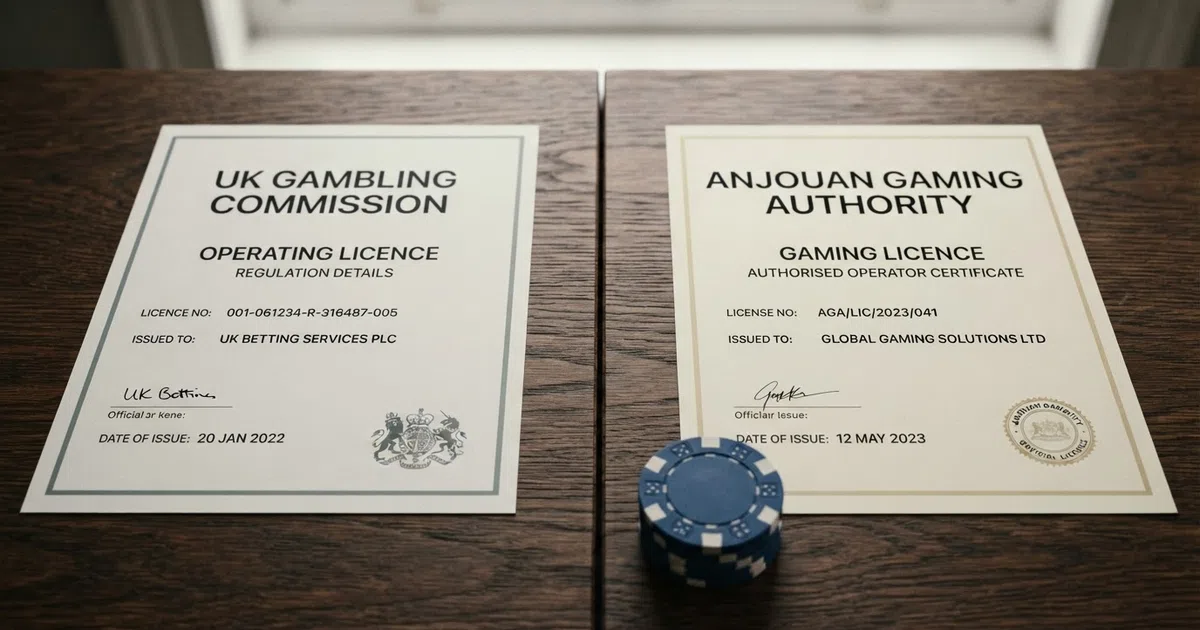
Data current as of 17 August 2026 and verified against the Anjouan Gaming Authority’s public register and the UK Gambling Commission’s published register of GB-licensed businesses.
What an Anjouan Casino Licence Delivers — and What It Does Not
The Anjouan Gaming Licence at a Glance — an Offshore Permit, Not a UK Passport
The Anjouan Gaming Authority sits under the Anjouan Offshore Financial Authority, the financial-regulator parent body for the Autonomous Island of Anjouan in the Union of the Comoros. The licensing regime itself rests on the Computer Gaming Licensing Act 007 of 2005, with the Money Laundering (Prevention) Act 008 of 2005 as its anti-money-laundering pillar. Together those two statutes give the authority a legal basis to issue internet gaming licences, and that is all they give it: an internet gaming licence. There is no land-based casino floor on Anjouan, no on-site regulator a player can visit, no British consumer-protection obligation attached to the permit, and no standing with the UK Gambling Commission.
The licence comes in two categories. A B2C operator licence authorises a company to offer gaming services directly to consumers; a B2B service-provider licence, or a Recognition Certificate, covers the suppliers — software studios, platform providers, RNG certifiers and payment processors. From July 2025 every B2B entity serving an Anjouan casino must hold one or the other; before that change, the supply chain operated without any Anjouan authorisation at all. The reform is the most material tightening the jurisdiction has introduced, and even it does not touch player-level protections: no ADR, no deposit-limit mandate, no wagering cap.
A licence is, in plain terms, a permit to operate under a particular regime. What it is not, for a UK player, is a pass into the British regulatory system. The Gambling Commission does not recognise Anjouan permits for UK-facing play, and the Gambling (Licensing and Advertising) Act 2014 makes a GB licence compulsory at the point of consumption — wherever the operator is based. The single most useful framing of the Anjouan licence for a UK reader is that it is a foreign business licence, not a British one, and the two are not interchangeable.
The Licensing Process — Cost, Timeline, and Who Applies
The economics of an Anjouan licence explain why so many operators have it. The issuance fee is €17,828, the same figure applies for the annual renewal, and processing typically takes four to six weeks. There is no statutory tax on gross gaming revenue, no corporate income tax and no VAT for qualifying International Business Companies. The total cost of admission is, by the standards of serious gambling jurisdictions, small.
Contrast that with a UK Gambling Commission licence, where fees are scaled to gross gambling yield bands and where a remote casino operator pays a Remote Gaming Duty that rose to 40% from 1 April 2026 on top of a 1.1% statutory levy. An operator choosing between the two is not making a quality judgement; they are running a balance sheet. The lower the cost of admission and the lighter the ongoing tax, the thinner the revenue base the regulator has to fund supervision — and that is precisely the trade-off the rest of this page returns to.
It is worth being clear about who applies. The Anjouan licence is open to any company that meets the authority’s basic fit-and-proper checks, sets up a qualifying IBC structure, and pays the fee. Operators running at scale, from Betpanda (an offshore operator), which has been linked to documented instances of fund confiscation. The jurisdiction’s pull is the cost-and-friction combination, not a brand of trust.
How Anjouan Became a Casino Licensing Hub — Over 850 Licences and Counting
The numbers describe the trajectory. Since the 2005 Act, the Anjouan authority has issued more than 850 licences supporting more than 2,000 active gaming sites. That is a fast build-up for a jurisdiction that did not have an internet gaming regime two decades ago, and the scale of the registry is the strongest available evidence of how the licensing model travels. When a permit takes four to six weeks to issue and costs less than many operators spend on a single marketing campaign, the volume of applicants is not surprising.
Volume, though, raises an unavoidable question about per-licence scrutiny. A regulator that has cleared 850 applications cannot, on any reasonable accounting, have run a deep review of each one. The industry framing captures the trade-off bluntly: Anjouan is widely classed as a tier-3 or light-touch jurisdiction, and the practitioner assessment is that “a tier-3 licence is not a strong consumer-protection signal. Segregated player funds, ADR, audited payouts, and binding mediation are typically not enforceable through this regulator.”
The two material updates to the regime — the July 2025 B2B requirement and the April 2026 Certificate Verification Framework revision — are tightening moves, not structural ones. They add documentation and supply-chain accountability, but they do not introduce an independent dispute resolution body, audited payout verification, or player-fund segregation. Those are the things that would push Anjouan from tier 3 toward tier 2, and none of them is on the table.
Online-Only — Why There Are No Anjouan Land-Based Casinos
A useful piece of context that often gets lost in offshore licensing discussion: the Anjouan gaming licence is an internet-only instrument. There are no physical casino floors on the island, no resort venues operating under Anjouan-issued permits, and no on-site regulator a player could visit. Every Anjouan-licensed operation is an online casino or sportsbook reached through a browser or an app.
What that means in practice is that every interaction a player has with an Anjouan-licensed brand is remote. There is no venue to walk into, no gaming commission officer on Anjouan to write to, no in-person complaint channel. Even compared with other offshore jurisdictions that operate tier-3 regimes, Anjouan is unusually thin: a regime designed for online-only businesses, run by an online-only administrator, and reaching a player only through their device.
Where Anjouan Casino Sites Operate — and Why the UK Is on the Exclusion List
The standard Anjouan exclusion list names the United States, the United Kingdom, France, the Netherlands, Australia, and any FATF-blacklisted country. The reason the UK appears is the Gambling (Licensing and Advertising) Act 2014, which made a GB licence compulsory at the point of consumption. From the Anjouan authority’s perspective, the UK is a market whose regulator has already closed the door, and the standard licence template geo-blocks it as a matter of policy.
In practice, though, the official exclusion and the actual market are not the same thing. The Anjouan validation page itself shows the gap: a check of Megapari’s entry on the Anjouan register lists the United Kingdom as an “Excluded Territory”, yet UK-facing review sites list Megapari as accessible. That mismatch — exclusion on the licence page, access in practice — is the most common pattern across the featured set. A UK player who registers and deposits at one of these sites is being accepted by the operator in spite of the licence’s own stated policy, which puts the misrepresentation on the operator’s side rather than the player’s.
The pattern tells a reader what to look for. An honest Anjouan casino that does not want UK players enforces the exclusion at registration; one that wants UK players quietly looks the other way. Either way, the regulator is not the enforcement mechanism, and that is the part the marketing pages leave out.
Crypto and Anjouan — Why the Licence Has Become a Go-To for Bitcoin Casinos
The Anjouan regime is structurally attractive to crypto operators, and the featured set reflects that. Betpanda, Bets.io, Casinopunkz, BiggerZ, Ybets and WildRoll are crypto-first or crypto-only brands; MrJones, Megapari, Goldbet and PalaceCasino mix in fiat. The two draws are the tax model and the KYC expectation. A 0% gross-gaming-revenue tax lets a crypto operator keep a far larger share of every edge than a UK-licensed operator can; a regulator with no mandatory pre-verification requirement lets a casino onboard players on an email and a wallet address rather than the full British identity stack.
The anonymity trade-off is where a UK player should pause. A crypto-only Anjouan casino typically asks for no name, no address, no date of birth before the first deposit. There is no Section 75 credit card protection, no bank-mediated chargeback, and no card-issuer dispute route, because the transaction is in Bitcoin or USDT, not in pounds through a UK card. If a withdrawal stalls or an account is closed, the trail back is thinner than anything a UK bank or card scheme would offer, and the regulator has no independent complaint body to escalate to. The tax efficiency that pulls the operator toward Anjouan is the same efficiency that strips the player of consumer protections that are routine in the British market.
Why an Anjouan Licence Is No Substitute for UKGC Protection
Who Issues the Anjouan Gaming Licence — AOFA, ALSI, and the 2005 Act
The institutional architecture is worth naming, because it is what a reader is being asked to trust. The Anjouan Offshore Financial Authority is the parent body; Anjouan Licensing Services Inc. (ALSI) is the sole authorised licence administrator; the two statutes that frame the regime are the Computer Gaming Licensing Act 007 of 2005 and the Money Laundering (Prevention) Act 008 of 2005. The categories the authority issues are B2C operator licences and B2B service-provider licences, with the B2B side tightened in July 2025 to require a Recognition Certificate or a full B2B licence for every supplier.
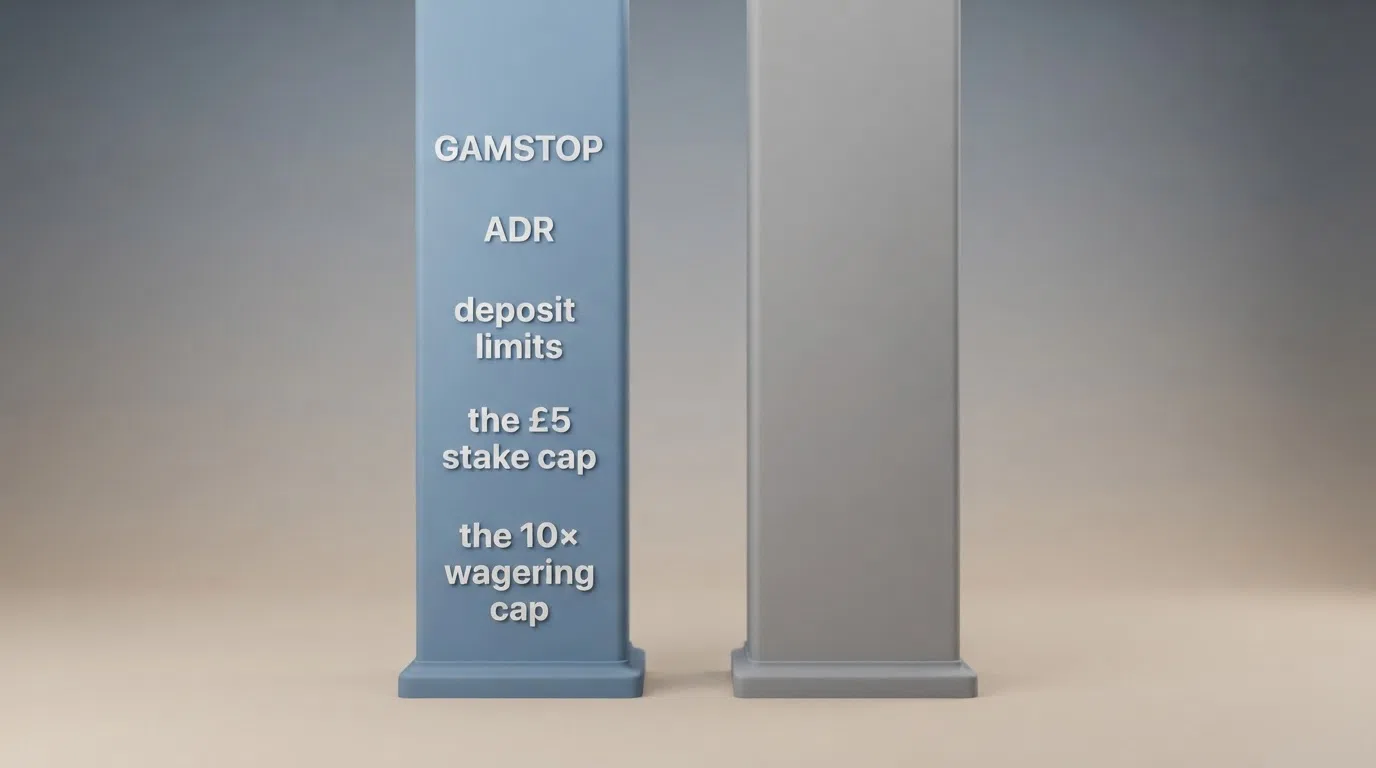
The point of the architecture is that none of the bodies in it is answerable to a UK audience. ALSI is a private administrator, the AOFA is the Anjouan financial regulator, and the legislative foundation is domestic Anjouan law. The UK Gambling Commission, the Department for Culture, Media and Sport, and the courts of Great Britain do not have a standing relationship with any of them. The licence travels because operators carry it; the licence carries no British standing because the British system has not granted it any.
How to Check an Anjouan Licence Is Genuine — the Verification Framework
The Anjouan authority maintains a public register, and a revised Certificate Verification Framework took effect on 1 April 2026. The validation page URL is the public-facing tool, and a successful check shows an operator’s name, licence number, status and listed excluded territories. The Megapari entry is the worked example: the licence number ALSI-112310012-FI5 is shown as active, with the United Kingdom listed among excluded territories.
What verification confirms, though, is more limited than it sounds. A live licence number proves the operator has paid the fee and is currently registered; it does not confirm audited payout rates, segregated player funds, or any commitment to independent dispute resolution. Q1 2026 compliance reports were due by 30 April 2026, and that reporting layer adds a documentary trail — but it is a reporting layer, not a player-protection mechanism. The framework is real, the limits on what it tells a player are real too, and those limits are the reason a licence check is a starting point, not a conclusion.
Anjouan’s Regulatory Tier — What “Light-Touch Offshore” Means in Practice
The industry classification of Anjouan as a tier-3 or light-touch jurisdiction is not a slur; it is a working description that maps to specific gaps. Lighter regulation, in Anjouan’s case, means no mandatory alternative dispute resolution body, no binding mediation service, no audited payout-rate verification, and no segregated player funds requirement. A player whose withdrawal stalls at an Anjouan casino has no independent escalation route: the dispute has to be settled directly with the operator, and the regulator’s posture on player complaints is, in the documented cases, unresponsive.
The July 2025 B2B update and the April 2026 Certificate Verification Framework revision are the most material changes the regime has made. Both are supply-chain reforms — they tighten who has to hold a licence, and they add a verification layer for the existing licences — and both are silent on the things a UK player actually needs. ADR, deposit limits, wagering caps, and the dispute resolution gap remain where they were before. The choice a UK player is being asked to make is between a British regulatory architecture that has built these tools in, and an offshore regime that has not, and “tier 3” is the polite way of capturing the size of that gap.
UKGC vs Anjouan — Every Protection a UK Player Leaves Behind
The regulatory gap is best read as a list, because the gap is precisely the protections the UK has built and Anjouan has not:
- GAMSTOP: Mandatory for every GB-licensed online operator since March 2020. Licence-bound, which means it cannot reach an Anjouan-licensed casino. A UK player who has self-excluded via GAMSTOP encounters no barrier at an offshore site.
- UKGC complaints and ADR: Every GB-licensed casino has access to an approved alternative dispute resolution provider. Anjouan casinos do not; disputes are handled directly with the operator.
- Slot stake limits: UK slots carry a statutory maximum of £5 per game cycle for players aged 25 and over, and £2 for players aged 18 to 24. Anjouan-licensed slots have no per-spin cap.
- Wagering cap: From 19 December 2025, wagering requirements at GB-licensed casinos are capped at 10×, and mixed-product promotional offers are banned. Anjouan bonuses carry 15× to 80× wagering in the featured set.
- Credit card ban: GB-licensed operators have been prohibited from accepting credit card payments since 14 April 2020. Anjouan operators are not bound by this and commonly accept credit cards where the card scheme allows.
- Deposit limits: From 31 October 2025, GB-licensed operators must prompt a customer to set a financial limit before the first deposit. Anjouan casinos are not required to do so.
- Reality checks and session tracking: GB-licensed slots must display total losses, wins and time played during a session. Anjouan casinos are not.
- Game design: GB-licensed online slots have auto-play banned, a minimum 2.5-second spin speed, losses disguised as wins banned, and reverse withdrawals banned. Anjouan slots have none of these rules imposed on them.
- Financial vulnerability checks: GB-licensed operators run light-touch vulnerability checks at a £150 net deposit in a rolling 30-day period. Anjouan operators have no equivalent requirement.
- Pre-verification: GB-licensed operators must verify name, address and date of birth before the first deposit. Anjouan operators vary; some allow registration on an email and a wallet address alone.
Each of these is a UK-specific protection. The fact that none of them is required at an Anjouan-licensed casino is the core of what a UK player is choosing between.
UKGC Enforcement — What the Commission Is Doing About Offshore Operators
The UKGC is not passive about offshore operators reaching British customers. The published enforcement figures for April 2024 to June 2025 show 3,140 disruption notices, 447,778 URLs referred to search engines, 287,961 URLs removed, and an average 32% fall in engagement across 160 disrupted sites. For October 2024 – September 2025, the Commission reported 208,088 enforcement actions, the largest category being search-engine referrals. The Crime and Policing Bill, which became law at the end of the last UK Parliament session, gave the Commission new powers to go after illegal sites’ IP addresses and domain names directly.
The enforcement strategy is disruption, not blocking: search-engine delisting, domain registrar action, payment-provider referrals, cease-and-desist notices. ISP-level blocking is not the Commission’s tool, though the new IP-and-domain powers narrow the gap. Anjouan-licensed casinos operating in the UK are outside the Commission’s licensing reach but not invisible to it, and a casino that draws enough enforcement attention can find its payment routes closed and its search presence eroded. The point of the enforcement record is that the British regulator is actively pushing back on offshore operators, and the cost of that pushback falls on the operator — though the player who deposits in the window before enforcement lands is the one left holding the bag.
The 0% Tax Model — What It Signals About Player Protection
The Anjouan tax model — 0% on gross gaming revenue, no corporate income tax, no VAT for qualifying IBCs — is a structural draw for operators, and it has a structural consequence. A jurisdiction that charges nothing on revenue has no revenue-funded supervisory infrastructure. The UK, by contrast, takes a 40% Remote Gaming Duty on online casino gross yield from 1 April 2026, plus a 1.1% statutory levy split 50% to treatment, 30% to prevention, and 20% to research. That money funds GamCare, the National Gambling Treatment Service, the Gambling Survey for Great Britain, and the regulator’s own enforcement capacity.
The implication is not subtle. A jurisdiction that earns only licence fees — Anjouan’s entire revenue model is €17,828 per licence per year — has an incentive to issue licences, not to police them. Every licence sold is revenue; every enforcement action is cost. The structural incentives of a low-tax, fee-funded regulator and a high-tax, levy-funded regulator point in opposite directions, and that is before any individual decision is made.
The B2B Licensing Update — What Changed in July 2025 and Why It Matters
Before July 2025, software suppliers, platform providers, RNG certifiers and payment processors could serve an Anjouan-licensed casino without any Anjouan authorisation of their own. The reform closed that gap: from that date, every B2B service provider in the supply chain has to hold a Recognition Certificate or a full B2B licence. The change adds a paper trail, and for an Anjouan-licensed casino the practical effect is that any game or payment rail serving it now has its own Anjouan filing.
What the update does not change is what a player might hope it changes. ADR, deposit limits, wagering caps, financial vulnerability checks, auto-play restrictions and the rest of the UK-level player protection stack remain unaddressed. The B2B reform is a supply-chain reform, not a consumer-protection reform, and the only way to read it correctly is to notice what is and what is not in the new rule. The supply chain is now licensed; the player still isn’t.
Anjouan-Licensed Casinos That Welcome UK Players — and the Risks Each One Carries
The ten operators ranked below all hold an Anjouan licence, all are accessible from the UK, and none appears on the UK Gambling Commission’s public register. A “welcome bonus” column next to a 35× to 80× wagering requirement, and a “yes” in the crypto column next to no ADR coverage, is the kind of trade-off a UK player needs to weigh on the same line.

| Operator | UKGC Licensed? | Welcome Bonus | Wagering | Games (providers / titles) | Crypto Support |
|---|---|---|---|---|---|
| Megapari | No | 100% up to €500 + 50 FS (package up to €1,060 + 100 FS) | 35× (bonus) | 80+ providers / — | Mixed fiat + crypto |
| Betpanda | No | 100% up to 1 BTC | 80× (bonus, 7-day window) | 80+ providers / 5,000+ | Crypto only |
| Bets.io | No | 225% up to 1 BTC + 225 FS | 40× (bonus + FS) | — / — | Crypto |
| MrJones Casino | No | 700% up to £5,200 (four deposits) | 30× (deposit + bonus, 15-day window) | — / 8,000+ | 230+ cryptocurrencies, GBP accepted |
| Goldbet Casino | No | 100% + 200 FS (package up to €/$4,500 + 200 FS) | 45× (bonus) | 140+ providers / 8,900+ | Crypto-friendly |
| Casinopunkz | No | 100% up to €5,000 + weekly cashback up to 15% | — | 80+ providers / — | Crypto-focused |
| BiggerZ | No | 150% up to $1,500 + 100 FS | 40× (bonus, 14-day window) | — / — | Crypto |
| Ybets | No | 500% up to $8,000 + 400 FS | 40× (bonus, 30-day window) | 80+ providers / 6,000+ | Crypto, no KYC |
| WildRoll | No | 500% up to $1,500 + 350 FS | 45× (bonus) | — / 5,000+ (600+ live) | Crypto only |
| PalaceCasino | No | 100% up to €/$1,000 | 15× (deposit + bonus, 24-hour window) | — / — | Crypto-friendly |
A “—” in a cell marks data the underlying sources do not give. Where wagering or game-count figures are absent, the operator itself has not published them, and a UK player cannot check what has not been put on the page. Several of the most prominent gaps fall on Casinopunkz (wagering not stated), Bets.io (provider and title counts not surfaced), BiggerZ (provider and title counts not surfaced), WildRoll (provider count not surfaced) and PalaceCasino (provider and title counts not surfaced). The reader should treat absent cells as a transparency signal in their own right.
Megapari
Megapari carries Anjouan licence ALSI-112310012-FI5, verified on the Anjouan validation page, and is the longest-running operator in the set, having launched in 2019. The welcome package is a 100% first-deposit match up to €500 with 50 free spins, extending across deposits to a total of up to €1,060 plus 100 free spins, with 35× wagering on the bonus amount. The game library spans 80+ providers across both casino and sportsbook. The operator, Vdsoft & Script Development SRL, is based in Costa Rica.
The flag on Megapari is the contradiction between the licence and the practice. The Anjouan validation page lists the United Kingdom as an Excluded Territory, yet UK-facing review sites list Megapari as accessible. A player who registers from a UK IP, deposits, and plays is being accepted in spite of the operator’s own licence terms, which makes the regulator’s silence on this point part of the deal. Megapari suits a UK player who wants the largest game-and-sportsbook footprint in the set and is comfortable with that contradiction; it is the wrong choice for a reader who wants an operator that enforces its own exclusion policy.
Betpanda
Betpanda runs on Anjouan licence ALSI-202408063-FB and is a crypto-only casino plus sportsbook launched in 2023 under Star Bright Media S.R.L. The welcome offer is a 100% first-deposit match up to 1 BTC, with 80× wagering on the bonus amount over a 7-day validity window — one of the steepest terms in the featured set, and the shortest. The library is 80+ providers and 5,000+ games.
The risk profile is the documented one. Betpanda shares its operator with Cryptorino and Casinopunkz, and that operator carries a public pattern of account closures and fund confiscation after wins. The 80× wagering term is the operator’s own ceiling, and a UK player who accepts it is accepting both the maths and the documented complaint trail. Betpanda fits a crypto-only reader who has weighed the term sheet and the complaint history together and decided the trade is worth making; for most UK players the arithmetic of clearing 80× the bonus in 7 days is itself a reason to look elsewhere.
Bets.io
Bets.io is licensed by the Anjouan Gaming Board, launched in 2021 under TESSERA LIMITED SRL, and runs as a crypto-focused casino and sportsbook. The welcome package is 225% up to 1 BTC plus 225 free spins across the first three deposits, with 40× wagering on the bonus and free spins and a 2 USDT maximum bet while the bonus is active.
The headline is generous and the term is moderate, but the documented pattern of recurring public complaints about account closures and confiscated deposits is the part to weigh. Bets.io is accessible to UK players per review sites, and a UK reader who goes in does so knowing that any complaint escalates to the operator and that the regulator has not, in the documented cases, intervened on the player side. A reader who values the bonus size and accepts that complaint-resolution posture can use Bets.io; a reader who wants a regulator on the other end of a dispute is the wrong fit.
MrJones Casino
MrJones is a 2025 entrant, licensed under Anjouan, and is the only operator in the set that directly markets GBP-denominated bonuses to UK players. The welcome package is 700% up to £5,200 across four deposits, with a 300% first-deposit match up to £1,200. Wagering is 30× on deposit plus bonus — applied to the combined sum, not just the bonus — with a 15-day validity, a £20 minimum deposit per stage, and a £10 maximum bet per round while the bonus is active. The library is 8,000+ games and the operator supports 230+ cryptocurrencies alongside GBP. The operator, ChapChap Technologies Ltd, launched MrJones in 2025.
The headline figure is the highest match in the set, and the term — 30× on deposit plus bonus — is one of the more demanding, because the multiple applies to the player’s own deposit as well as to the bonus. A £1,200 first deposit with a 300% match produces a £4,800 combined balance, and clearing 30× that figure inside 15 days is the work the bonus requires. MrJones is the right fit for a high-roll reader with the bankroll to clear the term and a tolerance for the newness of the brand; the bonus size is real, and the time window to extract it is tight.
Goldbet Casino
Goldbet Casino is independently verified under Anjouan licence ALSI-012401005-F11, and runs the largest game library in the featured set: 140+ providers and 8,900+ games. The welcome package is 100% plus 200 free spins on the first deposit, with a multi-deposit package up to €/$4,500 plus 200 free spins, and 45× wagering on the bonus amount. The first-deposit minimum is €/$10 and the operator is crypto-friendly.
The figure to weigh is the library. 140+ providers and 8,900+ games is a wider catalogue than any other operator in the set, and that breadth is the case for Goldbet. The 45× wagering is in the middle of the set’s range, the licence is independently verified, and the operator name and launch year are not on the public record — a transparency gap a reader should notice. Goldbet fits a player who values game-library breadth over bonus size and who is comfortable with the absent operator detail; for a reader who wants the named-operator picture, the gap is itself a reason to keep looking.
Casinopunkz
Casinopunkz is a 2024 crypto-focused casino that operates outside the UK regulatory framework and carries no UKGC licence. The welcome offer is a 100% match up to €5,000 with weekly cashback up to 15%, the library is 80+ providers, and the monthly maximum withdrawal is £45,000. The operator is SBM S.R.L., and the brand is a sister to Betpanda under the Star Bright Media parent. The site carries a /en-gb/ path, confirming a UK-facing design.
The risk is inherited. Sharing an operator with Betpanda means sharing the operator’s documented pattern of account closures and fund confiscation, and the wagering requirement is not stated in the public material — a transparency gap a reader has to price in. Casinopunkz is the choice for a crypto player who has read the Betpanda section and is comfortable with that operator pattern; the cashback structure and the £45,000 monthly ceiling are real terms, and the absent wagering figure is the part to chase before depositing.
BiggerZ
BiggerZ is one of the newest entrants in the set, having launched in August 2025 under Anjouan licence ALSI-202504023-FI1. The welcome offer is 150% up to $1,500 plus 100 free spins on the first deposit, with 40× wagering on the bonus amount over a 14-day validity. The product spans casino and 40+ sports, the minimum deposit is 10 USDT, and the operator is CDK PIAY INC LIMITADA, registered in Costa Rica. BiggerZ is accessible to UK players per review sites.
The newness is the variable. An August 2025 launch with a 14-day bonus window is the term sheet of a brand looking to land customers, and the absence of a long operating track record is a gap a reader cannot fill from outside. BiggerZ fits a reader who is comfortable with brand-new operators and who can read a 14-day wagering window without help; the size of the welcome offer and the multi-sports product are the case for it, and the newness is the caveat.
Ybets
Ybets is licensed by Anjouan Gaming and is the operator in the set with the largest aggregate welcome package: 500% up to $8,000 plus 400 free spins across four deposits. Wagering is 40× on the bonus funds with a 30-day validity. The library is 80+ providers and 6,000+ games, the operator supports crypto with no KYC for crypto players, and standard-account withdrawal limits are $1,000 per day and $10,000 per month. The operator name and launch year are not on the public record.
Two things in this term sheet do not work in the player’s favour. The first is the regulator: review sites describe Anjouan Gaming as “one of the weakest in the industry” and the operator’s regulator has a documented history of not responding to player complaints. The second is the withdrawal cap: a $1,000-per-day ceiling on a casino advertising up to $8,000 in bonus funds is a structural mismatch a player should notice. Ybets fits a crypto player with no KYC preference and a small-stake pattern that stays under the daily ceiling; for a player with a single big win in view, the cap is the term sheet speaking for itself.
WildRoll
WildRoll is licensed by Anjouan Gaming and launched in 2025 under Jackpot Junction Limited. The welcome package is 500% across four deposits up to $1,500 plus 350 free spins, with 45× wagering described as steep by reviewers. The product is the strongest live-dealer offering in the set: 5,000+ games and 600+ live tables, of which 370+ are from Pragmatic Play Live. The casino is crypto-only with no sportsbook and is accessible to UK players per review sites.
The single best reason to be at WildRoll is the live-dealer catalogue. 600+ live tables is a number no other operator in the set comes close to, and for a live-casino reader the product is the case. The 45× wagering is on the high end of the set’s range and the absence of a sportsbook narrows the appeal; for a crypto player who wants live tables above all else, WildRoll is the choice, and the steepness of the term is the price.
PalaceCasino
PalaceCasino carries Anjouan licence ALSI-202504039-FI2 and is the outlier on wagering. The welcome offer is 100% up to €/$1,000 with 15× wagering on deposit plus bonus — the lowest multiple in the set — and a 24-hour wagering window, with a €/$20 minimum deposit, no maximum cashout cap, and email verification only to claim the bonus. The operator is crypto-friendly. The operator name and launch year are not on the public record.
The single best reason to look at PalaceCasino is the 15× term, which is unusual for an offshore casino. The catch is the 24-hour window, which is the tightest validity in the set: a player who takes the bonus has a day to clear 15× the deposit-plus-bonus sum or lose it. The trade-off is mathematical — a low multiple and a short window, not a low multiple and a comfortable one. PalaceCasino fits a player with a small bankroll and a day to set aside, who is happy with email-only verification and an unlimited-cashout structure; the missing operator and launch details are the transparency gap a reader has to accept.
The Bonus Landscape at Anjouan-Licensed Casinos — Higher Rewards, Heavier Strings
The headline numbers in the set are bigger than anything a UK-licensed casino can offer under the December 2025 rules. A UKGC-licensed casino is capped at 10× wagering and cannot run mixed-product promotions; the Anjouan set runs from 15× at the low end to 80× at the high end, and the multi-deposit welcome packages stack free spins on top. A 700% match at MrJones or a 500% package at Ybets or WildRoll is the kind of headline a regulated British casino structurally cannot post.
The clearing cost is the other side. PalaceCasino’s 15× on deposit plus bonus in a 24-hour window is the most generous term in the set, and the 80× at Betpanda in a 7-day window is the harshest; the 30× to 45× range that covers most of the set is, by UKGC standards, several multiples beyond any lawful British bonus. A UK player chasing a 700% bonus at 30× wagering on the deposit-plus-bonus sum is signing up for a turnover requirement that no UK-licensed operator is permitted to impose. None of the featured operators offers a wager-free bonus; every welcome package in the set carries a multiple, a validity window, and a maximum bet, and the size of the bonus is the size of the maths the player is taking on.
A worked example: the MrJones first-deposit offer is a 300% match up to £1,200 with 30× wagering on deposit plus bonus and a £10 maximum bet per round. A first deposit of £400 produces a £1,200 bonus for a combined balance of £1,600, and clearing 30× on that figure is £48,000 of wagering. At a £10 maximum stake per round, that is 4,800 individual bets; at the 2.5-second spin interval a UKGC slot mandates, the time required is roughly 200 minutes of continuous play, with no reality check, no session clock, and no mandatory break. The offer is real, and the time it takes to clear it is a number the player should run before accepting the bonus.
New Anjouan Casinos Worth Watching — the 2024–2025 Entrant Wave
Four operators in the set launched in 2024 or 2025: Casinopunkz in 2024, MrJones in 2025, BiggerZ in August 2025, and WildRoll in 2025. All four are crypto-friendly or crypto-only, all four target UK players either directly or through affiliate channels, and all four carry Anjouan licences. The pattern is the bigger version of the wider trend: new Anjouan casinos are arriving with more aggressive welcome structures and lighter onboarding than the older brands, and the more aggressive the offer, the more careful the reader needs to be.
The 700% headline at MrJones, the 500% packages at Ybets and WildRoll, the email-only verification at PalaceCasino, and the no-KYC crypto onboarding at Ybets are the markers of a market competing for UK traffic through bonus size and frictionless signup. A newer licence with a bigger bonus is not, on the evidence, a safer bet. It is a newer licence with a bigger bonus, and the trade-off is the term sheet, the complaint history of the operator behind it, and the absence of UK-level protection in the background.
How to Evaluate an Anjouan-Licensed Casino — Criteria Beyond the Bonus Banner
A useful evaluation framework reads past the welcome banner to five checks:
- Licence verifiability. A live licence number on the Anjouan validation page is the starting point; a footer badge without a number is not. Megapari, Goldbet, Betpanda, BiggerZ and PalaceCasino all carry verifiable licence numbers; others do not surface one in the public material.
- Complaint history. Documented patterns of withheld withdrawals, account closures and unresponsive complaint handling are public records at Betpanda, Bets.io and Ybets. The regulator’s posture in those cases has not been to intervene.
- Wagering transparency. A casino that publishes its wagering multiple lets the player run the maths; a casino that does not — Casinopunkz is the case in the set — is asking the player to accept a term they cannot see.
- Operator track record. A brand sharing an operator with a documented-risk sister site inherits the operator’s pattern. Betpanda and Casinopunkz share Star Bright Media, and the pattern travels with the parent.
- UK access honesty. A casino that officially excludes the UK on its licence page but accepts UK registrations is misrepresenting its own licence terms. Megapari is the clearest example in the set.
The framework is qualitative, not arithmetic, and the reader has to weight the five against each other. The verification framework’s value is in the conversation it forces, not in the answer it produces.
Payment Methods at Anjouan-Licensed Casinos — Crypto Dominates, Fiat Is Scarce
The payment landscape at the featured set is crypto-first. Betpanda, Bets.io, Casinopunkz, BiggerZ, Ybets and WildRoll are crypto-only or crypto-focused, and MrJones supports 230+ cryptocurrencies alongside GBP. Megapari mixes fiat and crypto, and Goldbet and PalaceCasino take EUR or USD. The pattern is the structural draw of the Anjouan regime — the 0% GGR tax and the light KYC expectations pull crypto operators toward the licence, and the licence pulls them in.
For a UK player the payment pattern is a protection gap as well as a convenience feature. A credit card deposit at a UK-licensed operator sits inside Section 75 of the Consumer Credit Act and the card scheme’s chargeback rules; a Bitcoin or USDT transfer at an Anjouan-licensed casino sits inside neither. The UK’s April 2020 credit card ban applies only to GB-licensed operators, and offshore casinos are not bound by it. The withdrawal picture has its own limits: Ybets caps standard accounts at $1,000 per day and $10,000 per month, Casinopunkz caps at £45,000 per month, and most operators in the set do not publish a standard withdrawal ceiling. The absence of a published ceiling is itself information — the casino has not made the figure available, and the player cannot rely on a number that is not on the page.
The Responsible Gambling Safety Net Only a UKGC Casino Can Offer
GAMSTOP and Anjouan — Why Self-Exclusion Does Not Cross the Offshore Border
GAMSTOP is the UK’s national multi-operator online self-exclusion scheme. It has been mandatory for every GB-licensed online operator since 31 March 2020, and the exclusion periods run from six months to five years, with an auto-renewal option that extends the exclusion if the player does not contact GAMSTOP after expiry — for up to seven further years. The exclusion cannot be cancelled early, and the design is built around the assumption that a player who has decided to stop gambling can be locked out of the entire GB-licensed online market with a single registration.
The architecture is licence-bound, which is the part that matters for an Anjouan-licensed casino. GAMSTOP can block a player from registering or depositing at every GB-licensed online operator; it cannot reach any operator outside the GB licensing system. A UK player who has self-excluded via GAMSTOP and then visits an Anjouan-licensed casino encounters no barrier, no flag, and no cooling-off. The self-exclusion decision stops at the UKGC border, and the offshore casino has no obligation to honour it. The Gambling Commission’s own enforcement figures are the backdrop: the Commission is pushing back on offshore operators, not asking them to integrate with GAMSTOP.
Comparison of UKGC and Anjouan-Licensed Casino Protections
| Protection Mechanism | UKGC Licensed Casino | Anjouan-Licensed Casino |
|---|---|---|
| Self-Exclusion | Mandatory (GAMSTOP) | None |
| ADR / Disputes | Mandatory Access | None |
| Deposit Limits | Mandatory Prompt | None |
| Credit Card Ban | Mandatory (Since 2020) | None |
| Slot Stake Limits | £2 to £5 per spin | None |
| Wagering Caps | 10× Limit | None (Up to 80×) |
Where to Get Help — GamCare, the NHS, and the National Gambling Helpline
The help infrastructure in the UK is real and it is funded, and it is available regardless of where the gambling happened. GamCare operates the National Gambling Helpline; between April 2024 and March 2025, the service supported more than 130,000 calls and online messages, made 7,100 referrals into further treatment, delivered 8,100 regional treatment sessions, and held an average wait time of 1.3 days. The National Gambling Treatment Service treated 11,960 clients in 2024/25, an 11% increase on the previous year; 50% of those clients received their first appointment within six days, and 93% of those completing treatment saw improvement. NHS gambling harm clinics operate in England, Scotland and Wales, Gamblers Anonymous runs peer-support groups, and GambleAware funds the research, prevention and treatment pipeline.
The point is that these services are not conditional on the casino being licensed in the UK. A player who has been gambling at an Anjouan-licensed site and feels the play is getting away from them can call the National Gambling Helpline, ask for a referral, and access NHS treatment. The first sign that play is becoming difficult is the moment to make the call.
Deposit Limits and Reality Checks — Mandatory in the UK, Absent Offshore
The UK has built a set of mandatory player-protection tools into the GB licensing system. From 31 October 2025, GB-licensed operators must prompt a customer to set a financial limit before the first deposit, must action any decrease in that limit immediately, and must offer a gross deposit limit with at least equal prominence. Slot sessions must display total losses, wins and time played during play, and game-design rules ban auto-play, mandate a minimum 2.5-second spin speed, prohibit features that disguise losses as wins, and reverse withdrawals. None of these requirements is imposed on Anjouan-licensed casinos. A player who sets no personal limit at an offshore casino encounters no mandatory prompt, no mandatory cooling-off, and no on-screen session clock.
The asymmetry is the protection gap. The UK system is built around the assumption that friction in the deposit and play process is worth the trade-off in harm reduction. The Anjouan system is built around the assumption that the operator’s freedom to design the product is the priority, and the player is the one who sets the limits. A UK player who has been using the British system and switches to an offshore casino is voluntarily giving up the friction the British system built in.
How Many UK Adults Gamble — and How Many Seek Help
The Gambling Survey for Great Britain 2025 found that 47% of adults in Great Britain had gambled in the past four weeks, and 27% had gambled excluding National Lottery only; 38% had gambled online and 28% in person. The treatment figures for 2024/25 show 11,960 clients through the National Gambling Treatment Service, an 11% increase on the previous year, with 93% of completing clients seeing improvement. The statutory levy that funds this infrastructure — 1.1% of gross gambling yield for remote casino and betting licences, split 50% to treatment, 30% to prevention and 20% to research — took effect on 6 April 2025, replacing voluntary contributions. Remote Gaming Duty rose to 40% from 1 April 2026.
The number that matters for a reader of this page is the link between the levy and the treatment service. Every GB-licensed operator contributes to the funding of GamCare, the National Gambling Helpline, NHS gambling harm clinics and the National Gambling Treatment Service. An Anjouan-licensed casino contributes nothing to any of it. The British infrastructure exists because the British regulator has the tax base to fund it; the offshore alternative uses a different model, and the social cost of the difference is the part the offshore marketing pages do not show.
How We Evaluated These Anjouan-Licensed Casinos
The primary source for this ranking is the Anjouan Gaming Authority’s licence verification page, checked for every operator that publishes a licence number. The UK Gambling Commission’s public register was checked against the 2,666 licensed GB businesses on it; none of the ten featured operators appears. Operator details — bonus amounts, wagering multiples, validity windows, game counts, crypto support and launch years — were drawn from the Anjouan validation page, from the operators’ own published terms, and from a cross-reference of affiliate and review sites including casinosnongamestop.co.uk, notgamstop.co.com, Nongamstopuktips.com, Vistagamble.com, Esimatic.com, and Betpack.com. Where two sources disagreed, the more conservative figure was used; where neither source had a figure, the cell is marked with an em dash.
The ranking criteria, in order, are licence verifiability, bonus terms including wagering multiple and validity window, game-provider breadth, UK accessibility, documented player-complaint history, and operator transparency. The method has limits. It is a snapshot drawn from publicly available data and review-site reporting; it is not a real-money test, not an audit of payout speeds, and not a substitute for a player’s own due diligence on the day they deposit. A casino’s behaviour can change between this ranking and a player’s first session, and a verification pass today does not guarantee the casino’s standing tomorrow.
What a UK Player Should Actually Do About Anjouan-Licensed Casinos
The regulatory reality is the place to start. An Anjouan licence does not authorise play in Great Britain, and the UK Gambling Commission provides no safety net for players who use Anjouan-licensed casinos. The concrete losses are itemised elsewhere in this article and are worth restating as a single list: no GAMSTOP, no UKGC complaints route, no approved ADR, no £5 or £2 slot stake cap, no 10× wagering cap, no credit card ban, no mandatory deposit-limit offer, no reality checks, no auto-play ban, no 2.5-second spin speed, no financial vulnerability checks, and no British consumer redress if a withdrawal stalls. The set of protections a UK player is leaving behind is not a marginal set; it is the entire UK player-protection stack.
The documented risks are real. Multiple operators in the featured set — Betpanda, Bets.io and Ybets among them — carry public records of withheld withdrawals, confiscated deposits and unresponsive complaint handling, and the regulator has not, in the documented cases, intervened. A player who proceeds despite these risks should at minimum verify the licence on the Anjouan validation page before depositing, read the full bonus terms including the wagering multiple and the validity window, search for complaint histories against the operator name, and set a personal deposit and time limit before the first session. The personal limit is the player’s own substitute for the protection the UK system would have imposed automatically.
The help that exists is available regardless of where the gambling happened. GamCare, the National Gambling Helpline and the NHS gambling harm clinics are open to any UK resident, and the first sign that play is becoming difficult is the moment to call. This article does not recommend any operator and does not advise a UK player to gamble at an unlicensed casino; it gives the facts so the reader can make an informed decision, and the facts point toward the protections only a UKGC-licensed casino provides.
Frequently Asked Questions
What is the difference between a UKGC licence and an Anjouan gaming licence?
A UK Gambling Commission licence is a British statutory authorisation that comes with the full UK player-protection stack: GAMSTOP, approved ADR, the £5 and £2 slot stake caps, the 10× wagering cap, the credit card ban, mandatory deposit limits, reality checks, and the 2.5-second spin speed. An Anjouan gaming licence is an offshore permit issued under the Computer Gaming Licensing Act 007 of 2005 by the Anjouan Gaming Authority, and it carries none of those requirements. The two are not equivalent, and the UKGC does not recognise Anjouan licences for UK players.
How much does an Anjouan gaming licence cost compared to a UK Gambling Commission licence?
The official Anjouan licence fee is €17,828 for issuance and the same figure for annual renewal, with 0% tax on gross gaming revenue. UK Gambling Commission fees are scaled to gross gambling yield bands and are materially higher at every comparable revenue level, on top of a 40% Remote Gaming Duty and a 1.1% statutory levy. The cost gap is the main reason operators choose Anjouan, and the revenue gap is the reason the UK has a funded regulator while Anjouan runs a fee-funded one.
Can a UK player get in trouble for gambling at an Anjouan-licensed casino?
The UK sanctions under section 33 of the Gambling Act 2005 — up to 51 weeks’ imprisonment, an unlimited fine, or both — target the operator, advertiser and intermediary, not the player. A UK player who uses an Anjouan-licensed casino does not face a criminal penalty for playing; the cost is the loss of UK-level protections, not liberty. That is a real loss, and it is the one this article is built around, but it is not a criminal exposure for the player.
What happens if an Anjouan-licensed casino refuses to pay out my winnings?
The dispute is between the player and the operator. Anjouan provides no independent alternative dispute resolution service comparable to eCOGRA, IBAS, or the MGA’s Player Support Unit, and the regulator has a documented history of not responding to player complaints. A UK player whose withdrawal stalls at an Anjouan-licensed casino has no UKGC complaints route, no British ADR, and no Section 75 credit card protection, because the operator is not bound by any of those frameworks. The escalation options are the operator’s own customer service, public complaint platforms, and whatever pressure the player can bring to bear.
Why do some Anjouan casinos geo-block UK players while others do not?
The Anjouan authority lists the United Kingdom as a standard excluded territory, and an honest operator enforces the exclusion at registration. Operators that want UK traffic quietly allow UK registrations and deposits in spite of the licence’s own terms, which is the pattern in most of the featured set. The Megapari entry on the Anjouan validation page is the worked example: the UK is listed as an Excluded Territory, yet UK-facing review sites list the brand as accessible. The gap between official exclusion and actual access is a feature of the market, not a bug, and a UK player who registers at a casino that officially excludes the UK is being accepted in spite of the operator’s own licence terms.
Licence – Casino Welcome Bonuses UK
Content created by the «Casino Welcome Bonuses UK» team