
Casino No ID Verification UK: What the Search Actually Means (and What It Costs)
 Available in GB
A search for “casino no id verification UK” runs into a wall within seconds. The term describes something that, inside the British licensing system, does not exist. Every casino regulated by the UK Gambling Commission (UKGC) must verify a player’s name, address, and date of birth before any deposit or wager lands. That requirement has been in force without exception since 7 May 2019, when the old 72-hour grace period for sending documents was abolished. A site calling itself a “no verification casino” and advertising to UK players is, by definition, an offshore operator operating without a British licence.
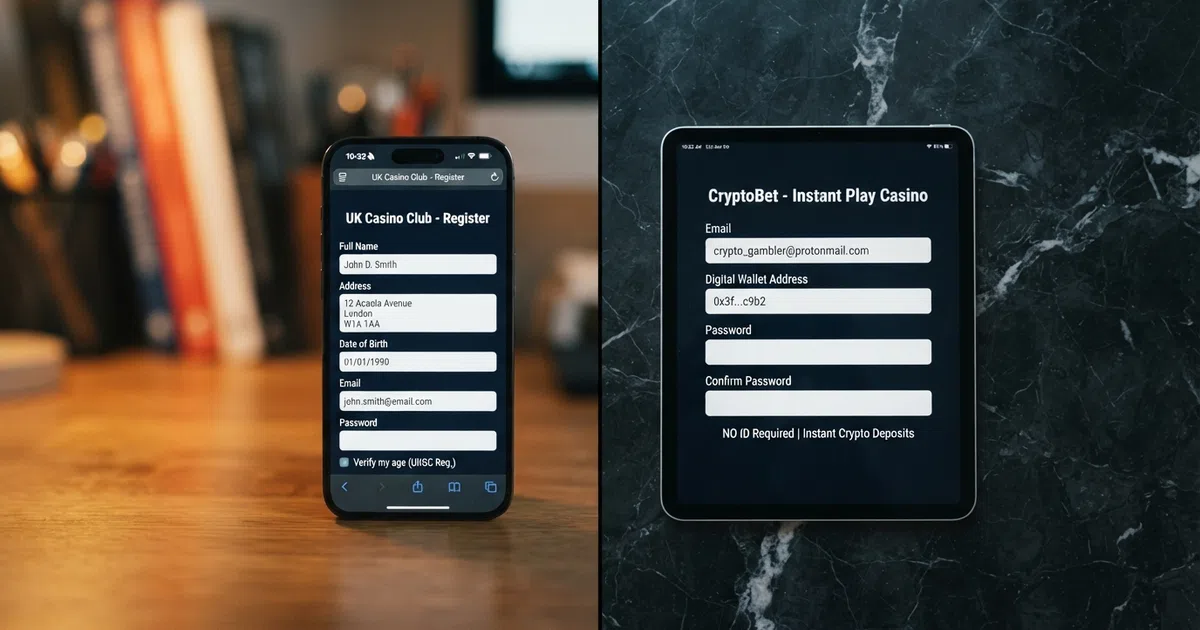
This page works through that tension honestly. The GB-licensed path (automated digital checks that complete in minutes) and the offshore path (genuinely no routine ID checks, but outside every British safeguard) are both here, with the cost of each laid out in the figures and the licence conditions that produce them. Ten operators are ranked across the two tiers; the legal framework, the withdrawal mechanics, the bonus maths, the slot catalogue, and the responsible-gambling infrastructure round out the picture.
Verified against the UK Gambling Commission public register as of 17 August 2026.
Why “No ID Verification” and a UK Casino Licence Cannot Coexist
The search term and a British casino licence are not two features on a slider a player can mix. They are mutually exclusive, because the licence requires the verification and the law backs it with criminal penalties for anyone who skips it.
The binding rule is LCCP Condition 17.1.1, in force since 7 May 2019. Every remote operator licensed in Great Britain must confirm a customer’s name, address, and date of birth before that customer deposits funds, places a bet, or uses a free spin or bonus. The pre-2019 grace period that allowed 72 hours of play before sending documents is gone; the same rule now applies whether the funds are the player’s own or the operator’s. Even a no-deposit free spins offer is “gambling” for the purposes of the condition, and verification must clear before the spins are credited. Automated providers such as Onfido and Jumio handle the digital checks; if those fail, the operator falls back to a document upload (passport, driving licence, recent utility bill). Without that pass, the account does not move past the registration wall.
The reason this matters to the keyword is direct. No GB-licensed casino can be a “no ID verification casino” because the licence itself forbids it. Any site marketing itself that way to UK players is, in regulatory terms, an offshore site offering gambling without a GB licence. Section 33 of the Gambling Act 2005 makes providing such facilities a criminal offence, carrying up to 51 weeks’ imprisonment and an unlimited fine. The criminal exposure sits with the operator, not the player, but the player inherits every consequence the licence would have prevented. The full list of those consequences, from GAMSTOP non-coverage to the absence of a 10× wagering cap, is enumerated later in this page.
What “no KYC really means” in the offshore market is worth stating plainly. No operator is truly verification-free at every threshold. Anti-money-laundering obligations apply in every jurisdiction a casino operates from, and even the most permissive crypto casino will request documents once cumulative activity crosses a certain line. What “no-KYC” actually means in practice is no verification up to a higher threshold, usually somewhere between £4,000 and £8,000 in cumulative crypto activity, with a document request triggered beyond that. The promise of total anonymity is a marketing line, not a legal one.
What “No ID Verification Casino” Means for a UK Player in 2026
The phrase is a search shortcut, not a regulatory category. In the UK market, it points at offshore and unlicensed operators, almost all of them crypto-first, licensed in Curaçao or, in one case, operating under a Costa Rican data-processing registration that is not a gambling licence at all. GB-licensed casinos cannot be no-ID by construction; offshore casinos are no-ID by choice, and the choice comes with a price measured in lost protections.
The distinction that matters is between “no verification at all” and “no routine verification below a threshold.” The first does not exist anywhere that handles fiat currency through regulated rails. The second is what the offshore market actually offers: signup with an email, deposit with crypto, play immediately, KYC reserved for fraud flags, AML triggers, or withdrawals above the threshold the operator publishes (or does not publish, which is itself a risk factor). At the smaller end of the market, where stakes are modest, the experience feels genuinely friction-free. At the larger end, the documents arrive whether the player expected them or not.
How Standard KYC Compares to the No-Verification Experience
A side-by-side walk through both paths makes the practical difference concrete. At a GB-licensed casino, signup takes an email and a password, then a screen asks for name, address, and date of birth. The operator runs an automated check against credit-reference and electoral-roll databases, often through a third party like Onfido or Jumio. Most checks clear in under a minute, with no document upload needed. If the check fails, the operator asks for a passport or driving licence and a recent utility bill, and the review is typically completed within hours. Only after verification does the deposit button unlock.
At an offshore no-KYC casino, the same signup takes an email and a crypto wallet address. The deposit screen shows a Bitcoin or USDT address, the funds arrive after on-chain confirmation, and play begins. There is no ID step at signup, no document request on the first few withdrawals, and no friction beyond the blockchain’s own settlement time. The player notices no difference until the first time the operator’s AML system flags a withdrawal, at which point the absence of a KYC file already on record slows the process rather than speeding it.
The honest comparison is not “which path is faster” (the offshore path is faster, and the difference is measurable in minutes versus hours), but “which path costs more when something goes wrong.” The GB path leaves a paper trail and a regulator; the offshore path leaves a wallet address and a customer-service queue.
Why Every GB-Licensed Casino Must Verify Your Identity Before You Play
This is not an operator preference or a brand-policy choice. It is a licensing condition with no exceptions, sitting inside a statute that makes ignoring it a criminal offence.
LCCP Condition 17.1.1 names the three data points (name, address, date of birth) and the moment at which they must be verified (before any deposit or gambling, with the customer’s own money or with a free bet or bonus). The Commission moved the moment earlier in May 2019, abolishing the 72-hour grace period that had allowed players to deposit and play before sending documents. That change closed the one route by which a GB-licensed site could have offered anything resembling the “no ID” experience. Today, the rule admits no gap.
The same KYC process that checks identity also enables the age-banded stake limits that followed: £5 per game cycle for players aged 25 and over (in force 9 April 2025) and £2 for players aged 18–24 (in force 21 May 2025). The Commission implemented both layers through the same licensing structure, with verification as the gateway. A casino that skipped ID could not apply the age-banded limits either, and a casino that skipped the stake limits would breach the operating licence conditions that came into force alongside them.
UK Casinos Ranked: From Instant Digital Checks to No Documents at All
Ten operators cover the two tiers the keyword describes. Five are GB-licensed, running automated digital verification that completes before a deposit is accepted. Five are offshore, operating without a GB licence and reserving identity checks for fraud or AML flags. Both tiers are reviewed below, on the same axes, so the comparison is direct.
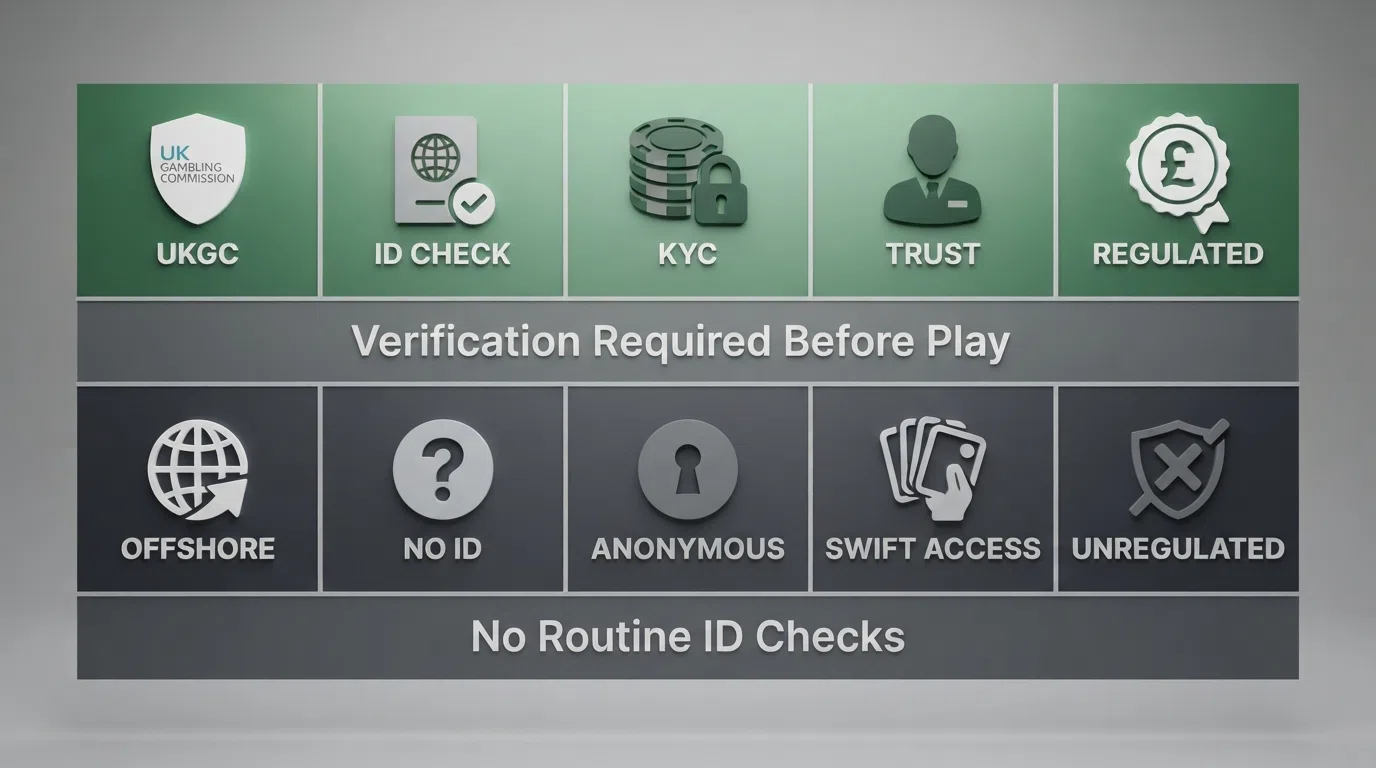
The ranking is qualitative. No criterion was weighted as a percentage. Licence status and regulatory standing came first (because a licence is the foundation of every other protection on this page), bonus terms and wagering came second, game catalogue and provider diversity came third, and the KYC approach was the defining axis that separated the two tiers. The UKGC public register, which holds 2,663 licence records and is searchable by business name, trading name, domain, or account number, was the reference for every licence claim. Operator websites were the source for bonus terms, and independent review databases covered KYC status and catalogue size.
The core trade-off the table shows is straightforward. GB-licensed operators trade a one-time ID check for the full British safer-gambling framework: GAMSTOP coverage, the 10× wagering cap, the £5/£2 stake limits, statutory game-design restrictions, ADR access, and UK court recourse. Offshore operators trade that framework for friction-free signup, crypto-native deposits, and a withdrawal experience that does not pause for a document request. No row in the table is a free lunch; each is a different bundle of trade-offs.
| Operator | Licence | GB Licence | Welcome Offer | Wagering | Slots | KYC Approach |
|---|---|---|---|---|---|---|
| Bet365 | UKGC | Active (acct 55149, WHG International) | Up to 500 Free Spins (£0.10/spin) | 10× | 1,000+ | Automated digital check before deposit |
| Sky Vegas | UKGC | Active (Flutter Entertainment) | Up to 200 Free Spins | 0× | 500+ | Automated digital check before deposit |
| Ladbrokes | UKGC | Active (Entain group) | 100 Free Spins + 300 LadBucks | 0× spins / 10× bonus | 1,000+ | Automated digital check before deposit |
| William Hill | UKGC | Active (acct 39225, WHG International) | 200 Free Spins on Big Bass Splash | 10× | 800+ | Automated digital check before deposit |
| Betfair | UKGC | Active (Flutter Entertainment) | 50 no-deposit + 100 Free Spins | 0× | 500+ | Automated digital check before deposit |
| Jackbit / Jack.com | Curaçao | None | 100 wager-free Free Spins (crypto) | 0× | 6,000+ | No routine ID; verification on fraud/AML flags only |
| BC.Game | Curaçao | Revoked December 2024 | Up to $4,000 + 400 Free Spins | Varies by tier | 8,000+ | No ID at signup; AML review above ~$2,000–$3,000 |
| Stake | Curaçao + 4 LATAM | Surrendered | No welcome offer (VIP focus) | N/A | 3,000+ | No routine verification; KYC at higher thresholds |
| Vave | Curaçao | None | 100% up to 1 BTC | Not specified | 6,000+ | No ID at signup; right to verify at any time |
| Cryptorino | Costa Rica (data-processing) | None | 100% up to 1 BTC | 66× | 6,000+ | No KYC; test withdrawal in 20 minutes |
Bet365 — GB-Licensed, Automated Digital Checks
Bet365 is the largest GB-licensed operator in the set, with a catalogue of more than 1,000 slots, an active UKGC licence (account 55149, WHG International), and a verification flow that completes before the first deposit is accepted. The welcome offer runs up to 500 Free Spins at £0.10 each, unlocked by a minimum £10 lifetime deposit and selected across ten prize tiers within 20 days of registration. Wagering on the bonus sits at 10×, the standard cap that applies to every GB-licensed casino from 19 January 2026.
Demo mode is available after verification, and the provider mix covers NetEnt, Pragmatic Play, Playtech, Microgames, and Evolution. The catalogue size and the live-dealer range make this a broad-market choice rather than a specialist one. For a player prioritising friction-free access under full British protection, the identity check is the cost of admission, and the automated flow keeps that cost to a few minutes in most cases. Verdict: the safe default for a UK player who wants a full-service casino and accepts the ID step as the trade for every protection that follows.
Sky Vegas — GB-Licensed, Zero-Wagering Free Spins
Sky Vegas is Flutter Entertainment’s slot-focused brand, and the welcome offer is the cleanest in the GB tier: up to 200 Free Spins at £0.10 each, credited after a £10 deposit and spend, with zero wagering on whatever the spins produce. Free spins expire in 7 days, and the qualifying deposit-and-spend must happen within 30 days of registration. Wagering of 0× sits well inside the 10× cap that took effect on 19 January 2026, so there is no tension between the offer and the regulation.
The catalogue runs to 500+ slots, with NetEnt, Pragmatic Play, Playtech, Evolution, and Blueprint as the main providers. Demo mode is available. The licence is active on the UKGC register. The only friction is the same one every GB-licensed operator carries: a digital KYC pass before the first deposit clears. For a player who values clarity over headline size, the zero-wagering structure removes the usual bonus-maths headache. Verdict: the simplest offer in the GB tier, with the fewest moving parts between signup and withdrawal.
Ladbrokes — GB-Licensed, Free Spins Plus LadBucks
Ladbrokes (Entain group) splits its welcome package into two parts: 100 Free Spins plus 300 LadBucks, both unlocked by depositing and spending £10 on slots. The free spins carry zero wagering and credit winnings as cash, while the £10 casino bonus carries 10× wagering with a maximum £2 stake per spin while bonus funds are active. Free spins expire in 7 days; the bonus wagering must be completed within 30 days.
The slot catalogue runs to 1,000+, with NetEnt, Pragmatic Play, Playtech, IGT, and Evolution as the headline providers. The LadBucks element is a cashable reward on top of the spins, which is unusual in the GB tier. Verification, as ever, is the price of admission, with the same LCCP 17.1.1 flow every GB-licensed site runs. The two-part structure is the only complexity; the maths is straightforward once the two wagering rates are separated. Verdict: the best GB option for a player who wants both zero-wagering spins and a cashable bonus element in the same package.
William Hill — GB-Licensed, Big Bass Splash Free Spins
William Hill (evoke; UKGC account 39225, WHG International Limited) offers 200 Free Spins on Big Bass Splash at £0.10 per spin, triggered by depositing and staking £10 or more. The spins carry 10× wagering on winnings, which must be completed within 72 hours, and the offer runs until 31 December 2026. The £30 maximum cashout from the free spins is the ceiling a player needs to know upfront: even a strong run on Big Bass Splash converts to no more than £30 withdrawable from this bonus.
The catalogue runs to 800+ slots, with NetEnt, Pragmatic Play, Playtech, Evolution, and IGT in the provider mix. Demo mode is available. The Big Bass Splash focus is the trade-off: the offer is a single-game package rather than a multi-game prize, and the £30 cap is the lowest among the GB welcome offers in this set. For a player who likes the Big Bass series and is comfortable with a small-bonus, short-window structure, the offer is a clean fit. Verdict: a named-slot offer with a hard cap, best suited to a player who has decided on the title before signing up.
Betfair — GB-Licensed, No-Deposit Free Spins With No Wagering
Betfair (Flutter Entertainment) is the only GB-licensed operator in the featured set offering no-deposit free spins: 50 Free Spins at £0.10 each, with no wagering on winnings, credited before any deposit. A second tranche of 100 Free Spins (also 0×) is unlocked by a £10 deposit. Both sets of spins expire 7 days from credit.
The catalogue runs to 500+ slots, with NetEnt, Pragmatic Play, Playtech, Evolution, and Blueprint as the provider mix. The licence is active on the UKGC register. The catch is the one every no-deposit offer carries inside the British system: verification must clear before the 50 free spins are playable. The same LCCP 17.1.1 condition that applies to every other form of gambling applies to a free bet or bonus, so even a no-deposit offer triggers the KYC gate. For a player who wants to test a GB-licensed casino without funding the account, the offer exists, but it is not a no-ID route. Verdict: the closest the GB tier comes to the keyword’s promise, though the ID step still sits before the spins are playable.
Jackbit / Jack.com — Curaçao-Licensed, Genuinely No Routine ID Checks
Jackbit is the closest the market gets to the “no ID” promise. The operator runs on a Curaçao licence (Ryker B.V., since 2022) and was rebranding to Jack.com from April 2026 at the time of the source review. There is no GB licence and no obligation to follow LCCP conditions. Verification is reserved for fraud or clear AML flags; there is no routine document request on cashout, and the welcome offer (100 wager-free Free Spins on a crypto deposit) is claimable without an ID step.
The catalogue runs to 6,000+ games from Pragmatic Play, NetEnt, Play’n GO, Evolution, Hacksaw, and Push Gaming, with demo mode on most titles. No published maximum cashout for crypto withdrawals means the ceiling is the operator’s internal risk policy rather than a figure a player can find in the terms. The trade-off is everything on the British side that follows from the missing licence: no GAMSTOP, no ADR, no 10× cap on any other bonus, no stake limits, no game-design restrictions, no UK court recourse. For a player who values the no-ID experience and accepts the gap, this is the cleanest expression of it. Verdict: the most genuinely no-KYC experience in the set, with a Curaçao licence as the only oversight layer.
BC.Game — Curaçao-Licensed, Former UKGC Operator With 8,000+ Games
BC.Game holds a Curaçao licence and previously held a UKGC licence, which was revoked in December 2024. The catalogue is the largest in the set, at 8,000+ games from 38+ providers, including Pragmatic Play, Evolution, Hacksaw, Push Gaming, and BC.Game’s proprietary BC Originals. The welcome offer runs up to $4,000 plus 400 Free Spins across the first four deposits, with wagering that varies by tier.
The KYC story is conditional rather than absolute. No ID is required at signup, but withdrawals above roughly $2,000–$3,000 can trigger an AML review, and the operator caps unverified monthly volume at approximately €10,000 (dropping to about €5,000 under its big-winner clause). Demo mode is available. The UKGC revocation matters for any player weighing the operator: the licence that once sat behind BC.Game is gone, and the operator is now outside the British system entirely. For a player who values catalogue size and accepts the conditional KYC threshold, the offer is large; for a player who values continuity of oversight, the revocation is the headline. Verdict: a large-catalogue, conditional-KYC option for a player who has read the AML thresholds and accepted what they mean for big-win withdrawals.
Stake — Curaçao-Licensed, UKGC Licence Surrendered, Provably Fair Originals
Stake operates under a Curaçao licence (Medium Rare N.V.) plus four Latin American market authorisations, and has surrendered its UKGC licence. There is no welcome offer; the operator runs a VIP and loyalty programme focus instead. The catalogue runs to 3,000+ games, including Stake’s proprietary Stake Originals, which are provably fair (a verifiable-randomness model that lets the player check each round’s outcome after the fact).
The provider mix covers Pragmatic Play, Evolution, Hacksaw, Push Gaming, and the proprietary titles. Demo mode is available, with provably fair verification on Stake Originals. KYC is absent for standard play but may be triggered at higher thresholds, and the operator’s terms reserve the right to verify at any point. The surrender of the UKGC licence puts Stake in the same regulatory position as the other offshore operators in this set; the provably fair framework is a partial substitute for the regulatory audit a GB licence would provide, but only for the proprietary titles. Verdict: a strong catalogue for a player who values the provably fair concept, and a clean fit for someone who already understands the operator’s VIP structure.
Vave — Curaçao-Licensed, Crypto-First With 6,000+ Titles
Vave runs on a Curaçao licence (TechOptions Group B.V.) with no GB licence. The welcome offer is a 100% match on the first deposit, up to 1 BTC. The wagering requirement is not specified in the reviewed sources, which is itself a risk factor: a player cannot calculate the bonus’s expected cost without that number, and the comparison to the GB tier’s 10× cap becomes impossible. KYC is absent at signup, but the operator reserves the right to verify at any time, with no published threshold. That reservation is worth reading carefully: “no threshold published” is not the same as “no threshold exists,” and a player who assumes the absence of a published number means the absence of a check will be surprised.
The catalogue runs to 6,000+ games from Pragmatic Play, Evolution, NetEnt, and Play’n GO, with demo mode available. For a player prioritising catalogue size and willing to accept an undisclosed wagering multiple and an unpublished KYC threshold, the offer is large in headline terms. The two gaps, however, are exactly the figures a player needs to make a decision, and their absence is information in itself. Verdict: a large-catalogue, headline-strong option for a player who treats the missing numbers as a warning rather than an oversight.
Cryptorino — Costa Rica Data-Processing Licence, No KYC at Any Threshold
Cryptorino is the most unusual licence profile in the set. The operator is registered in Costa Rica through Star Bright Media S.R.L. and runs on a data-processing registration rather than a gambling-specific licence. The catalogue is 6,000+ games from 70+ providers, including Pragmatic Play, Evolution, NetEnt, Play’n GO, and Hacksaw. The welcome offer is 100% up to 1 BTC, but the wagering requirement is 66×, the steepest in the set by a wide margin.
The KYC record is the strongest in the set: a test withdrawal landed in 20 minutes with no documents requested, and the minimum withdrawal is €10. There is no published maximum cashout. The licence profile is the trade-off. A data-processing registration is not a gambling licence; it does not carry the operator-side audit obligations a Curaçao or MGA licence would, and the dispute-resolution path is correspondingly thin. For a player who values the no-KYC experience above everything else and treats the licence gap as an accepted cost, the offer is fast and friction-free. Verdict: the fastest no-KYC withdrawal in the set, paired with the highest wagering requirement and the lightest licence.
What UK Law Says About Gambling Without Identity Checks
The UK regulatory framework makes genuine no-ID play impossible inside the GB system, by design. Three layers combine to produce that result: the statute, the licensing conditions, and the enforcement tools the Commission actually holds. Each layer is worth understanding separately.
The statute is the Gambling Act 2005, extended to remote operators serving GB customers by the Gambling (Licensing and Advertising) Act 2014. The 2014 reform is the “point-of-consumption” change that made a GB licence compulsory for any operator taking GB players, wherever the operator is based. Before 2014, an operator licensed in another jurisdiction could take GB customers; after 2014, the licence requirement moved to the player’s location, not the operator’s. The reform is the reason every offshore site in this page is operating illegally from a UK regulatory perspective, and it is the foundation for every other rule that follows.
The three licensing objectives, set out in Section 1 of the Gambling Act, are: preventing gambling from being a source of crime or disorder, ensuring gambling is conducted in a fair and open way, and protecting children and other vulnerable persons. KYC serves all three: it confirms age, it produces an audit trail for AML purposes, and it creates a customer record that the Commission can review. No other single condition touches all three objectives at once, which is why the Commission treats 17.1.1 as non-negotiable.
The enforcement layer is where the picture becomes more complicated. The Commission does not hold statutory ISP or DNS blocking powers; legislation has been proposed but not enacted. What it does have is disruption: cease-and-desist notices, search-engine delisting referrals (447,778 URLs were referred for delisting between April 2024 and June 2025), domain registrar pressure, and payment-provider referrals. The Commission’s enforcement record is substantial, but it works by making the unlicensed market harder to reach, not by cutting it off.
The Gambling Act 2005 and LCCP 17.1.1: The Law That Makes No-ID Play Impossible in Great Britain
The single licence condition that closes the door is 17.1.1. Verify name, address, and date of birth before any deposit or gambling, with the customer’s own money or a free bet or bonus. The 2019 abolition of the 72-hour grace period removed the last gap. The three licensing objectives in Section 1 of the Act are the policy foundation; the 2014 point-of-consumption reform is the jurisdictional foundation; 17.1.1 is the operational rule that makes no-ID play impossible in practice.
A reader looking for the legal reason an operator cannot offer no-ID play in GB will find it in three layers: the statute (Gambling Act 2005), the licensing condition (LCCP 17.1.1), and the regulator’s enforcement of both. Each layer reinforces the others, and the combined effect is the binary outcome a player searching for no-ID casinos encounters: the GB-licensed market does not offer it, and the offshore market offers it without the GB licence.
Anti-Money-Laundering Rules: The Other Reason Casinos Demand Your Documents
KYC is not only a licensing requirement; it is also an anti-money-laundering obligation under the Proceeds of Crime Act 2002 and the Money Laundering Regulations 2017. These rules apply to any firm handling fiat currency in the UK, and they create a second, independent legal duty to verify identity that exists alongside the Commission’s licensing conditions. Enhanced due diligence is triggered at higher deposit and withdrawal volumes; the thresholds vary by operator, but the principle does not.
For the offshore no-KYC market, the practical effect is that no operator handling GBP balances or fiat payment rails can skip AML entirely. The crypto-only operators in this set (Cryptorino, in particular) reduce their exposure by staying outside the fiat system, but the AML obligation does not disappear; it shifts. An offshore casino handling only crypto still has duties under its own jurisdiction’s AML regime, and at sufficient volume the verification request arrives whether the operator published a threshold or not. The GB-specific layer on top of this is the £150 net-deposit financial vulnerability check (in force since 28 February 2025), which uses publicly available data (CCJs, IVAs, bankruptcy orders) and applies only inside the GB system.
The conclusion for a player weighing the keyword is direct. AML is not jurisdiction-optional. Even the most permissive crypto casino will verify at some point, and the difference between a GB-licensed and an offshore site is not “verification versus no verification” but “verification at signup versus verification at the threshold the operator publishes (or does not publish).”
Offshore Casinos Accepting UK Players: What the Law Says About the Operator and the Player
The legal position splits cleanly between operator and player. The operator is exposed. Section 33 of the Gambling Act 2005 makes providing facilities for gambling without the required licence a criminal offence, carrying up to 51 weeks’ imprisonment, an unlimited fine, or both. The Commission enforces this through disruption notices, search-engine delisting referrals (447,778 URLs referred between April 2024 and June 2025), domain registrar pressure, and payment-provider referrals, but not through prosecution of players. There is no established penalty for a British resident who merely gambles on an unlicensed site. The loss is protection, not liberty.
The practical consequences for a player at an offshore site flow from the absence of UK oversight, not from any new legal exposure. The site may disappear; the operator may freeze funds pending an AML review; the dispute resolution path is the operator’s own customer service, with no ADR escalation and no UK court jurisdiction. A player who treats an offshore site as a substitute for a GB-licensed one is trading the regulatory safety net for a friction-free signup, and the safety net is the only thing that gives a complaint a path forward.
The BC.Game case is worth naming. BC.Game once held a UKGC licence, which was revoked in December 2024. The site continues to operate under a Curaçao licence and accepts players from jurisdictions it is licensed for. The revocation is a live example of the licence action the Commission takes when its conditions are breached, and the operator’s continued operation is a live example of what “offshore” looks like in practice: the same product, the same games, the same players, but outside the British system.
The Nine Protections You Lose When You Step Outside the GB Licensing System
A structured accounting of every GB-mandated safeguard that an offshore no-KYC casino is not required to provide. The price of skipping ID checks, in other words, is the entire player-protection framework.
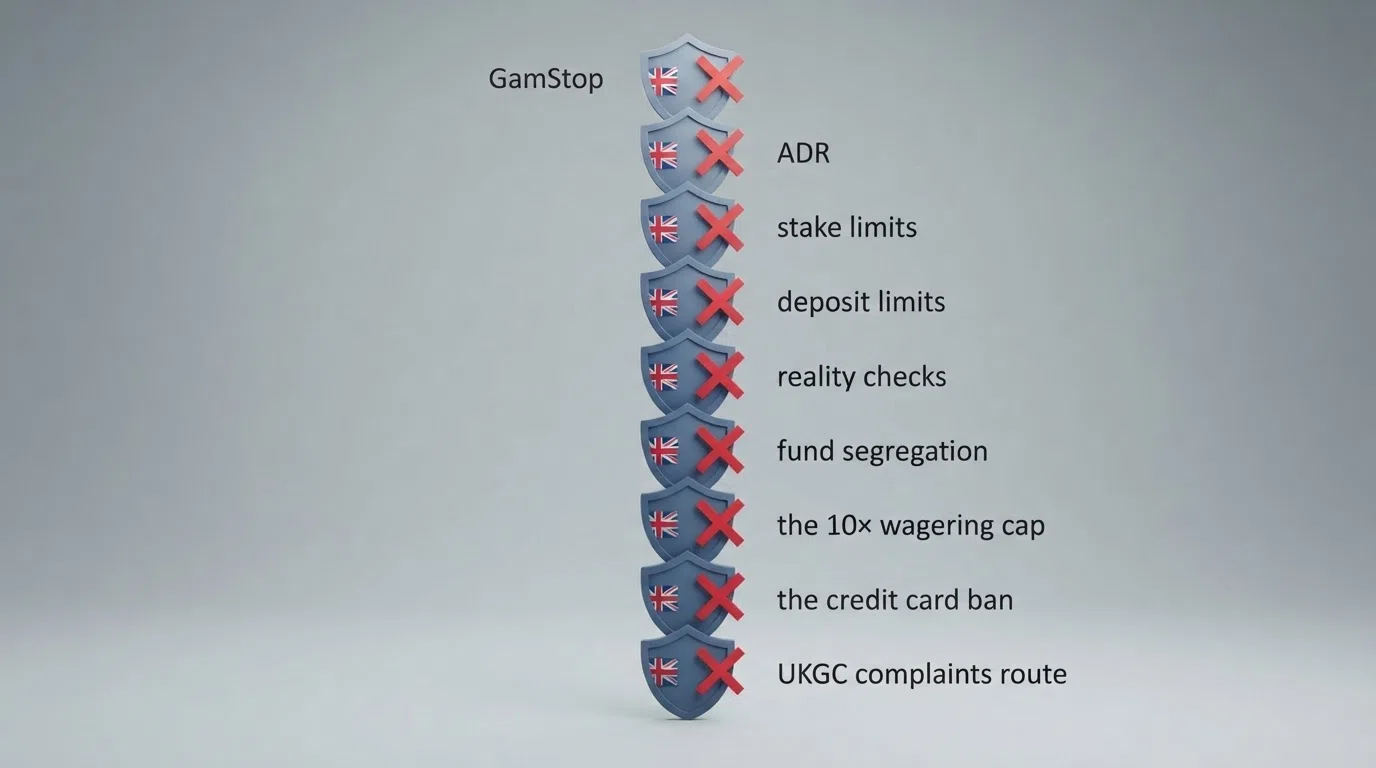
- GAMSTOP coverage. The national self-exclusion scheme is mandatory for every UKGC online operating licence (since 31 March 2020). An unlicensed operator has no obligation to check the register, and the scheme cannot reach the site. An excluded player who searches for no-ID casinos is walking directly into the gap.
- UKGC complaints route. The Commission handles complaints about GB-licensed operators when the operator’s own process has been exhausted. An offshore site sits outside the Commission’s jurisdiction, and the complaints path ends with the operator.
- Approved ADR provider. Every GB-licensed casino must offer access to an alternative dispute resolution provider. An offshore site may offer its own escalation route or none at all.
- British consumer protection if funds are withheld. Section 33 of the Gambling Act makes the operator’s conduct a criminal offence, but it does not give the player a private right of action to recover funds. A player at an offshore site has no British consumer protection framework to invoke.
- Guaranteed fund segregation. GB-licensed operators must hold customer funds in segregated accounts. Curaçao licence conditions exist but are inconsistently audited; data-processing registrations (as in the Cryptorino case) carry no segregation requirement at all.
- Statutory stake limits and game-design protections. The £5/£2 per-game-cycle stake cap (age-banded, in force from April and May 2025), the 2.5-second minimum spin speed, the auto-play ban, the losses-disguised-as-wins ban, the reverse-withdrawals ban (all in force since 31 October 2021) apply only at GB-licensed sites.
- 10× wagering cap on bonuses. In force at every GB-licensed site from 19 January 2026. Offshore sites commonly apply 40× to 80×; Cryptorino’s 66× sits in the middle of that range.
- Financial vulnerability checks and affordability protections. The £150 net-deposit check (in force since 28 February 2025) and the customer-set financial limit (mandatory from 31 October 2025) are GB-specific and have no offshore equivalent.
- Recourse to UK courts. The operator is outside GB jurisdiction. A player whose withdrawal is refused has the casino’s customer service, possibly an e-mediator in the operator’s licensing jurisdiction, and no UK court to apply to.
GamStop Cannot Reach an Unlicensed Site: Self-Exclusion Outside the British System
GAMSTOP is licence-bound. The scheme is mandatory for every UKGC online operating licence (since 31 March 2020) and tied to the operating licence itself. An unlicensed operator has no obligation to check the register and no technical integration with the scheme. Exclusion periods run to six months, one year, or five years (or five years with auto-renewal), and they cannot be cancelled early. For a player self-excluded from British gambling, the gap that opens when they search for “no ID casino” is the gap GAMSTOP cannot close.
The practical scenario is direct. A self-excluded player cannot deposit at any GB-licensed casino; the operator checks the register at signup, the exclusion is on file, and the account is blocked. At an offshore no-KYC casino, the register is never queried. The only barrier is the operator’s own AML threshold, and the only protection is the player’s own commitment to the exclusion. The combination of “no ID” and “no licence” produces exactly the failure mode GAMSTOP was designed to prevent.
How Withdrawals Work When Nobody Asks for Your Passport
The withdrawal experience is the main reason players search for no-ID casinos. The promise is the one the marketing uses: deposit, play, withdraw, and never send a document. The reality is that the promise holds, with caveats, up to a threshold, and falls apart past it.
The typical no-KYC flow runs: request a withdrawal, the operator’s automated system processes it, the funds move to the crypto wallet, and the player sees them arrive in minutes to hours. BTC transfers via automated hot wallets confirm in 10 to 60 minutes; manual approval queues (used for larger amounts or unusual activity patterns) can take up to 24 hours. The Cryptorino test withdrawal in 20 minutes is at the fast end of this range; BC.Game’s AML review window at ~$2,000–$3,000 is the threshold the operator has chosen; Vave reserves the right to verify at any time without publishing a number. Jackbit explicitly reserves verification for fraud or AML flags, which is the closest to a “no documents at withdrawal” promise the market offers.
The threshold is the part the marketing tends to understate. The £4,000–£8,000 range covers most no-KYC sites’ cumulative crypto activity, above which even the most permissive operator will request documents. A player who wins a large amount and tries to withdraw it without having verified first will discover the threshold by hitting it. The maximum cashout caps that some operators publish (BC.Game’s ~€10,000 monthly unverified, dropping to ~€5,000 under the big-winner clause) operate as soft caps, enforced by the AML system rather than the cashier interface.
No-ID Withdrawals: The Process, the Speed, and the Limits
The mechanics at a no-KYC casino are simpler than the equivalent at a GB-licensed site but less forgiving when the AML system flags a withdrawal. The first few withdrawals, in the small-amount range, move through automated hot-wallet systems with no operator intervention. A test withdrawal at Cryptorino landed in 20 minutes; Jackbit’s standard practice is no routine document request on cashout. The speed advantage over a GB-licensed site (where the cashier can take 24–72 hours even for a verified player) is real and measurable.
Above the threshold, the same operators apply verification. The request arrives by email, the upload portal opens, and the review process is the same as at a GB-licensed site, except the file is being created from scratch rather than read from the existing KYC record. The process takes hours to days, depending on the operator’s review queue. A player who planned around the “no documents” promise and is asked for them at withdrawal will find the experience slower than if the verification had been done at signup.
The published limits that exist (BC.Game’s monthly cap, the absence of a published cap at Jackbit and Cryptorino) are the operator’s internal risk policy expressed in different ways. A published cap is a constraint a player can plan around; an unpublished cap is a constraint a player discovers by reaching it.
Payment Methods That Work Without Identity Documents: Crypto, E-Wallets, and Mobile Billing
The payment method determines whether the no-ID experience holds. Cryptocurrency is the no-KYC default: BTC, ETH, USDT, LTC, XMR all move without a bank intermediary and without a GBP account, and the on-chain settlement is the entire transaction. E-wallets sit in a middle ground, with fewer document requests than bank transfers but a traceable trail that the e-wallet provider itself has already captured. Pay-by-mobile is a deposit-only option, with low deposit ceilings and no withdrawal route. Bank transfer and debit card are effectively incompatible with no-KYC gambling, because every bank in the chain has KYC obligations and every debit card links to a verified bank account.
The fiat-side complication is regulatory. Credit cards have been banned for all remote gambling at GB-licensed sites since 14 April 2020, including credit-card-funded e-wallet payments, which removes the most frictionless fiat rail from the British market. Offshore no-KYC casinos are not bound by the ban, but the payment processors they work with often are, and the practical effect is that even the offshore market relies on crypto rails for genuine no-ID deposits. The Cryptorino case (crypto-only) and the Jackbit case (crypto deposit for the wager-free spins) reflect this: the operators that promise no-ID play are the ones that have built their cashier around crypto.
A reader weighing the payment-method question should expect the no-ID experience to require crypto. Fiat rails (debit card, bank transfer) are available at some offshore sites but typically trigger a verification step at deposit, not withdrawal, and a player who chose the offshore path to skip verification is not helped by a deposit-time check.
No-ID Bonuses: What You Gain in Speed, What You Lose in Protections
The bonus landscape splits cleanly along the licence line. GB-licensed offers (10× wagering cap, zero-wagering free spins common, structured terms) sit on one side. Offshore offers (large headline numbers, high wagering, no regulatory cap) sit on the other. The difference is not just in the size of the bonus; it is in the cost of clearing it, which is the number the marketing does not show.
The 10× cap, in force at every GB-licensed site from 19 January 2026, is the regulatory floor that makes the GB offer mathematically safer. A £100 bonus at 10× wagering means £1,000 of turnover, which at a 96.5% RTP produces an expected loss of about £35. The same £100 bonus at 66× wagering (the Cryptorino rate) means £6,600 of turnover, producing an expected loss of about £231. The headline numbers at offshore sites can be larger (100% up to 1 BTC; up to $4,000 + 400 free spins) but the clearing cost is correspondingly larger, and the absence of a regulatory cap means the multiplier is set by the operator rather than by the Commission.
The specific calculation: with a £100 bonus and Gates of Olympus’s 96.50% RTP, the UKGC-cap expected loss is £1,000 × (1 − 0.965) = £35. The same £100 bonus at Cryptorino’s 66× wagering produces turnover of £6,600 and an expected loss of £6,600 × (1 − 0.965) = £231. The difference (£231 − £35 = £196) is the cost of the regulatory gap, expressed in expected loss per £100 of bonus. Where an offshore bonus is wager-free (Jackbit’s 100 free spins on crypto deposit), the multiplier is 0× and the expected cost drops to the slot’s own house edge; where the multiplier is not specified (Vave), the player cannot calculate the cost at all.
These are statistical estimates averaged over many spins under the stated assumptions, not guaranteed outcomes for any individual player. A single session can produce a win or a loss well outside the expected range. The expected loss is the cost of the offer over a large number of clears, and it is the figure that makes the GB vs offshore comparison concrete.
No-Deposit Bonuses and Free Spins at Casinos That Skip ID
The offer the keyword demands is the one that is hardest to find honestly. A true no-deposit, no-ID bonus is rare because the casino has no customer identity to prevent multi-accounting, and multi-accounting is the failure mode that no-deposit offers invite. The closest the GB tier comes is Betfair’s 50 no-deposit free spins (0× wagering) — but LCCP 17.1.1 still requires the KYC pass before those spins are playable, so the offer is no-deposit but not no-ID. The closest the offshore tier comes is Jackbit’s 100 wager-free free spins, but the “no-deposit” element is replaced by a “crypto deposit” requirement, and the offer is no-ID but not no-deposit.
The structural truth is that the no-deposit and no-ID offers occupy different cells. No-deposit requires a KYC file to prevent abuse; no-ID requires a deposit (or a crypto balance already on file) to make the offer economically viable. A player who wants both, simultaneously and unconditionally, is asking for an offer the market is not set up to provide.
The wagering terms at offshore sites make the gap clear. Cryptorino’s 66× wagering on a 100% up to 1 BTC bonus is steep enough to wipe most bonus-derived winnings before the cashout cap arrives. Jackbit’s 0× wagering on its crypto-deposit free spins is the cleanest structure in the offshore tier. A player who values the no-ID experience and the bonus economics together should look for the 0× offer first, the 10× offer second, and the high-multiplier offer last.
Welcome Offers and Match Bonuses: The GB-Licensed vs Offshore Difference
A direct comparison of the welcome packages in the set, with the headline number, the wagering multiple, the validity window, and the cashout ceiling each named. The split between the two tiers is sharp.
GB-licensed offers all sit at or below the 10× cap, with zero-wagering free spins the dominant structure. Bet365’s up to 500 free spins at 10× wagering and 20-day selection window; Sky Vegas’s 200 free spins at 0× and 7-day expiry; Ladbrokes’s 100 free spins plus 300 LadBucks with 0× on spins and 10× on the bonus; William Hill’s 200 free spins on Big Bass Splash at 10× with a £30 cashout cap and 72-hour window; Betfair’s 50 no-deposit plus 100 free spins at 0×. Every one of these is structured, capped, and audited under the GB regulatory framework.
Offshore offers run to larger headline numbers and higher wagering multiples. Jackbit’s 100 wager-free free spins on crypto deposit; BC.Game’s up to $4,000 plus 400 free spins with variable wagering; Vave’s 100% up to 1 BTC with wagering not specified; Cryptorino’s 100% up to 1 BTC at 66×. Stake has no welcome offer and runs a VIP/loyalty programme focus instead. The variance between these offers is wider than in the GB tier, and the absence of a cap means the worst case (66× at Cryptorino) is the most expensive bonus-to-clear in the set.
Wagering Requirements: UKGC 10× Cap vs Offshore Multipliers — and What Each Costs You
The single number that determines whether a bonus is worth claiming. The 10× cap (in force from 19 January 2026) is the ceiling at every GB-licensed site; offshore sites commonly apply 40× to 80×, with Cryptorino at 66× as the specific example in this set, BC.Game varying by tier, Jackbit at 0× on its specific offer, and Vave not specifying. The expected-loss calculation above makes the gap concrete: the same £100 bonus costs about £35 in expected loss under the 10× cap, and about £231 under the 66× multiplier, a difference of £196 per £100 of bonus.
The conversion formula is direct. Turnover equals the bonus amount multiplied by the wagering factor. Expected loss equals turnover multiplied by (1 minus the RTP). At a 96.5% RTP (Gates of Olympus’s top tier), the expected loss per £100 of bonus is £3.50 per multiple. The 10× cap produces £35 per £100 bonus; the 66× multiplier produces £231 per £100. A player who clears bonuses at scale (10 clears of a £100 bonus, for example) loses about £350 under the cap and about £2,310 at 66×, for the same bonus total.
Where wagering is not disclosed (Vave), the player cannot calculate the cost, and the offer is therefore uncomparable. The 10× cap and the offshore multiples are the figures that make the comparison possible; their absence is itself a data point.
Slots Without Verification: The Titles, the RTPs, and the Trade-Off
UK players can access thousands of slots without sending documents, but the slot experience at a no-KYC casino is not the same as the slot experience at a GB-licensed site. The differences fall into three categories: the catalogue size, the RTP configuration, and the game-design protections that are absent offshore.
The catalogue sizes range from 500+ at the smaller GB operators (Sky Vegas, Betfair) to 8,000+ at BC.Game, with most offshore operators in the 3,000–6,000 range. The size difference reflects the GB certification bottleneck; offshore operators can aggregate from any provider willing to integrate, while GB-licensed operators must work with providers that have passed the Commission’s technical standards. The trade-off is breadth for the offshore player, certification for the GB player.
RTP is the figure that does the work in any slot session, and RTP is not one number per game. Pragmatic Play deploys three RTP tiers: 96.50%, 95.51%, and 94.50%. NetEnt’s Starburst has a theoretical maximum of 96.09%, but most UK casinos deploy 94.05% or 92.05%. The same game, in other words, can run at materially different RTPs depending on the operator and the jurisdiction, and the player typically cannot tell which tier is active without checking the in-game help file. At an offshore casino, the deployed tier is not enforced by the regulator, and a player who assumes Tier 1 may be playing Tier 3.
The game-design protections (auto-play ban, 2.5-second minimum spin speed, losses-disguised-as-wins ban, reverse-withdrawals ban) are in force at every GB-licensed site since 31 October 2021. Offshore sites are not bound by them. Auto-play is available; spin speed is unrestricted; LDWs are not banned; reverse withdrawals may be permitted. The session experience at an offshore casino can be faster, with fewer breaks, and with visual cues (LDWs) that the GB regulator has determined mislead players about the outcome.
| Slot Title | Provider | RTP | Volatility |
|---|---|---|---|
| Book of Dead | Play’n GO | 96.21% | High |
| Gates of Olympus | Pragmatic Play | 96.50% | High |
| Big Bass Bonanza | Pragmatic Play | 96.71% | High |
| Starburst | NetEnt | 96.09% (max; 94.05%/92.05% in most UK configs) | Low |
The Slot Catalogues Compared: From 500 to 8,000 Titles
Catalogue size is the most visible difference between the two tiers. Bet365 sits at 1,000+, Sky Vegas and Betfair at 500+, Ladbrokes at 1,000+, William Hill at 800+, and the offshore operators from 3,000+ (Stake) to 6,000+ (Jackbit, Vave, Cryptorino) to 8,000+ (BC.Game). The reason for the gap is regulatory: GB-licensed operators work with providers that have passed the Commission’s technical standards, and that list is shorter than the global provider pool.
The provider overlap is partial. Pragmatic Play, NetEnt, Evolution, and Play’n GO appear in both tiers. The catalogue size at offshore operators comes from aggregating additional providers (Hacksaw, Push Gaming, and smaller studios) that may not hold GB certification. The trade-off is breadth against audit: more titles, fewer independently certified by the British regulator.
The RTP-tier issue cuts across the catalogue. A player who plays Gates of Olympus at a GB-licensed casino is most likely on the 96.50% tier; the same game at an offshore casino could be on 95.51% or 94.50%, with the player unable to verify which. The slot table above uses the top-tier RTP for each title, but the deployed tier at any specific operator may be lower, and the difference over a session of several hundred spins is meaningful.
Real-Money Slot Play Without Sending a Passport
The core promise of the keyword, played out at the offshore casinos where it is possible. The flow is direct: crypto deposit, play immediately, withdrawal without routine document request, provided cumulative activity stays below the AML threshold. The slot experience is otherwise similar to a GB-licensed site, with the same game mechanics, the same pay tables, the same bonus features. The differences are the protections that are absent.
Auto-play is available, which means the player can set a number of spins and let the game run. Spin speed is not capped at 2.5 seconds. Losses disguised as wins (LDWs, slot features that present a winning outcome with celebratory sounds despite the net result being a loss) are not banned. Reverse withdrawals (cancelling a withdrawal request to keep playing) are not prohibited. The session can be faster, with fewer breaks, with visual cues the GB regulator has determined to be misleading. None of these are illegal; all of them are permitted at a Curaçao-licensed or Costa Rica–registered site in a way they are not at a GB-licensed one.
The AML threshold is the only brake. A player whose cumulative activity crosses the operator’s published (or unpublished) threshold will trigger a document request, and the verification that was skipped at signup arrives at withdrawal time. The flow reverses at that point: the offshore site, which moved faster at the start, moves slower at the end. The GB-licensed site, which moved slower at the start, has the file already on record and processes the withdrawal as a routine action.
Free-Play and Demo Mode: Playing Slots Without an Account
Demo mode is the one route that works everywhere. No account, no deposit, no ID, at both GB-licensed and offshore casinos. The games load in the browser, the player uses a virtual balance, and the experience is the same as real-money play except for the absence of a stake. All ten operators in the set offer demo mode, which makes it the closest thing to a no-verification, no-commitment route into the games.
The differences are subtle. At a GB-licensed site, demo mode may still require account creation after KYC, in line with the Commission’s responsible-gambling framework. At an offshore site, demo mode is often accessible without any account. The RTP configuration may differ between demo and real-money mode at the same operator, which is a subtlety the player cannot detect from the game interface. What demo mode is good for: testing games, learning mechanics, checking the visual style. What it cannot do: produce real-money wins, support withdrawals, qualify for bonus offers.
For a player deciding between two offshore operators, demo mode is the cheapest way to compare. The same Pragmatic Play title, loaded in demo mode at two different sites, will reveal any obvious differences in presentation, but the RTP tier deployed in real-money mode is not visible in demo mode at all. The published RTPs in the slot table above are the top-tier figures; the deployed tier is a separate question.
Slot RTP and Volatility: What the Numbers Mean When Verification Is Off the Table
RTP (return to player) is the long-run percentage of stakes a slot returns to players, expressed as a number between 0% and 100%. A 96% RTP slot returns, on average, £96 for every £100 staked over a very large number of spins. Volatility is the distribution of outcomes around that average: high-volatility slots pay less often but in larger amounts, and low-volatility slots pay more often but in smaller amounts. The two numbers together describe what a session feels like and what it costs in the long run.
The RTP tier system is the part the keyword makes newly relevant. Pragmatic Play deploys three tiers: 96.50% (Tier 1), 95.51% (Tier 2), 94.50% (Tier 3). The same Gates of Olympus title at three different operators can return three different long-run rates, and the player typically cannot tell which tier is active without reading the in-game help file. NetEnt’s Starburst has a theoretical maximum of 96.09%, but most UK casinos deploy 94.05% or 92.05%, with the top tier available only at a minority of sites. The deployed tier matters: the difference between 96.50% and 94.50% is two percentage points of stake, which compounds over a session of several hundred spins.
The four titles in the slot table above are the ones with verified RTP figures from the source review: Book of Dead at 96.21% (high volatility, Play’n GO), Gates of Olympus at 96.50% (high volatility, Pragmatic Play, three tiers), Big Bass Bonanza at 96.71% (high volatility, Pragmatic Play), Starburst at 96.09% max with 94.05% or 92.05% in most UK configurations (low volatility, NetEnt). At an offshore casino, the deployed tier is typically not enforced by the regulator, and a player who assumes the top tier is playing the top tier at their own risk.
Why Crypto Is the Engine Behind Every No-KYC Casino
Cryptocurrency is not a feature of no-KYC casinos; it is the enabling infrastructure. Every fiat payment rail (bank transfer, debit card, e-wallet) leaves an identity trail that a regulator or a payment processor can follow. Crypto moves without that trail, at the cost of the consumer protections a bank account provides. The no-ID market exists because crypto makes it possible; without crypto, anonymous gambling at scale would not exist, because every fiat path leads back to a verified identity.
The five offshore operators in this set are all crypto-first. Jackbit takes crypto for its wager-free free spins. BC.Game is built around multi-currency play with proprietary BC Originals. Stake runs crypto-native with provably fair Stake Originals. Vave’s welcome offer is denominated in BTC. Cryptorino is crypto-only, with no fiat rails at all. The pattern is consistent: the no-ID proposition is built on a crypto cashier, and the operators that promise no-ID play are the ones that have built their cashier around it.
Bitcoin Casinos Where UK Players Face No ID Checks
The five offshore operators in the set all accept Bitcoin and other cryptocurrencies, and they all sit outside the GB licensing system. The licence regimes vary: Jackbit on Curaçao (Ryker B.V.); BC.Game on Curaçao after the UKGC revocation; Stake on Curaçao plus four Latin American authorisations; Vave on Curaçao (TechOptions Group B.V.); Cryptorino on a Costa Rican data-processing registration. None holds a GB licence. A BTC deposit at any of them enables instant play, with the on-chain confirmation as the only settlement delay, and a withdrawal to a personal wallet without document upload, provided cumulative activity stays below the AML threshold.
The GBP friction is worth naming. Crypto casinos rarely offer GBP-denominated accounts, which means the player carries the exchange-rate risk on every deposit and withdrawal. A player depositing £500 worth of BTC at one price and withdrawing at another may see the GBP value of the balance change between the two points, independent of any win or loss on the games. The crypto experience is faster and more private than the fiat experience, but it adds a layer of currency risk a GBP account would not.
Why Crypto Enables Anonymity in a Way Fiat Payments Cannot
The technical reason is the absence of intermediaries. The fiat payment chain runs from the player to the player’s bank to a payment processor to an acquiring bank to the casino; every link has KYC obligations under AML regulations, and every link can be queried by a regulator or law enforcement. The crypto payment chain runs from the player to a wallet to the blockchain to the casino’s wallet; no intermediary has a KYC duty, and the only on-chain data is the wallet address and the transaction.
The practical limit is the fiat on-ramp. Buying crypto in the first place usually requires ID, because the major exchanges (Coinbase, Kraken, Binance UK) all run KYC on their GBP on-ramps. A player who buys BTC through a KYC’d exchange and deposits at a no-KYC casino has not achieved true anonymity; they have moved the verification step from the casino to the exchange. The crypto experience is private in the casino-customer relationship, not in the source-of-funds relationship. A player who wants true anonymity buys crypto through a non-KYC route (peer-to-peer, Bitcoin ATMs without ID limits), and the smaller the amounts, the more feasible that path is.
The AML obligations do not disappear. The casino still has duties under its own jurisdiction’s AML regime, and at sufficient volume the verification request arrives. The crypto path shifts the timing of verification from signup to threshold, and the operator’s discretion over the threshold is the lever that determines when. Vave’s “right to verify at any time” is the broadest version of that lever; Jackbit’s fraud-and-AML-flags-only is the narrowest.
Depositing and Withdrawing With Cryptocurrency: Speed, Limits, and Practical Risk
The crypto cashier is faster than the fiat cashier at every step. Deposits confirm on-chain in 10–60 minutes for BTC, faster for ETH and USDT. Withdrawals through automated hot wallets land in minutes; manual approval queues can take up to 24 hours. The Cryptorino test withdrawal in 20 minutes is at the fast end of the range. The minimum withdrawal at Cryptorino is €10. BC.Game’s monthly cap for unverified accounts is approximately €10,000, dropping to ~€5,000 under the big-winner clause. Jackbit publishes no maximum for crypto withdrawals. The numbers are operator-specific and outside the GB regulatory framework, which is both the appeal and the risk.
The risk of sending crypto to an unlicensed operator is the inverse of the speed. There is no UK court to apply to if the operator refuses to release funds. There is no ADR provider. The wallet address is the only identifier the casino holds, and a dispute leaves the player with no leverage beyond the operator’s own customer service. The crypto path optimises for the case where everything works, and the absence of recourse is the price when it does not. A player who treats the offshore crypto path as a low-friction way to access games and a separate question from what happens at dispute time is being honest about the trade-off.
The Safety Net You Leave Behind at an Unlicensed Casino
Responsible-gambling protections are not an optional extra in the GB system; they are statutory requirements built into every licence. Every one of them is absent at an offshore no-KYC casino. The prevalence data shows why this matters: approximately 2.4% of adults in Great Britain scored 8+ on the Problem Gambling Severity Index in 2025 (GSGB Year 3, confidence interval 1.9%–2.8%), and GamCare’s National Gambling Helpline made 996 referrals to treatment in January 2026, up 48% year-on-year from 674 in January 2025. The protection framework exists because the problem exists, and the framework is what the offshore path trades away.
The infrastructure that remains available regardless of where a player gambled is the help infrastructure: GamCare, the National Gambling Helpline, the NHS gambling harm clinics, Gamblers Anonymous, and the National Gambling Support Network. These are not offshore replacements; they are British services that accept referrals from anyone with a gambling problem, including players who gambled on unlicensed sites.
Self-Exclusion: What GamStop Covers — and the Offshore Sites It Cannot Reach
GAMSTOP is the British national self-exclusion scheme, mandatory for every UKGC online operating licence since 31 March 2020. The mechanics are direct: a player registers, selects an exclusion period (six months, one year, five years, or five years with auto-renewal), and is blocked from every GB-licensed casino and bookmaker. The exclusion cannot be cancelled early, and the scheme is enforced at the operator level through integration with the operator’s signup and login systems.
The scheme is licence-bound. An unlicensed operator has no obligation to check the GAMSTOP register, and no technical integration exists. A self-excluded player who searches for “no ID casino” and signs up at an offshore no-KYC casino is not protected by the exclusion they registered. The only barrier is the operator’s own AML threshold, and the only safeguard is the player’s own commitment. The combination of “no ID” and “no licence” produces exactly the failure mode GAMSTOP was designed to prevent, and the absence of ISP blocking (the Commission does not currently hold that power) means the unlicensed site remains accessible to a self-excluded player who looks for it.
The SENSE scheme (the land-based casino self-exclusion) is a separate, complementary tool, also tied to British licensed premises. It does not extend to offshore sites either. A self-excluded player who needs the protection needs to stay inside the licensed market; the offshore market does not honour the exclusion.
Deposit Limits, Reality Checks, and Time-Outs: Tools an Unlicensed Casino Will Not Offer
The GB mandatory responsible-gambling tools are structured into the licensing conditions, and every GB-licensed site must offer them. From 31 October 2025, operators must prompt customers to set a financial limit before the first deposit; from 30 September 2026, a gross deposit limit must be offered and only that form may be called a “deposit limit” (RTS 12). Reality checks arrive at prescribed intervals during play. Time-out and cooling-off periods are available. The £150 net-deposit financial vulnerability check (in force since 28 February 2025) runs in the background using publicly available data (CCJs, IVAs, bankruptcy orders). The statutory stake limits (£5/£2 per game cycle, age-banded) cap the size of a single bet.
The offshore reality is the absence of all of this. No deposit limits are enforced; the player sets their own boundary or plays without one. No reality checks interrupt the session. No time-outs are imposed. No £150 vulnerability check runs in the background. No stake cap applies. The only brake on spend is the player’s own discipline, and the casino’s incentive structure (every additional spin is additional revenue) is not aligned with the player’s interest in stopping. A player who needs the GB protection framework to control their play is making a serious mistake by moving offshore, because the framework is the protection.
The affordability-check regime (financial risk assessments at higher deposit levels) is the next layer the Commission is preparing, with Stage 1 thresholds at £5,000 net deposit in 24 hours. The start date has not been confirmed at the time of writing. When it begins, it will apply at GB-licensed sites only, and the offshore gap will widen further.
Where to Get Help: GamCare, the National Gambling Helpline, and NHS Clinics
Problem gambling support in Great Britain is free, confidential, and available 24/7, regardless of where the gambling happened.
- National Gambling Helpline (operated by GamCare): 0808 8020 133, free and confidential, 24/7, plus live chat. GamCare made 996 referrals to treatment and peer-based support services in January 2026, up 48% year-on-year from 674 in January 2025.
- National Gambling Support Network: funded by GambleAware; provides treatment and recovery support across England, Scotland, and Wales.
- NHS gambling harm clinics: operate in England, Scotland, and Wales; offer specialist treatment for problem gambling.
- Gamblers Anonymous: peer-support meetings across the UK; a fellowship-based recovery route.
- GAMSTOP: national self-exclusion register for online gambling; covers GB-licensed sites only.
These services exist because approximately 2.4% of adults in Great Britain score 8+ on the Problem Gambling Severity Index (GSGB Year 3, 2025) and 47% of adults gambled in the past four weeks (27% excluding National Lottery only). The infrastructure is funded by the statutory levy (1.1% of GGY for remote casino licences, allocated 50% to treatment, 30% to prevention, 20% to research). A player who is struggling, whether at a GB-licensed site or an offshore one, can reach these services directly.
How We Selected and Ranked These Casinos
The selection is transparent and replicable. Three sources did the work: the UKGC public register for licence verification (2,663 records, searchable by business name, trading name, domain, or account number, last updated 29 July 2026); operator websites for current offer terms; and independent review databases for KYC status, withdrawal speeds, and catalogue sizes. Every licence claim on this page is verifiable against the public register; every offer is verifiable against the operator’s current terms page; every KYC and catalogue figure is sourced to the independent review that tested it.
The operator set is ten. Five GB-licensed operators (Bet365, Sky Vegas, Ladbrokes, William Hill, Betfair), selected because they represent the major UK groups and the variety of bonus structures within the GB framework. Five offshore no-KYC operators (Jackbit, BC.Game, Stake, Vave, Cryptorino), selected to cover the licence-type variety (four Curaçao, one Costa Rica data-processing) and the bonus-structure variety (zero-wagering at Jackbit, tiered at BC.Game, VIP at Stake, undisclosed at Vave, high-multiplier at Cryptorino). BC.Game and Stake were included specifically because they once held UKGC licences (BC.Game’s revoked in December 2024; Stake’s surrendered), and the comparison to the active GB operators is the most direct evidence of what the licence actually provides.
The ranking criteria, applied qualitatively with no weighting or percentage assigned to any single factor: licence status and regulatory standing first; bonus terms and wagering second; game catalogue and provider diversity third; KYC approach as the defining axis that separated the two tiers. No operator paid for inclusion. The ranking is qualitative, and a different editor with different weighting might order the GB tier differently; the tier structure would not change.
The limitation is honest. The featured set is a snapshot. Bonus terms change; licences are granted and revoked (BC.Game’s revocation in December 2024 is the most recent example in this set; the UKGC public register records both directions). A reader who wants the current status of any operator can find it on the Commission’s public register, which is the definitive reference for every licence claim on this page. The audit of this article is fixed to the source data; the operators’ own positions may move.
Your Move: What a UK Player Should Actually Do About No-ID Casinos
The honest answer to the search query is short. Genuinely no-ID casinos exist, and they are offshore. They operate without a GB licence, and the protections a player forfeits are real and measurable: no GAMSTOP, no UKGC complaints route, no ADR, no 10× bonus cap, no stake limits, no game-design restrictions, no UK court recourse, no financial vulnerability checks. The trade is speed and privacy against the entire British safer-gambling framework, and the framework is the only thing that gives a complaint a path forward when something goes wrong.
For a player who wants low-friction play with full protections, the answer is a GB-licensed operator with automated digital verification. The check completes in minutes, the deposit unlocks, and every protection listed above is in place. Bet365, Sky Vegas, Ladbrokes, William Hill, and Betfair are the five featured in this set; the broader GB-licensed market runs to 2,663 licence records on the Commission’s register, and the choice within it is wide.
For a player who insists on no documents, the answer is to keep the stake small enough to lose entirely, to use cryptocurrency, to stay below the AML threshold the operator publishes, and to understand that no British legal recourse exists if funds are withheld. Jackbit is the cleanest expression of the no-ID experience in the set, with the narrowest verification policy; Cryptorino offers the fastest withdrawal but the heaviest wagering; BC.Game offers the largest catalogue but a published AML cap. Each operator has read the market position in a different way, and the right one for a given player depends on what they are optimising for.
The closer question is the one the page cannot answer: whether the no-ID experience is worth what it costs. The marketing promises friction-free play and full anonymity. The reality is friction-free play with anonymous crypto deposits, no recourse at dispute, and a regulatory framework that does not recognise the operator’s existence. The page has given the figures (the 10× vs 66× expected-loss gap, the £4,000–£8,000 AML threshold, the missing GAMSTOP coverage, the absence of a stake cap). The decision is the reader’s.
Frequently Asked Questions
Can a UK player be prosecuted for merely signing up at an unlicensed casino site?
No. Providing unlicensed gambling facilities is a criminal offence under Section 33 of the Gambling Act 2005, but penalties apply to the operator, not the player. British residents face no criminal prosecution for gambling on these sites; instead, the primary cost is the forfeiture of UKGC-mandated player protections.
How long does automated identity verification actually take at a UKGC-licensed casino — seconds, minutes, or hours?
Typically under a minute for the electronic check, which runs against credit-reference and electoral-roll databases via providers like Onfido and Jumio. If the electronic check fails, the operator falls back to a document upload (passport, driving licence, utility bill), and the review completes within hours. The 72-hour pre-2019 grace period for sending documents is gone; verification must clear before the first deposit is accepted under LCCP 17.1.1.
If an offshore no-KYC casino refuses to release my withdrawal, what can I actually do about it?
Escalate through the operator’s own customer service, and if that fails, pursue whatever dispute resolution the operator’s licence jurisdiction offers. Curaçao-licensed operators (Jackbit, BC.Game, Stake, Vave) sit under a light regulatory framework with limited player recourse. Cryptorino’s data-processing registration in Costa Rica offers even less. The British protections (UKGC complaints route, ADR access, UK court jurisdiction) are unavailable because the operator is outside the GB system. The wallet address is the only identifier, and a dispute leaves the player with no leverage.
Do any casinos that skip ID checks offer responsible-gambling tools like deposit limits or self-exclusion?
Rarely, and never with the structure the GB framework requires. Some offshore operators offer optional deposit limits, but they are customer-set without enforcement, and self-exclusion at an unlicensed site is honoured only at that operator’s discretion. GAMSTOP does not reach unlicensed sites. Reality checks, time-outs, the £150 net-deposit financial vulnerability check, and the £5/£2 stake limits are GB-specific and have no offshore equivalent. A player who needs the GB protection framework to control their play should stay inside the licensed market.
Is there a low-risk way to test a no-ID casino with a small deposit before committing significant money?
Yes, and the steps are practical. Use demo mode first (available at all ten operators in this set) to test the games without any commitment. Make a small crypto deposit (well below the £4,000–£8,000 cumulative AML threshold) and run a short session. Test a withdrawal before depositing more; Cryptorino’s published 20-minute test withdrawal is a useful benchmark. Read the bonus terms for the wagering multiple, and do not assume the headline bonus figure is the net value. Keep the stake at a level the player can afford to lose entirely, because the offshore path has no recourse if funds are withheld.
What is the real difference in day-to-day use between a no-KYC casino and a UKGC site with fast digital checks?
The signup and first-deposit experience. At a GB-licensed site, the electronic check takes under a minute and the deposit unlocks immediately afterwards; at an offshore no-KYC site, the signup is just an email and the deposit moves on-chain without any check. The withdrawal experience favours the offshore path for small amounts (Cryptorino’s 20-minute test, Jackbit’s no-routine-request policy) and the GB path for larger amounts (where the KYC file is already on record and the withdrawal processes as routine). The session experience differs in the protections applied: GB sites enforce the 2.5-second spin speed, the auto-play ban, the LDW ban, and the £5/£2 stake cap; offshore sites do not. The catalogue size is larger offshore (up to 8,000+ at BC.Game) but the RTP tier deployed is not enforced by a regulator.
Account – Casino Welcome Bonuses UK
Content created by the «Casino Welcome Bonuses UK» team