
New UK Online Casinos in 2026: What's Worth Your First Deposit
 Available in GB
A new wave of UK casino sites has reshaped the market in 2026. The Welcome bonus looks smaller than it did two years ago, the spin counts are higher, and the small print is now genuinely friendlier because a statutory cap forced it to be. The trade is that the operator behind the bonus is paying Remote Gaming Duty at 40% plus a statutory levy on top, which is a fiscal burden most European markets have not imposed. The consequence is that the gap between a “new” casino and an established one has narrowed on the things that matter (wagering terms, game rules, safer-gambling tools) and widened on the things operators can still compete on (mobile design, withdrawal speed, catalogue freshness). This page ranks the ten new and recently refreshed UK casino sites that have made the strongest case for a first deposit in 2026, with every UKGC licence cross-checked and every bonus term verified against the operator’s own conditions.

Verification: data current as of 17 August 2026 and checked against the UK Gambling Commission public register (gamblingcommission.gov.uk).
What “New” Actually Means at a UK Online Casino in 2026
The word “new” gets used loosely in affiliate marketing. In the UK, a genuinely new online casino is one that has either just received its first UK Gambling Commission licence, just launched a UK-facing product for the first time, or has rebuilt its platform and welcome offer to the point that the experience is materially different from what it was a year ago. The UK market in 2026 has all three categories live at once. Established names like Grosvenor, 32Red and Sky Vegas are running refreshed welcome offers built around the new 10× wagering cap. Genuine 2026 launches — Los Vegas under SuprPlay — sit alongside 2023 and 2024 entries like Midnite, Pub Casino and BetMGM UK that are still establishing a track record.
The market context is unusual. UK online Gross Gambling Yield hit £1.55 billion in the most recent quarter, up 7% year on year, with slots growing 12% year on year. Overall gambling participation sits at 47% of adults, with online participation at 37% (15% once you strip out lottery-only players). The Commission logged 5.2 million customer interactions in the same quarter, up 32% year on year, most of them automated. What this means for someone choosing a new casino is that the new-casino cohort is competing for a market that is still growing, with a regulator that is watching every interaction more closely than it did a year ago. talkSPORT’s coverage puts the practical result plainly: “New casinos compete hardest on mobile experience and withdrawal speed, making them a better choice than legacy platforms for players who primarily play on phones or prioritise fast payouts.” That observation is the spine of this page.
What Qualifies as a “New” Casino Site in the UK
A UK casino can be “new” in three distinct ways, and they are not equivalent. A fresh launch means a brand-new operator has secured its first UKGC licence and accepted its first customer deposit — a Los Vegas-style entry where the platform, the games and the welcome offer have never been seen before. A UK market debut means an established international brand enters Britain for the first time: BetMGM’s 2024 UK launch under an MGM Resorts / LeoVegas licence structure is the clearest example, bringing a global casino name to a UK audience it had previously reached only through overseas sites. A major platform overhaul means a legacy operator has rebuilt its cashier, refreshed its welcome structure or repositioned its brand — the category that catches Grosvenor, 32Red and Sky Vegas in 2026.
The launch date alone does not tell the full story. A 2026 launch under a licence held by a company that also runs a 2018 brand inherits that older brand’s compliance history, payment-provider relationships and game-supply contracts. The Commission’s public register — 2,663 licence records as of 29 July 2026 — is the only place to check who is behind a licence and which trading names it covers. Where a “new” site is really a rebrand of an existing one, the launch year understates how tested the operation actually is; where a “new” site is genuinely a first licence, every other signal has to be read more carefully.
Best-Rated New Casino Sites: What the Quality Signals Actually Are
The strongest UK review sites in this category — talkSPORT, The Independent, Racing Post, OLBG, The Standard, The review site Casino.org — apply a recognisable method. They verify the UKGC licence and account number against the public register. They check the welcome offer against the operator’s own published terms. They record game-provider breadth, payment-method coverage, mobile-platform quality, and any unresolved player complaints. They weight the launch date or refresh date against the offer value, because a genuine first licence and a refreshed welcome on a Rank Group or Kindred brand carry different risk profiles.
For a UK player, the signals that matter are concrete. The UKGC licence account number must resolve on the public register and the domain you are visiting must match a listed domain. The operator must name an ADR (alternative dispute resolution) provider — an independent body that handles complaints the operator has not resolved. Independent testing certification from eCOGRA, eCOGRA, Independent Testing, or iTech Labs or iTech Labs on the games is a baseline expectation. Where any of those is missing, the welcome offer’s headline number is the least important thing on the page. A new casino with a thin track record demands a harder look at its licence, its ownership and its payment-method coverage than an established brand does — because the question is not whether the welcome bonus exists, but whether the operator will still be paying out withdrawals in eighteen months.
The UK Online Casino Market in 2026: Size, Shape and What Is Changing
The UK online casino market is, by any measure, a large one. A £1.55 billion quarterly GGY, growing 7% year on year, with slots up 12%. Forty-seven per cent of adults gamble, and 37% do so online. Slots drive the growth; the rest of the market is steady. The headline numbers describe an industry that is still expanding despite — or because of — the most aggressive regulatory tightening in its history.
The fiscal pressure on new operators is the single biggest structural change in 2026. Remote Gaming Duty rose from 21% to 40% on 1 April 2026. A statutory levy of 1.1% of GGY, split 50% to treatment, 30% to prevention and 20% to research, took effect on 6 April 2025. Combined, the operator-side burden is among the highest in Europe. The wagering cap at 10× that took effect on 19 January 2026 makes the welcome bonus cheaper to clear, but it also makes the welcome bonus smaller to begin with, because operators can no longer make back the cost of a 35× bonus on the volume of play it would have generated. The stake limits — £5 for 25+, £2 for 18–24 — cap the largest individual bet a player can place and force slot games to be paced at a minimum 2.5 seconds per spin. The £150 net-deposit vulnerability check, the mandatory deposit-limit prompt before a first deposit, the gross-only “deposit limit” terminology from 30 September 2026 — each of these is a regulatory input that changes what a new casino looks like at launch.
What this means for a UK player evaluating new sites is straightforward. The free-spin counts on this list (50, 100, 140, 200, 270, 320) are higher than equivalent offers two years ago. The wagering requirements are dramatically lower. The slot catalogues are larger and more current. The trade is that the operators carrying these offers are doing so on thinner margins, and the regulatory floor under them is more demanding. A new UK casino in 2026 is not a less safe place to play than an established one; it is a more tightly governed one.
Real-Money Play at New UK Casinos: What You Need Before You Deposit
Every new player at a UK-licensed casino faces the same mandatory steps before the first spin. Identity verification — name, address, date of birth — has been required before first deposit or any gambling (including free bets and bonuses) since 7 May 2019. That is not a marketing opt-in; it is a licence condition. The operator cannot let you deposit, bet or claim a bonus without it.
From 31 October 2025, the operator must prompt you to set a financial limit before your first deposit. You can set the limit at zero, decline to set one, or set a real number; the prompt itself is mandatory. From 30 September 2026, only a limit based on money paid in (gross) may be called a “deposit limit” — the terminology is being standardised so that a player reading “deposit limit” in the cashier knows it is a gross figure.
The financial vulnerability check fires at £150 in net deposits over a rolling 30-day period, in force from 28 February 2025. It uses publicly available data only — bankruptcy orders, county court judgments, individual voluntary arrangements, debt relief orders. It is not a credit check and requires nothing from the player. Most players will never trigger it. If you do, the operator reviews the result and may apply additional checks before accepting further deposits. The point of the system is that it runs silently for the vast majority of users; its existence is what makes a regulated market different from an offshore one.
Brand-New Entrants vs Established Names: Two Kinds of “New”
A new casino site built by SuprPlay Limited (Los Vegas, Duelz) and one refreshed by Rank Group (Grosvenor) are not the same proposition. The genuine startup operator brings a modern platform, mobile-first design, and often a faster withdrawal process — because that is the only way to win attention in a market where every new entrant is fighting the same comparison points. Los Vegas’s 2025/2026 launch is the clearest current example: a brand-new UKGC licence (48695), a 140-free-spin welcome offer structured around the 10× cap, and a platform integration with the same SuprPlay engine that runs Duelz.
An established name refreshed for 2026 brings something the startup cannot easily replicate: a multi-year operating history, a known payment-provider setup, a deeper game library, and a brand name UK players already trust. Grosvenor’s 2026 welcome offer (deposit £20, get £40 plus 100 free spins at 10× wagering ) is not a smaller version of a startup’s offer — it is a different trade. The player gets the Rank Group omni-channel presence and a longer bonus validity window in exchange for a slightly less generous spin count.
The distinction matters because the risk profile differs. A brand-new licence holder has no UKGC enforcement history. A multi-year licence holder has either a clean record or visible sanctions. The newer the licence, the more carefully a player should read the rest of the page: the ADR provider, the safer-gambling tools, the withdrawal timeframes, the published terms. The ranking below reflects that — the genuinely new entries sit at the top because the offer structure is the most novel, but every entry has been through the same UKGC verification.
The 10 UK Casino Launches Worth Your Time in 2026
The ranking below orders ten operators by launch freshness weighted against offer value. Every licence has been cross-checked against the UKGC public register (2,663 records, last updated 29 July 2026 ) and every welcome offer has been verified against the operator’s own published terms. The split between genuine new launches and established operators with refreshed new-casino-style value is roughly half-and-half — and the table is designed to make that split visible at a glance.
| # | Casino | UKGC Licence | Welcome Offer | Free Spins | Wagering | Standout Feature |
|---|---|---|---|---|---|---|
| 1 | MrQ | 39326 (Lindar Media) | 100 free spins on £10 deposit | 100 | 0× | No-wagering specialist; wins are real cash |
| 2 | Los Vegas | 48695 (SuprPlay) | 140 free spins on £25 deposit | 140 (20/day × 7) | 10× | One of the newest UK-licensed launches |
| 3 | Duelz | 48695 (SuprPlay) | 100% up to £100 + 100 free spins | 100 | 10× | Only matched-deposit bonus at the 10× cap |
| 4 | BetMGM | MGM Resorts / LeoVegas | 200 free spins on £10 deposit | 200 | 35× (on spin winnings) | Global brand’s 2024 UK debut |
| 5 | Pub Casino | L&L Europe (UKGC) | Bet £10, get 50 free spins | 50 | 0× | L&L Europe no-wagering offer |
| 6 | Midnite | UKGC-licensed | Wager £20, get 100 free spins | 100 | 0× | Stake-qualifying, no-wagering spins |
| 7 | Grosvenor | Rank Group (UKGC) | £20 deposit → £40 + 100 free spins | 100 | 10× | UK high-street brand; 30-day window |
| 8 | 32Red | Kindred Group (UKGC) | 320 free spins on £30 stake | 320 | 0× | Highest spin count; 30-day validity |
| 9 | QuinnBet | UKGC-licensed | Stake £10, get 50 free spins | 50 | 0× | Exclusive “Baa, Baa, Baa” slot |
| 10 | Sky Vegas | Flutter (UKGC) | 70 no-deposit + 200 on £10 spend | 270 | 0× | Only true no-deposit offer on this list |
MrQ: No-Wagering Spins That Pay as Real Cash
MrQ has spent years positioning itself as the no-wagering specialist of the UK market, and the 2026 offer is unchanged in spirit. Deposit £10 and you receive 100 free spins on Big Bass Splash at 10p per spin. The headline figure — 100 spins for a tenner — looks modest next to the 200- and 320-spin offers further down this list. The number that matters is the wagering requirement: zero. Every penny of spin winnings lands as withdrawable cash the moment the spin settles, with no turnover to complete and no max-cashout cap to hit.
The practical consequence is that the 48-hour validity window is the only timer running. MrQ credits the spins on first deposit and they expire two days later. That is tighter than 32Red’s 30-day window or Grosvenor’s 7-day spin window, and it is the trade for the no-wagering structure. The licence is held by Lindar Media (UKGC 39326), one of the more established no-wagering operators in the UK. MrQ is a standout for players who want to avoid the complexities of turnover requirements entirely.
Los Vegas: A 2026 Launch with 140 Free Spins and a 10× Cap
Los Vegas Casino is one of the newest UK-licensed brands on this list, launched in 2025/2026 under SuprPlay Limited (UKGC 48695 ) — the same licence holder as Duelz, which means the platform engine, the payment-provider stack and the compliance framework are shared between the two brands. The welcome offer is 140 free spins released in tranches: 20 spins per day for 7 days, on a £2 minimum deposit, at 10p per spin. The 10× wagering on winnings sits exactly at the January 2026 statutory cap, and a £100-per-day max-cashout ceiling caps what can be withdrawn from each day’s tranche.
The structure of the offer is unusual. A daily release means a player who deposits on Monday has spin credits through Sunday; the offer rewards return visits rather than a single extended session. The £100-per-day cap is a real ceiling — on a 10p spin with 96.71% RTP over 20 spins, a typical day’s spin value is well under £100, but the cap is what stops a freak win from clearing a disproportionately large balance. SuprPlay’s track record with Duelz gives a reasonable proxy for the player experience at Los Vegas: same cashier, same compliance posture, same support infrastructure. With 20 spins per day for 7 days, on a £2 minimum deposit, this offer is tailored for the returning player, providing a steady incentive over the first week.
Duelz: A 100% Match Bonus at the New 10× Wagering Ceiling
Duelz’s welcome offer is the only matched-deposit bonus on this list that sits exactly at the 10× statutory cap. Deposit £20 or more, get a 100% match up to £100 plus 100 free spins. The 10× wagering on the matched bonus means a player who claims the full £100 must turn over £1,000 in qualifying play before withdrawing the bonus or any winnings attributable to it. At 10×, that is a meaningful but not crushing play requirement; at the 35× that was standard before January 2026, the same £100 bonus would have demanded £3,500.
Duelz is also held by SuprPlay Limited under UKGC 48695 — the shared licence with Los Vegas. That dual-brand structure suggests SuprPlay is running Duelz as the matched-bonus entry and Los Vegas as the free-spins-led entry, each side of the welcome-offer market under one licence. The gap in the published data is on the spin value and max-cashout terms for the 100 free spins; the offer page does not state these at the level of detail the MrQ and 32Red pages do. As a result, the spin side of the Duelz offer has to be valued qualitatively rather than as a specific number — a player should read the live terms before claiming.
BetMGM: 200 Free Spins from a Global Brand’s UK Debut
BetMGM is the UK-facing product of MGM Resorts, one of the largest casino companies in the world, running on a LeoVegas-group UKGC licence structure. The UK launch in 2024 brought the BetMGM name to a British audience for the first time. The welcome offer in 2026 is 200 free spins unlocked by a £10 minimum deposit, with each spin valued at 10p on a featured Pragmatic Play title. A 7-day validity window and a £100 max-cashout from spin winnings frame the offer.
The number that needs careful reading is the wagering: 35× on spin winnings, which is the same multiplier that was standard across the UK market before the 19 January 2026 cap. Two readings are possible. The first is that the offer was drafted before the cap took effect and has not been re-issued; the second is that the 35× is the published figure in the source the research drew on, but the live terms now show 10×. The published figure is 35×; the live terms should be checked before claiming. A player who sees 10× on the live offer is getting the same 200 spins at a fraction of the historical play burden. A player who still sees 35× is looking at an offer that pre-dates the cap and warrants a closer look at the small print.
Pub Casino: No-Wagering Spins for a £10 Bet
Pub Casino runs a no-wagering welcome offer that mirrors MrQ’s in spirit but trades the deposit-only model for a stake-qualifying one. Bet £10 on any qualifying slot, receive 50 free spins. Wagering on the spin winnings is zero, so anything the spins pay out is real cash. The licence sits with L&L Europe, a UKGC-licensed operator with multiple UK casino brands, and the casino itself launched in 2023.
The published gaps are wider than for some other entries on this list. Spin value, validity window and max-cashout terms are not stated in the source research and are best read off the live offer page. For a player who already plans to play £10 of their own money on slots anyway, Pub Casino’s offer is essentially a free add-on with no catch; for a player who would rather not stake anything to unlock the bonus, MrQ’s deposit-only model is the closer fit. Pub Casino’s strength is its simplicity: a clear qualifying action, a clear no-wagering promise, and a licence holder with a multi-brand UK track record.
Midnite: Wager £20, Get 100 Zero-Wagering Spins on Big Bass Splash
Midnite’s welcome offer is the stake-qualifying cousin of MrQ’s deposit-only model. Wager £20 on eligible slots, receive 100 free spins on Big Bass Splash at 10p per spin. The wagering on the spin winnings is zero, the validity is 7 days from credit, and the slot’s 96.71% RTP is the number that defines the expected return over a session of play. Midnite launched in 2023 and holds a UKGC licence.
The distinction between “deposit £X” and “wager £X” matters. A deposit-only offer rewards the act of funding the account; a stake-qualifying offer rewards the act of playing. For a player who would deposit £20 and play through it regardless, the distinction is academic. For a player planning a smaller session, the deposit-only offers on this list (MrQ, Sky Vegas) are a more efficient use of the welcome bonus. Midnite’s offer is a strong contender for players seeking simplicity and zero wagering.
Grosvenor Casino: A £40 Bonus and 100 Spins from a High-Street Name
Grosvenor is the UK’s most recognised high-street casino brand, and the 2026 welcome offer is built for the player who values brand and track record over headline spin count. Deposit £20, receive a £40 bonus and 100 free spins on Big Bass Splash. The 10× wagering applies to bonus plus deposit, which is a stricter reading than the spins-only wagering most other entries apply — a player claiming the full £40 must turn over £40 + £20 = £600 in qualifying play, not £400.
The max-cashout structure is two-tier. Free-spin winnings are capped at £100; bonus winnings are capped at £2,000. The 30-day validity on the match bonus and the 7-day window on the free spins are practical advantages: a player has a full month to clear the match bonus at their own pace. Rank Group’s ownership is the trust anchor — Grosvenor is a publicly visible omni-channel brand with UK high-street premises, not a single-site online startup. Grosvenor’s offer is a reliable, predictable choice for players who value an established brand presence over high spin counts, with the added benefit of a 30-day window to clear the match bonus.
32Red: 320 Free Spins with Zero Wagering and a 30-Day Window
32Red runs the highest free-spin count on this list and the cleanest no-wagering structure around it. Deposit £30 and stake it on slots, receive 320 free spins on Big Bass Splash at 10p per spin. The wagering on spin winnings is zero. The validity is 30 days from credit — the longest on this list, and a meaningful practical advantage for a casual player. 32Red is held by Kindred Group, an operator with a deeply established reputation in the British market. Players who favour long-term validity windows will find 32Red’s offer particularly accommodating.
The qualifying action is a real stake — the £30 must be wagered, not merely deposited, before the spins credit. That is a real difference from a deposit-only model: a player who deposits £30 and withdraws without playing forfeits the spins. For a player who plans to play the £30 anyway, this is a non-issue. The other operational detail is the payment-method restriction: debit card or instant bank transfer only. E-wallets and pay-by-mobile are excluded from the offer, which is a material constraint for a player who would otherwise fund via PayPal. Read the live terms before depositing.
QuinnBet: 50 No-Wagering Spins for a £10 Stake
QuinnBet is primarily a sports-betting brand, and the casino arm runs a welcome offer that reflects that heritage. Stake £10 on QuinnCasino games, receive 50 free spins at 10p each on “Baa, Baa, Baa” — a QuinnBet-owned exclusive slot rather than a mass-market title. The wagering is zero, winnings are real cash with a £100 max cap, and the validity is 7 days from credit. With its exclusive-slot focus, QuinnBet offers a unique alternative to the standard Pragmatic Play-led promotions found elsewhere.
The exclusive-slot angle is the differentiator. “Baa, Baa, Baa” is not a Pragmatic Play or NetEnt title carried across the industry; it is a QuinnBet in-house production. The RTP and volatility of an exclusive slot are not independently published in the same way a Pragmatic Play title’s are, which means a player evaluating this offer is taking a small additional bet on a less-tested game. For a player who values novelty and is comfortable with a less familiar slot, that is a feature. For a player who wants the 96.71% RTP guarantee that comes with a named mass-market title, the 0× offers on Big Bass Splash (MrQ, Midnite, 32Red) are a closer fit.
Sky Vegas: 70 No-Deposit Free Spins — No Wagering, No Deposit, No Catch
Sky Vegas runs the only true no-deposit welcome offer on this list. 70 free spins land in a new account with no deposit required, no wagering, and no qualifying action beyond completing the registration and identity verification. A second tranche of 200 free spins unlocks when the player spends £10, with the same zero-wagering structure. Sky Vegas is held by Flutter Entertainment, the largest gambling group in the UK, and the platform integration with Flutter’s broader product suite is the trust signal here.
The no-deposit structure is genuinely unusual in the UK market. Most UKGC-licensed operators avoid it because the KYC-before-deposit rule means a player claiming a no-deposit offer still has to be fully verified before the spins credit. For a player, the practical effect is that the 70 free spins are a real-cash trial run — no money down, no financial commitment, and the winnings (if any) are withdrawable. The published gaps are on spin value, validity and max-cashout terms, which the research does not record; the live offer page should be checked before claiming. For a player who wants to test a casino before committing any money, Sky Vegas is the only option on this list that makes that possible.
Why Your 2026 Welcome Bonus Looks Smaller — and Why That Protects You
The 19 January 2026 wagering cap is the most important change to UK casino bonuses in a decade. From that date, no UK-licensed operator can offer a bonus with a wagering requirement above 10× the bonus amount. The cap replaced a market in which 35×, 40× and 50× wagering was routine, and where the gap between the headline bonus number and the real cost of clearing it was a deliberate design choice. The Commission’s own framing is that “capping the wagering requirement to ten decreases the likelihood of harm, reduces complexity, and improves transparency while maintaining consumer choice.”
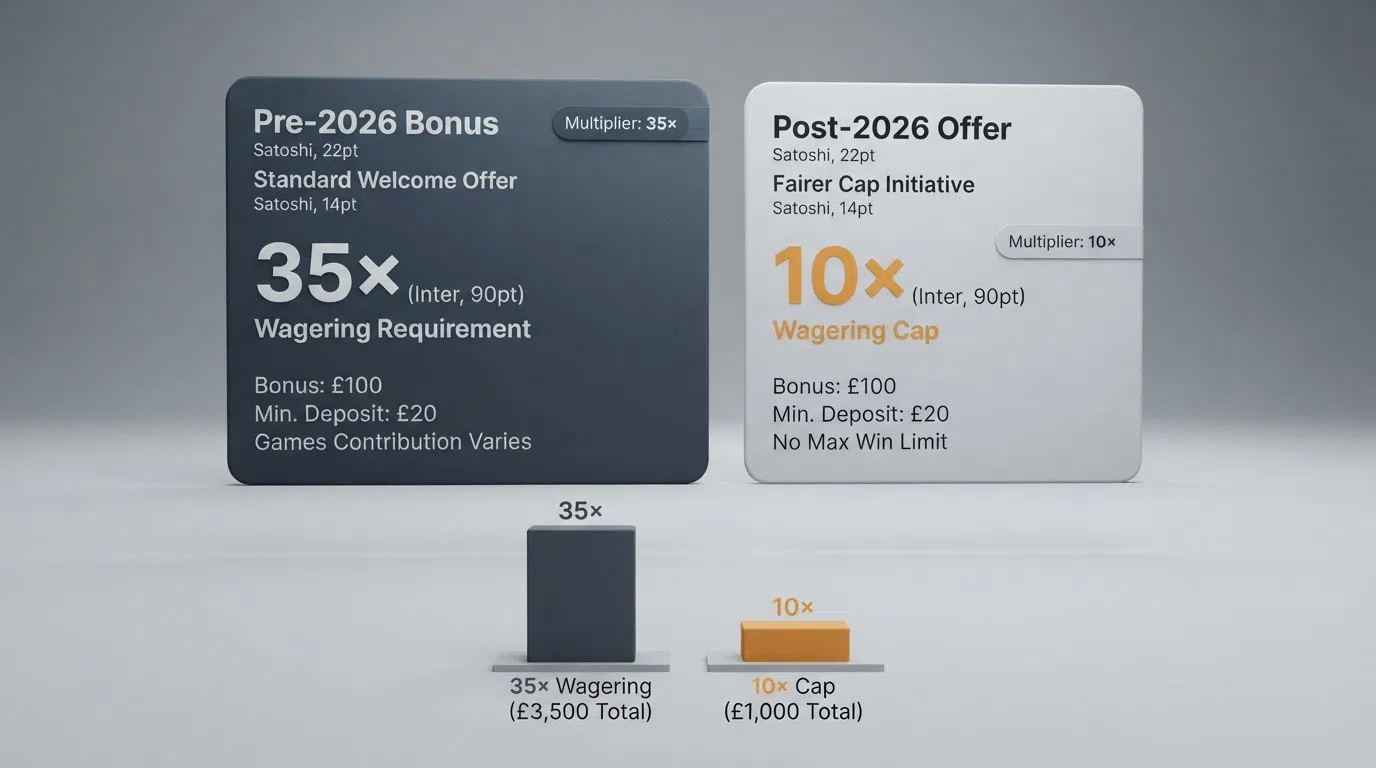
A smaller-looking offer at 10× is genuinely cheaper to clear than a larger headline offer at 35×. A £100 bonus at 10× demands £1,000 in turnover before withdrawal. The same £100 bonus at 35× demanded £3,500. The work the prescribed calculation below does is to put a real number on that — the expected cost of clearing the bonus, in time and in money, under the new cap. The headline figure on the offer card is no longer the right number to compare; the wagering multiplier is.
The same rule change brought in a ban on mixed-product promotional offers — a “bet on football, get free spins” structure can no longer be marketed to UK players. And the direct-marketing opt-in rules, in force from 1 May 2025, mean a player must affirmatively opt in to receive bonus offers, per product and per channel. A new UK casino cannot email a player about a casino bonus unless the player has specifically asked to receive casino emails. The cumulative effect is that the welcome offer you do see has been screened through stricter rules than the welcome offer you would have seen two years ago. The price of admission to a UK welcome bonus is lower; the rules governing how it reaches you are tighter.
No-Deposit Bonuses at New UK Casinos: The Real Picture
No-deposit offers are rare at UKGC-licensed casinos, and the reason is regulatory friction rather than operator generosity. Since 7 May 2019, a player has to be identity-verified before any gambling activity, including the claim of a free bet or bonus. A no-deposit offer still requires the operator to run full KYC, which removes most of the cost saving the offer would otherwise deliver. Most UK-licensed operators have decided that the marketing cost of a no-deposit bonus is not worth the player acquisition it generates.
Sky Vegas is the only featured operator on this list that runs a true no-deposit offer: 70 free spins with no deposit and no wagering. Every other entry is a deposit-tied or stake-tied offer. For a UK player, the practical consequence is that “no-deposit casino” as a category is narrow — the headline-grabbing no-deposit bonuses that dominate offshore marketing are not the standard offering at any UKGC-licensed site. If a casino is advertising a substantial no-deposit bonus with no UKGC licence number on its page, the explanation is almost always that the licence in question is not a GB one.
Free-Spins Offers: How the Numbers Compare Across New UK Casinos
Free spins are the dominant welcome format at new UK casinos, and the numbers on this list range from 50 (Pub Casino, QuinnBet) to 320 (32Red). The spin value, where published, is 10p per spin across the board. The wagering requirement on the spin winnings is the number that determines the real value of the offer, not the spin count.
A 0× wagering offer (MrQ, Pub Casino, Midnite, 32Red, QuinnBet, Sky Vegas — six of the ten on this list) pays out in real cash with no turnover requirement. A 10× offer (Los Vegas, Duelz, Grosvenor) demands a defined volume of qualifying play. A 35× offer (BetMGM, on its pre-cap published terms) is an order of magnitude more expensive to clear. The qualifying action also varies: MrQ and Sky Vegas (on the deposit part) are deposit-only, Midnite and QuinnBet are stake-only, and Los Vegas is a multi-day release that rewards return visits. The max-cashout cap varies from uncapped (MrQ, where the winnings are real cash and have no ceiling beyond the operator’s standard withdrawal terms) to £100 per day (Los Vegas) to a £100 flat cap (QuinnBet) to a £2,000 bonus cap (Grosvenor). Where the data is missing — Duelz’s spin value, Pub Casino’s validity, Sky Vegas’s max cashout — the offer has to be valued qualitatively rather than as a specific number.
Welcome Packages: Deposit-Match Bonuses and Multi-Part Offers
Only two operators on this list carry a cash match bonus, and both sit at the 10× statutory ceiling. Duelz offers a 100% match up to £100 plus 100 free spins. Grosvenor offers a £40 bonus plus 100 free spins on a £20 deposit. Both are multi-part offers where the player gets a matched cash component alongside a free-spin component, and both apply 10× wagering to the cash component.
A deposit-match bonus with 10× wagering on a £100 bonus demands £1,000 in qualifying play. The prescribed calculation below puts a time figure on that: at the 10× cap, the offer is materially cheaper to clear than the equivalent £100 bonus at 35× would have been. The reason most new UK casinos have moved away from large match bonuses toward free-spins-led welcome packages is the fiscal pressure of 40% Remote Gaming Duty plus the 1.1% statutory levy. A free-spins-led offer has a fixed cost to the operator (the spin value times the number of spins) that a matched-deposit bonus does not — and operators under fiscal pressure have rationally moved toward the offer they can price with confidence. The result is that the new UK casino welcome in 2026 is overwhelmingly a free-spins offer; the cash match is the exception, and both of the two cash matches on this list sit at the lowest allowable wagering cap.
Bonus Codes and How You Claim a New-Player Offer
Most new UK casino bonuses auto-apply on the qualifying deposit, and bonus codes are the exception rather than the rule. The standard flow is: register, complete KYC verification, make a qualifying deposit, and the bonus credits to the account automatically. The opt-in happens during the registration flow or at the cashier — a checkbox to confirm the player wants the welcome offer, and from 1 May 2025 a separate opt-in for any direct marketing about that offer.
The exceptions are usually legacy. A bonus code may still appear on affiliate-linked promotions, where the code tracks which affiliate drove the player. 32Red’s offer restricts the qualifying payment methods to debit card or instant bank transfer only, which is a payment-method exclusion rather than a code issue, but it operates the same way: a player depositing via PayPal would not trigger the bonus, and the offer page makes that clear at the cashier. The general rule for a UK player is to read the qualifying action (deposit, stake, payment method, minimum amount) at the offer page before depositing. A bonus that auto-credits is no use if the deposit was the wrong type.
No-Wagering and Low-Wagering Offers: The 2026 Standard
Six of the ten featured operators carry 0× wagering on free spins — MrQ, Pub Casino, Midnite, 32Red, QuinnBet and Sky Vegas. The other four sit at 10× (Los Vegas, Duelz, Grosvenor) or, on the published pre-cap terms, 35× (BetMGM). The 10× statutory cap made low-wagering the ceiling for everyone and narrowed the gap between the no-wagering and the low-wagering brands. A market that was once split between “no-wagering specialists” and “everyone else at 35×” is now a market where 10× is the new normal and 0× is a frequent refinement of it.
What wagering costs in real money is the question the calculation below answers. The short version is that a 0× offer pays the player back the spin value times the slot’s RTP, with no further deduction; a 10× offer deducts the expected house edge on the additional qualifying turnover. The difference is small at the slot’s published RTP of around 96% — the house edge is 4%, so an extra £1,000 of qualifying turnover costs the player about £40 in expected loss. That is the arithmetic that makes the 10× cap meaningful: the cap did not change the headline bonus, it changed the size of the deduction the player has to absorb to clear the bonus.
New-Player vs Existing-Player Promotions: Why the Offer Changes After Sign-Up
The welcome bonus is a one-time acquisition cost for the operator, and its generosity reflects the competitive pressure to win the sign-up. The ongoing promotion programme is a different cost structure: it has to be sustainable for the operator at 40% Remote Gaming Duty and 1.1% statutory levy, and it has to compete with the welcome offer the player could get by moving to a different brand. The result is that the welcome offer on this page is the most generous promotion a new UK casino will run in the player’s first year of play, and almost every operator’s ongoing programme is more modest.
The standard ongoing format is daily drops, slot-specific tournaments, leaderboard prize pools, and cashback on net losses over a defined period. A small number of operators run reload bonuses — matched deposits on a second or third deposit — but these are less common at UKGC-licensed sites than at offshore ones, in part because the mixed-product and bonus-cap rules make them harder to design. The practical advice is to read the promotions page before depositing, not the welcome offer alone, because the welcome offer is the one that disappears after day one.
The Games You Will Actually Play at a New UK Casino
A new UK casino’s game catalogue is the second-most visible marketing point after the welcome offer, and the second-most important. The single best proxy for catalogue quality is the number of game providers, not the total slot count. A casino with fifty providers covers a fundamentally different range of game types, mechanics and RTP profiles than a casino with five — even if the total slot count is similar. The provider roster also tells a player which exclusive titles, which branded slots and which live-dealer variants the casino can offer.
The regulatory design rules that shape every slot at a UK-licensed casino are uniform across the market. Since 31 October 2021, auto-play is banned, spin speed may not exceed 2.5 seconds per game cycle, features that speed up play are banned, losses disguised as wins are banned, and reverse withdrawals are permanently banned. The operator must display a session-tracking view of total losses, total wins and time played during a slots session. A slot at a UK-licensed casino plays slower, costs less per spin (capped at £5 for 25+, £2 for 18–24 ) and is more transparent about losses than the same slot at an offshore casino — and these rules apply identically to every operator on this list.
Slot Sites and Slot Games: What a New UK Casino’s Lobby Actually Holds
The slot catalogues at the featured operators range from “provider-led” (MrQ, Duelz, BetMGM) to library-scale (Los Vegas, at 3,500+ games ). The dominant providers across the featured set are Pragmatic Play, NetEnt, Play’n GO, Microgaming, Evolution, IGT and Playtech. The boutique providers that differentiate a new casino’s catalogue — Hacksaw Gaming, Yggdrasil, Thunderkick, Elk Studios, Big Time Gaming, Quickspin, Betsoft, iSoftBet, Nolimit City — tend to be present at the library-scale operators and absent or thin at the smaller ones.
Big Bass Splash is the most common bonus-qualifying slot on this list. It is the named slot at MrQ, Midnite, 32Red and Grosvenor. Its 96.71% RTP is published and consistent across operators, which makes it a useful baseline for the calculation below. The majority of slots at any UK casino do not carry an independently published RTP on the operator’s game-info panel — the figure is in the game’s paytable or in the provider’s own documentation, not surfaced at the lobby. For a player who wants to evaluate a slot’s RTP, the provider’s game page is the definitive source. For players who prefer not to hunt for these figures, no-wagering offers provide a simpler, more transparent experience.
Live Casino at New UK Sites: Evolution-Powered Tables from Day One
Every new UK casino on this list launches with live-dealer tables, and Evolution is the near-universal provider. The standard game types — roulette, blackjack, baccarat, game-show titles like Crazy Time and Monopoly Live — are present at every Evolution-powered lobby. The differences between operators are in table limits, the presence of dedicated branded tables, and the availability of VIP rooms. For most players, the live-casino experience is functionally identical across operators; the choice between two Evolution-powered live lobbies is a choice of lobby design and table limits, not of game variety.
The RTP profile of live casino games differs from slots in a way that matters for bonus clearing. Live roulette and blackjack have a lower house edge than a typical slot (roughly 2.7% on European roulette, under 1% on basic-strategy blackjack), so the expected cost of clearing a bonus through live-casino play is lower than through slot play. Most UK bonus terms, however, weight slot play more heavily toward wagering requirements than live-casino play — a 10× wagering requirement on a £100 bonus may require 100% of slot play to count, but only 10–20% of live-casino play. The arithmetic favours slots for bonus clearing even though the house edge favours table games.
UK Casino Launch Profile
| Casino | Launch/Refresh | Track Record |
|---|---|---|
| MrQ | Established | High |
| Los Vegas | 2025/2026 | New |
| Duelz | Established | High |
| BetMGM | 2024 | Moderate |
| Pub Casino | 2023 | Moderate |
The provider roster is the single best proxy for game quality at a new casino. Pragmatic Play, NetEnt, Play’n GO, Microgaming, Evolution, IGT and Playtech are the major studios that appear across the featured operators. Hacksaw Gaming, Yggdrasil, Thunderkick, Elk Studios, Big Time Gaming, Quickspin, Betsoft, iSoftBet and Nolimit City are the boutique and emerging providers that differentiate a new casino’s catalogue from a legacy one. Having access to a broad range of studios allows players to explore different mechanics and volatility profiles, which is key to finding a preferred casino experience.
The gaps in a provider roster matter as much as the inclusions. A casino without a Playtech live-casino table cannot offer Playtech’s branded game-show titles. A casino without Hacksaw Gaming cannot offer the multiplier-driven mechanics that have driven the high-volatility slot segment in 2026. A casino without Yggdrasil is missing a significant share of the mid-volatility catalogue. Players often use the provider list as a primary filter to find specific games.
Non-Slot Casino Games: Table Games, Instant-Win and Bingo at New Sites
Slots dominate the new-casino conversation, but the table-game, instant-win and bingo-hybrid categories are present at every featured operator. RNG blackjack, roulette and baccarat are standard. Instant-win and scratch-style games are a growing category at newer platforms, often sourced from Hacksaw Gaming, Play’n GO or in-house studios. The bingo-and-slots hybrid — a single site that runs both slot games and bingo rooms — is a format that several UKGC-licensed operators serve, and the bingo side of those sites is governed by the same regulatory framework as the casino side.
The table-game RTP advantage matters for bonus clearing. A basic-strategy blackjack hand has a house edge under 1%; a European roulette spin has a house edge of 2.7%. A typical slot at 96% RTP has a house edge of 4%. The arithmetic means that clearing a £1,000 wagering requirement through table games costs the player less in expected loss than clearing it through slots — but most UK bonuses do not allow 100% of table-game play to count toward wagering. The 10%–20% contribution rate on table games is the operator’s protection against exactly this edge. A player who plans to clear a bonus through table games will take longer to do it than the headline wagering figure suggests, because only a fraction of each stake counts.
2026 Slot and Game Releases: What Is New This Year
The 2026 slot-release calendar is dominated by Pragmatic Play, NetEnt, Play’n GO and Hacksaw Gaming, with a long tail of releases from Nolimit City, Elk Studios, Thunderkick and Yggdrasil. The cadence is roughly weekly at the most prolific studios. A new casino’s recency affects its access to the latest titles: a platform integration signed in 2024 or later is more likely to carry 2026 releases than a platform integration signed in 2018 and refreshed piecemeal since. This is one of the genuine advantages the new-casino cohort has over legacy operators: the platform is built around the most recent aggregator integrations, and the latest games are available from day one.
For a player, the practical consequence is that a new UK casino is more likely than a legacy operator to carry the slot released last week. The game catalogue at a brand-new operator is not necessarily larger than at a legacy one, but it is more current, and the share of 2026 titles in the lobby is higher. For a player who follows new releases, the new-casino cohort is the easiest place to find them.
How You Pay and How Fast You Get Paid at New UK Casinos
Payment-method support and withdrawal speed are where new casinos genuinely outperform legacy operators. The standard payment-method set at a new UK casino is debit card, PayPal, Apple Pay, Trustly, pay-by-mobile and instant bank transfer. Credit cards have been banned for all remote gambling in Great Britain since 14 April 2020, including credit-card-funded payments via e-wallets. Anonymous play is not possible at a licensed GB site.
The three stages of a withdrawal are the pending period, the operator processing time, and the payment-provider settlement. Since the reverse-withdrawal ban took effect on 31 October 2021, the pending period is purely administrative — it is the operator’s internal review time, not a player-reversal window. KYC verification before first deposit front-loads the identity check, which removes the biggest historical cause of withdrawal delay. Realistic withdrawal timeframes at UKGC-licensed casinos are same-day post-processing for e-wallets, 1–3 business days for debit cards, and 1–5 business days for bank transfers. Where a new casino promises faster withdrawals than those figures, the difference is in the operator processing stage, not in the payment-provider settlement.
Debit Cards and Instant Bank Transfers: The UK Default
Debit card is the universal deposit and withdrawal method at UKGC-licensed casinos. Every operator on this list accepts Visa Debit and Mastercard Debit; most accept Maestro. The 3-D Secure step (the Verified by Visa / Mastercard Identity Check prompt) is the standard authentication on the first deposit, and the operator’s cashier handles it inline. Withdrawal times on debit card are 1–3 business days in the typical case, with same-day processing more common at the new-casino cohort than at legacy operators.
Instant bank transfer via Trustly or open-banking rails is the faster alternative. A player who pays by bank transfer typically sees the funds in the casino account within seconds, and the same rails support same-day withdrawals to the originating account. The 32Red welcome offer restricts the qualifying payment method to debit card or instant bank transfer — a payment-method exclusion that means a player depositing via PayPal would not trigger the offer. Read the live offer terms before depositing, because payment-method exclusions are a real and increasingly common feature of UK welcome offers.
PayPal, Apple Pay and E-Wallets at New UK Casinos
PayPal is the e-wallet option UK players look for first, and its presence at a UKGC-licensed casino is a trust signal in its own right — PayPal’s merchant-vetting process for gambling operators is strict, and a PayPal deposit route is not extended to operators that fail it. Apple Pay is a deposit-only method at UK casinos; the withdrawal has to go back to a debit card or bank account, not to Apple Pay, because Apple Pay does not function as a payout rail.
E-wallet withdrawals are typically faster than debit-card withdrawals once the operator has processed them. The same-day figure is the realistic expectation at most new UK casinos. The data on per-operator payment-method support is not comprehensively published in the source research, so the practical advice is to check the cashier page before registering. The presence of PayPal, Apple Pay, Trustly and instant bank transfer is the standard set at the new-casino cohort, and a missing method is a reason to look elsewhere.
Pay-by-Phone and Mobile Billing: The £40 Daily Cap
Pay-by-phone is the convenience method for small deposits. A player enters a mobile number, the deposit is charged to the mobile bill or deducted from a prepaid balance via Boku or a similar pay-by-mobile provider, and the funds land in the casino account within seconds. The daily deposit cap is £40 — a spending-control limit that exists to prevent the method being used for larger transfers.
The critical limitation is that pay-by-phone cannot be used for withdrawals. A player depositing via pay-by-mobile has to register a secondary withdrawal method (debit card, bank account, PayPal) before requesting a cashout. For a player who makes small, frequent deposits and is happy to register a separate payout method, pay-by-mobile is a useful option; for others, debit card or bank transfers offer a more direct route to funds.
Trustly, Open Banking and Pay-N-Play at New UK Casinos
Trustly and open-banking payments are the fastest route from deposit to play at most new UK casinos. A direct bank-to-operator transfer via open-banking rails clears within seconds, the funds are available immediately, and the same rails support same-day withdrawals back to the originating account. The pay-n-play / no-registration model — deposit, play, withdraw without creating a full account — is built on these rails in markets where regulation allows it. In the UK, the KYC-before-deposit rule constrains the no-registration model: a player still has to be fully verified before the first deposit, which removes most of the speed advantage pay-n-play offers in less-regulated markets.
For a UK player, the practical value of Trustly and open-banking payments is the same-day withdrawal time, not the registration speed. A new UK casino with Trustly or open-banking support will typically clear a withdrawal to a UK bank account within hours of approval, where a debit-card withdrawal takes one to three business days. Which featured operators carry Trustly or open-banking is not comprehensively listed in the source research; the cashier page is the definitive source.
Withdrawal Speed and the Pending Period: What Actually Determines How Fast You Get Paid
The three stages of a withdrawal are the pending period (the operator’s internal review time, since the reverse-withdrawal ban took effect on 31 October 2021 ), the operator’s processing time, and the payment-provider settlement. The pending period is the variable most under the operator’s control. A new casino with a 0-hour pending period clears withdrawals as soon as the player requests them; a legacy operator with a 24-hour pending period adds a day to every withdrawal. KYC verification before first deposit front-loads the identity check, so a player who has deposited, played and won has no verification work outstanding at withdrawal time.
Realistic withdrawal timeframes at UK casinos, post-KYC and post-pending period, are same-day for e-wallets, 1–3 business days for debit cards, and 1–5 business days for bank transfers. The fastest realistic end-to-end time at a new UK casino — pending, processing and settlement — is a few hours via Trustly or open banking. The slowest, on a debit card at an operator with a 24-hour pending period, is four business days. Where a casino advertises “instant withdrawals,” the claim refers to the processing stage, not the settlement stage, and a player should expect the realistic end-to-end time to be a few hours, not a few minutes.
New UK Casinos Are Built for Your Phone
New UK casinos launch mobile-first. The mobile browser experience at a new UK casino is the intended primary channel in most cases, with desktop as a secondary view of the same platform. Thirty-seven per cent of UK adults gamble online, and the share of mobile-dominant traffic at newer platforms is higher than at legacy ones. talkSPORT’s framing is that this is the single biggest practical reason to choose a new casino over an established one.
The two delivery methods are a mobile-optimised browser (responsive design or a PWA — Progressive Web App) and a dedicated iOS / Android app. The browser experience is full-function: the same game library, the same cashier, the same bonus claims, the same KYC flow, no app download, no storage footprint, and always up to date. The dedicated app adds biometric login (Face ID, Touch ID, fingerprint), push notifications for promotions and offers, and sometimes smoother gameplay on older devices. The trade is that an app has to be downloaded, updated, and maintained; the browser does not.
Mobile Site vs Casino App: What You Gain — and Lose — with Each
The mobile-browser experience is the default at every featured operator and is the primary channel at most of them. The full casino — game library, cashier, bonuses, KYC, support — is available without a download. Updates happen on the operator’s side and reach the player on the next page load. A browser-based experience has no push notifications, so the player does not receive promotional alerts unless they log in to look for them.
- A dedicated app, where available, adds biometric login, push notifications, and sometimes smoother gameplay — but not a different game library or a different bonus.
- Many new UK casinos do not offer a dedicated app at all, and the browser experience is the intended primary channel — not a fallback.
The data on per-operator app availability is not comprehensively published in the source research. The App Store and Google Play listings, and the operator’s own site footer, are the easiest way to check.
Try Before You Deposit: Free Play and Demo Mode at New Casinos
Demo mode lets a player test a new casino’s slot catalogue without risking a penny. Most UKGC-licensed operators offer free-play versions of their real-money slots, with a capped virtual balance and no real-money outcome. The demo version of a slot is mechanically identical to the real-money version — same paytable, same bonus-round frequency, same volatility profile — which makes it a usable way to evaluate an unfamiliar game at an unfamiliar casino.
The regulatory distinction matters. Demo play at a UKGC-licensed casino does not require KYC because no real-money gambling is occurring. A player can launch a demo slot, play a hundred virtual spins, and form a view of the game’s mechanics without ever submitting identity documents. The KYC-before-deposit rule applies to the moment a player switches to real-money play, not to the demo session that precedes it. The limitation of demo mode is that it shows the game but not the real-money experience — no withdrawal process, no bonus interaction, no stake-limit prompt, no session-tracking display.
Free Slots vs Real-Money Slots: What Demo Mode Can and Cannot Tell You
Demo mode is accurate on what it covers: the slot’s mechanics, the bonus-round frequency, the visual quality, the mobile responsiveness, the loading speed. It is silent on what the real-money session cost: a £5-per-spin session costs at most £5 every 2.5 seconds, and the demo version does not show the running total the way the real-money session-tracking display does. It is also silent on the emotional weight of a losing streak, the friction of a withdrawal request, the experience of triggering the £150 vulnerability check, and the small print of any bonus the player has claimed.
The practical use of demo mode at a new casino is to test three or four slots, form a view of the lobby’s usability, and decide whether to deposit. The RTP and volatility information available in demo mode is the same information the real-money game screen shows — the paytable is the same, the in-game info panel is the same. For a player who wants to evaluate a slot’s expected return before depositing, demo mode is a real tool. For a player who wants to evaluate the casino’s payment process, support, or bonus terms, the only honest test is a real-money session.
Crypto at a UK Casino? Here Is What the Rules Actually Say
No UKGC-licensed casino accepts Bitcoin or any other cryptocurrency. The statement is absolute. Any UK-facing casino advertising itself as a “UK crypto casino” or “UK Bitcoin casino” is licensed offshore, not by the Gambling Commission, and the protections a UK player expects from a UK-licensed site do not apply. The review site Bookies.com puts the position plainly: “No casino licensed by the UK Gambling Commission accepts Bitcoin, or any other cryptocurrency, as a deposit method. Any UK online casino advertising itself as a ‘UK Bitcoin casino’ is licensed offshore, which puts it outside UK player protections.”
The reason crypto and UK licensing are incompatible is the regulatory perimeter. KYC obligations, source-of-funds checks, anti-money-laundering requirements under the Gambling Act 2005 and the Proceeds of Crime Act 2002 all assume a regulated payment system with auditable intermediaries. Cryptocurrency deposits are pseudonymous and difficult to audit to the standard the UKGC requires. The result is that no UKGC-licensed operator has a crypto deposit route, and none will in the foreseeable future.
Offshore Crypto Casinos: What They Offer and What You Risk
An offshore crypto casino offers features the UK has banned: auto-play, Bonus Buy, credit card deposits, higher stake limits, anonymous play, no KYC, no deposit-limit prompts, no GAMSTOP coverage. The marketing is built around exactly the features the UK market has removed, and the implicit pitch is that the player has more freedom. What the marketing does not foreground is the regulatory perimeter the player is leaving.
A player at an offshore crypto casino has no GAMSTOP coverage, no UKGC complaints route, no ADR provider, and no British consumer redress. Funds held by an unlicensed operator are not protected by any UK statutory regime. If the operator refuses a withdrawal, the player has no route to an ombudsman, no route to the Commission, and no route to a British court. The UKGC’s enforcement against unlicensed operators is disruption-focused: cease-and-desist, search-engine delisting, domain-registrar pressure, payment-provider referrals. April 2024 to June 2025 saw 3,140 disruption notices, 447,778 URLs referred, and 287,961 removed. The Commission does not currently have statutory ISP or DNS blocking powers. A UK player who chooses to play at an offshore crypto casino is not breaking the law — there is no criminal penalty for playing on unlicensed sites — but the player is leaving every UK regulatory protection behind at the door.
Your Protections at a New UK Casino: Licensing, GamStop and the Rules That Cover You
A UKGC licence is the single most important feature of any new casino site. It carries binding player protections that no offshore regulator replicates, and the verification process takes two minutes on the public register. The three licensing objectives set by section 1 of the Gambling Act 2005 are preventing gambling from being a source of crime or disorder, ensuring gambling is conducted in a fair and open way, and protecting children and other vulnerable persons from harm or exploitation. Every licence condition and code of practice flows from those three objectives.

The practical protections a UKGC licence guarantees are concrete. GAMSTOP self-exclusion is mandatory for all GB-licensed online operators and cannot be circumvented by opening a new account with the same operator under a different name. The operator must offer deposit-limit tools, reality checks, time-outs and self-exclusion, and must enforce them when the customer asks. An ADR provider must be named and the complaints route must be public. Where the operator fails to resolve a complaint, the player can take it to the ADR, and the ADR’s decision is binding on the operator. Where the operator’s conduct breaches the licence, the Commission can fine, suspend or revoke the licence. The public register is the route to verify any of this, and 2,663 records were live as of 29 July 2026.
GamStop Self-Exclusion: How It Works and What It Covers
GAMSTOP is a national multi-operator online self-exclusion register. A player registers once, free, online, in minutes, and the exclusion applies to every GB-licensed online operator within 24 hours. The exclusion periods are six months, one year, five years, or five years with auto-renewal. The minimum period is binding — a player cannot cancel the exclusion early, even if the request comes the day after registration. Marketing stops. Logins are blocked. New accounts cannot be opened at any GB-licensed operator for the duration.
The critical limitation is that GAMSTOP covers GB-licensed operators only. An offshore or unlicensed casino is not a member of GAMSTOP and is not bound by its register. A player who has self-excluded via GAMSTOP and then deposits at an offshore crypto casino is taking a step outside the protection the exclusion provides. The same limitation applies to any other unregulated channel: lottery, betting exchanges or any operator not licensed by the Commission. GAMSTOP is the strongest self-exclusion tool available to a UK player, and it works exactly as advertised — for the operators it covers.
Casinos Not on GamStop: What They Are and Why They Are Not Licensed in Britain
A casino outside GAMSTOP is a casino outside British regulation. The most common licensing jurisdictions for these sites are Curaçao, Costa Rica, Malta (under non-UK regulatory tiers) and Gibraltar (without a GB consumer-facing licence). Each of those licences is a real licence in its home jurisdiction, but none of them is a substitute for a UKGC licence at the point of consumption. The Gambling (Licensing and Advertising) Act 2014 made a GB licence compulsory for any operator serving GB customers, and operating without one is a criminal offence under section 33 of the Gambling Act 2005.
What “not on GamStop” casinos offer is the feature set the UK has banned: auto-play, Bonus Buy, higher stake limits, credit card deposits, cryptocurrency, no KYC. What they do not offer is the protection the UK market requires: no GAMSTOP, no ADR, no UKGC complaints route, no British consumer redress, no enforceable safer-gambling tools. A player who values the feature set is making a deliberate trade against the protection set. The UKGC’s enforcement record shows the regulator is actively pursuing these operators, but the player at an offshore site has no individual recourse if something goes wrong.
The Rules That Shape Every Spin: Stake Limits, Spin Speed and Game Design
The UK’s game-design rules are the strictest in Europe. The age-banded stake limits — £5 per game cycle for players aged 25 and over, £2 for 18-to-24-year-olds — mean two adults at the same casino can face different maximum bets on the same slot. The slot-play rules ban auto-play, cap spin speed at 2.5 seconds, ban features that speed up play, ban losses disguised as wins, ban reverse withdrawals, and require a session-tracking display of total losses, total wins and time played.
A £5-per-spin session at a UK casino costs at most £5 every 2.5 seconds, and the player sees the running total throughout. A 25-year-old and a 30-year-old at the same casino playing the same slot on the same night will have different maximum bets available to them. The rules apply identically to every slot at every UKGC-licensed casino, and the practical consequence is that a UK slot session is paced, capped and transparent in a way the same slot is not at an offshore operator. The rules are the reason the no-wagering offers on this list are economically viable for the operator — a slower, capped, more transparent slot session costs the operator less in expected losses, and a share of that saving is passed back to the player in the welcome offer.
Financial Checks, Deposit Limits and the £150 Threshold
The UK’s financial-safety net operates automatically. The financial vulnerability check at £150 net deposit in a rolling 30-day period, in force from 28 February 2025, uses publicly available data only — bankruptcy orders, county court judgments, individual voluntary arrangements, debt relief orders. It is not a credit check and requires nothing from the player. If the data returns a match, the operator reviews the result and may apply additional checks before accepting further deposits. Most players never trigger it.
The mandatory deposit-limit prompt before first deposit, in force from 31 October 2025, is the second line. A player can set the limit at zero, decline to set one, or set a real number; the prompt itself is the regulatory requirement. From 30 September 2026, only a gross deposit limit (based solely on money paid in) may be called a “deposit limit” — the standardisation is designed to make the cashier language unambiguous. A more thorough financial risk assessment, at higher net-deposit thresholds (£5,000 / £2,500 in 24 hours for 25+ / under-25, with final thresholds of £1,000–£3,000 and £750–£2,000) has been announced but not yet commenced — the pilot is complete, the framework is approved, and the start date is unconfirmed.
How to Check a New Casino’s UKGC Licence in Two Minutes
The UKGC public register is free, searchable and definitive. The verification process takes two minutes: search by operator name, trading name or licence account number at gamblingcommission.gov.uk. The licence status must read “active.” The activity must include “casino” or “general betting (remote).” The domain you are visiting must match a listed domain. A licence number that does not resolve, a domain not listed, or a status marked “suspended” or “surrendered” is the end of the conversation — the operator is not what the marketing claims.
The register was last updated on 29 July 2026 and contains 2,663 records. The Commission maintains the register on an ongoing basis; a licence that has been revoked or surrendered is removed or annotated, and a fresh search returns the current status. For a UK player, this is the single most effective safety step available, and the one that costs nothing but the time to use it.
The Safer-Gambling Tools Every New UK Casino Must Give You
The safer-gambling tools at a UKGC-licensed casino are not optional extras. They are licence conditions, set out in the LCCP Social Responsibility Codes, and the Commission enforces them with fines, suspensions and licence revocations. The scale of the system is visible in the data: 5.2 million customer interactions in a single quarter (Q4 2025/26), up 32% year on year, with the majority automated. The system is active at a scale that an offshore operator cannot replicate.
Outside the casino, the support infrastructure is free, confidential and independent. GamCare runs the National Gambling Helpline on freephone 0808 8020 133 and a live chat at gamcare.org.uk. GambleAware funds research, prevention and treatment, and its 2024 survey found that 30% of adults with gambling problems now want treatment or support, up from 17% in 2020. NHS gambling harm clinics operate in England, Scotland and Wales. Gamblers Anonymous runs peer-support groups across the UK. GAMSTOP is the self-exclusion register. The availability of these resources ensures players have access to help whenever it is needed.
Deposit Limits, Reality Checks and Session Time-Outs
The three tools every UK casino session starts with are a deposit limit, a reality check, and a session time-out. Each is described in detail in the section on your protections at a new UK casino above; the short version is that they are the baseline controls the regulator requires every operator to offer, and they are the reason a UK slot session is paced, capped and interruptible in a way the same slot is not at an offshore site.
Self-Exclusion via GAMSTOP: The Nuclear Option That Actually Works
GAMSTOP is the hardest self-exclusion tool available to a UK player, and the one that works across every GB-licensed operator simultaneously. The registration is free, takes minutes, and the exclusion applies within 24 hours. The minimum period is six months and cannot be cancelled early. The full process and its limitations are described in the section on your protections above; the practical point is that for a player who needs to stop, GAMSTOP is the route that removes the decision from the daily choice architecture entirely.
Problem Gambling Support in the UK: Who to Contact and What They Offer
Free, confidential help is available by phone, live chat and in person, and the demand for it has nearly doubled since 2020. GamCare’s National Gambling Helpline (0808 8020 133, live chat at gamcare.org.uk) is the front door for most players. GamCare also runs counselling, financial advice and five regional hubs. GambleAware funds the wider system and publishes the annual treatment and support survey — the 2024 edition found 30% of adults with gambling problems now want treatment or support, up from 17% in 2020. NHS gambling harm clinics operate in England, Scotland and Wales. Gamblers Anonymous runs peer-support groups across the UK. The prevalence data, from the Gambling Survey for Great Britain and the GambleAware annual, shows 16% of gamblers showing some level of gambling-related problems (PGSI 1+), up from 13% in 2023, with statistically significant rises across the low-, moderate- and high-risk categories. Demand for the help system is rising; the help system is funded to meet it.
Operator Obligations: What the UKGC Requires Every Casino to Do
The LCCP Social Responsibility Codes are the licence conditions behind every safer-gambling tool described above. The statutory levy of 1.1% of GGY, in force from 6 April 2025, funds the system: 50% to treatment, 30% to prevention, 20% to research. The 5.2 million customer interactions in Q4 2025/26 are the evidence that the system is active and largely automated. The Commission’s enforcement powers — fines, suspensions, licence revocations — are the reason the licence conditions are taken seriously. A UKGC-licensed operator that breaches an SR code is exposed to a regulatory sanction that an offshore operator is not.
How We Selected and Ranked the Best New UK Casino Sites
Every operator on this page passed three checks: a UKGC licence verification against the public register (2,663 records as of 29 July 2026 ), a welcome-offer verification against the operator’s own published terms, and a platform-quality assessment based on game-provider breadth, mobile experience and safer-gambling tool coverage. The ranking reflects launch freshness weighted against offer value. Genuine 2026 launches sit at the top of the table because the offer structure is the most novel; established brands with refreshed 2026 welcome offers sit lower because the offer change is incremental rather than foundational.
The source set for the verification work was the UKGC public register, operator terms pages, independent review data from the publishers cited in the research, and player-forum sentiment for unresolved complaint patterns. The ranking is not proprietary — there is no proprietary scoring algorithm — and the placement is qualitative, not commercial. No operator has paid for placement. The featured-operator set is the full set of ten; the methodology is the same for every entry.
What Matters — and What Doesn’t — When You Pick a New UK Casino Site
The welcome bonus is the loudest thing on the page, and it is one of the least important. The wagering multiplier, the max-cashout cap and the validity window determine the real value; the headline number is the marketing. The 10× statutory cap means a 10× bonus costs less to clear than a 35× bonus at a larger headline figure, and the calculation below puts a real number on that. The slot count is similarly noisy — a casino carrying 3,500 games from fifty providers is a different proposition from a casino carrying 3,500 games from five, and the provider roster is the better signal.
The three factors that actually determine the experience are the licence status (and what it guarantees), the withdrawal speed and payment-method support, and the game-provider mix. The first is verifiable in two minutes on the UKGC public register. The second is verifiable on the cashier page and the withdrawal terms. The third is verifiable in the lobby. None of the three costs the player a penny to check, and all three carry more weight than the welcome offer. The prescribed calculation that follows quantifies the welcome-offer arithmetic; the rest of the page is the qualitative work the calculation cannot do.
How Much Does a UK Welcome Bonus Actually Cost to Clear?
The 10× wagering cap that took effect on 19 January 2026 changed the arithmetic of every welcome offer on this page. To put a real number on that, take a representative example: Duelz’s 100% match up to £100 at 10× wagering, a £5 maximum spin stake for players aged 25 and over, a 2.5-second minimum spin speed and a 5-second interval between spins (the formula’s pacing assumption).
Required turnover on the £100 bonus at 10× wagering is £1,000. At a £5 spin value, that is 200 qualifying spins. At 5 seconds per spin, the play time is 1,000 seconds, or roughly 17 minutes. The slot’s expected return over £1,000 of qualifying play, at a 96% RTP (the typical figure for a UK slot), is £960 in returns against £1,000 in stakes — an expected loss of £40, the bonus’s real cost to the player. The same £100 bonus at the pre-cap 35× wagering would have demanded £3,500 in turnover, 700 spins, about 58 minutes of play, and an expected loss of £140. The cap changed the headline number, the real cost and the time commitment, and the real cost changed more than the headline did. This is a statistical estimate over many spins under the stated assumptions; it is not a guaranteed outcome for any individual player.
Frequently Asked Questions About New UK Casino Sites
What is the maximum wagering requirement at new UK casino sites in 2026?
Since 19 January 2026, the maximum wagering requirement on any UK-licensed casino bonus is 10× the bonus amount. That cap applies to every UKGC-licensed operator, replacing the 35×–50× multipliers that were routine before the rule change. The cap does not apply to offshore or unlicensed operators, which are not bound by UKGC conditions.
How quickly can I withdraw winnings from a new UK casino site?
Withdrawal speed depends on the payment method and the operator’s processing time. E-wallets and Trustly or open-banking withdrawals at new UK casinos typically clear the same day after the operator’s pending period. Debit-card withdrawals take 1–3 business days. Bank transfers take 1–5 business days. KYC verification before first deposit means the identity check is already done at withdrawal time, so the typical end-to-end time at a new UK casino is a few hours via e-wallet, a day or two via debit card.
Can I play at new UK casinos on my mobile phone without downloading an app?
Yes. Every featured operator on this page supports mobile play through a phone or tablet browser, with no download required. The full game library, cashier, bonus claims and KYC flow are available on mobile. Some operators also offer dedicated iOS or Android apps, which add biometric login and push notifications but do not add a different game library.
What is the difference between a UKGC-licensed casino and a non-GamStop casino?
A UKGC-licensed casino holds a Gambling Commission licence and is bound by UK licence conditions, including GAMSTOP membership, ADR provision, deposit-limit tools and the 10× wagering cap. A non-GamStop casino is unlicensed in Great Britain, typically operating under a Curaçao, Costa Rica, Malta or Gibraltar licence, and offers features the UK has banned (auto-play, higher stake limits, credit card deposits, crypto). A non-GamStop casino is not bound by UK player protections and provides no UKGC complaints route, no ADR and no British consumer redress.
How do I check if a new casino site has a valid UK Gambling Commission licence?
Visit the UKGC public register at gamblingcommission.gov.uk and search by operator name, trading name or licence account number. The licence status must read “active,” the activity must include “casino” or “general betting (remote),” and the domain you are visiting must match a listed domain. The register was last updated 29 July 2026 and contains 2,663 records. A licence that does not resolve, a domain not listed, or a status marked “suspended” or “surrendered” is the end of the conversation.
Casinos – Casino Welcome Bonuses UK
Content created by the «Casino Welcome Bonuses UK» team